Bathroom Exhaust Fan Leaks Cold Air
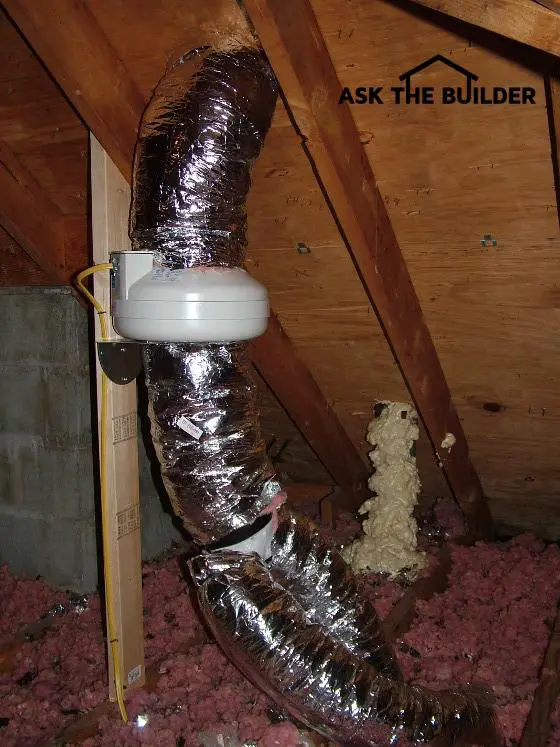
Bathroom Fan Leaks Cold Air | The off-white, overweight flying saucer is really a quiet bathroom exhaust fan. You can see the flexible insulated exhaust pipe that prevents condensation. The humid bath air goes out the roof. © 2021 Tim Carter
Bathroom Fan Leaks Cold Air TIPS
- Fan dampers meant to stop mice, not air
- NEVER install bath exhaust in an attic or under a roof overhang
- WATCH my Two VIDEOS below about bath exhaust fans
- BEST wall exhaust vent hood has a double door CLICK HERE to BUY NOW
- CLICK HERE to Get Tim's FREE & FUNNY Newsletter
I can call you on the phone to solve your bathroom fan leaking cold air problem. The call is FREE if you're not satisfied with my solution. CLICK HERE to set up the call.
DEAR TIM: My husband and I purchased a small ranch home built in the 1950s. A year ago we installed new exhaust fans in the bathrooms, kitchen, and basement. Last winter I noticed cold air would fall out of the fan covers when the fan was not operating. The small bathroom is now the coldest room in the house. Did we make a mistake? Why is cold air coming into the house? What's the best way to exhaust the air from the bathrooms? Because heating costs are rising, we must stop or minimize the cold air infiltration. Jill L-H., Maumee, OH
DEAR JILL: My gut reaction is that you did nothing wrong. My experience tells me that you probably didn't do some extra things that would have made a big difference.
Unfortunately, these extra added touches don't come as part of the written instructions with many exhaust fans. I have never seen these tips on a sheet of paper. When you install as many fans as I have, you start to learn what works best.
CLICK HERE to get FREE & FAST BIDS from a local bath-fan installer.
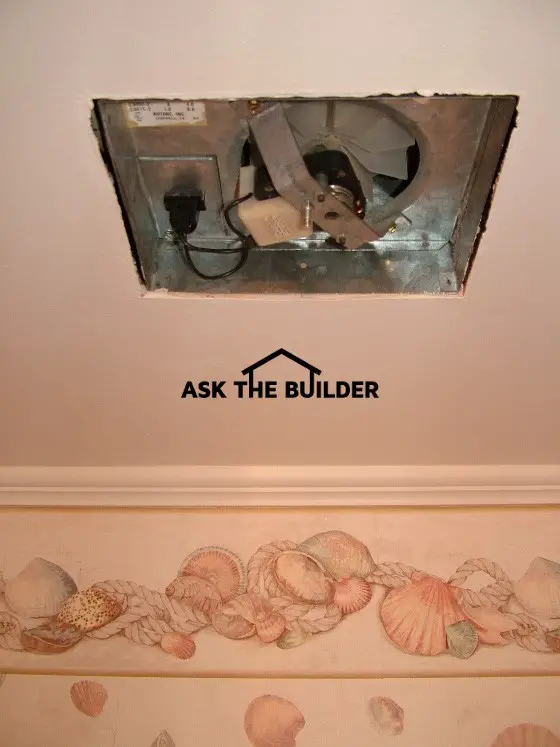
This exhaust fan has a built-in damper, but most fit poorly allowing cold air to drift back into a home. © 2017 Tim Carter
Why Do Bath Fans Leak Cold Air?
Let's briefly discuss the dynamics of what is happening with the exhaust fans. I assume you used the suggested smooth-metal piping to connect the fan to the exterior of your home. My guess is the bathroom fan exhaust pipe is located in a cold attic space.
If so, the pipe gets very cold when the fan is not in use. This cold pipe can cause the air inside the pipe to go from warm to cold.
Cold air is denser and heavier than warm air and wants to go down, not up. This is why you feel it fall down out of the exhaust fan cover.
Should Pipe Joints be Sealed?
Metal pipe joints should be sealed with special metal duct tape used by professional HVAC contractors.
Cold air from the attic can also be entering the joints in the metal piping if they are unsealed. It is an excellent idea to use aluminum duct tape that heating and cooling contractors use to seal ducts.
This is an inexpensive special tape you often can only find where furnaces, air conditioners and ductwork are sold. Do not confuse this professional tape with the common duct tape sold at home centers and hardware stores.
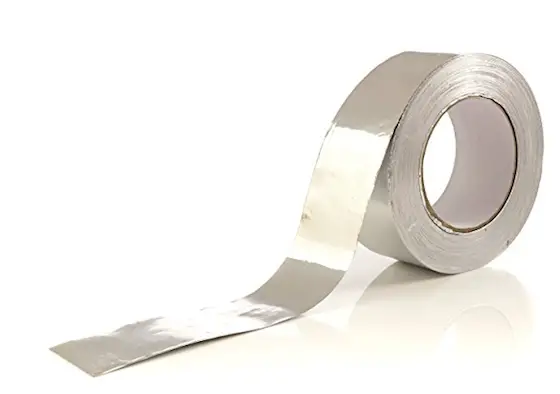
This is very cool duct tape. Pros never use the crap tape you see at home centers. This tape is thin aluminum with a strong adhesive. CLICK THE IMAGE NOW TO ORDER SOME.
Should a Bath Fan Vent Outdoors?
All bath fans should vent or exhaust to the outdoors. Never allow a bath fan to dump moist air into an attic.
Should Bath Fans Have an Internal Damper?
Bath fans should have an internal flapper damper that blocks cold air. These dampers usually fit poorly inside the fan housing and the cold air can seep by them. If you want to stop cold air, you need to have a great damper, or double damper at the exhaust hood where the air leaves your home.
Should Vent Hoods Have a Sealed Door?
Some vent hoods made by the fan manufacturers have swinging doors that have a felt seal. These are not bad. I've had decent success with these.
But the best vent hood I've ever used to stop cold air is one that exits the sidewall of your home and has a double damper. These are ingenious and inexpensive bathroom exhaust vent hoods that are very easy to install. Here's the one I have at my own home:
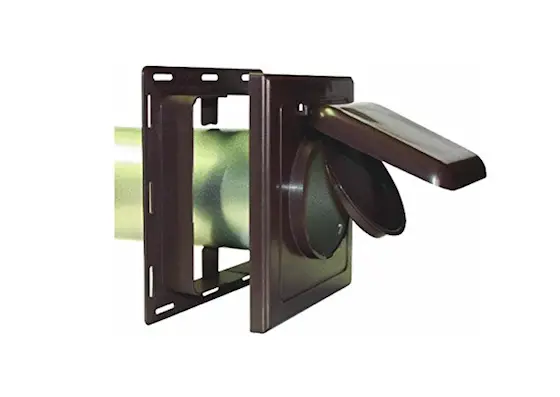
Look at the double doors. This keeps pests out and prevents cold air from backdrafting into your home. CLICK THE IMAGE to order it now.
Where Should a Bath Fan Exhaust Outdoors?
A bath fan can exhaust through the roof or you can go out a sidewall of your home.
Exhausting bath exhaust out a roof is the safest and best method. This ensures all humid air from showers and baths will never rot any wood. If you exhaust bath air under, or near, a roof overhang, the humid air can get sucked into the attic through soffit vents. This moisture can condense on the trusses, roof rafters and roof sheathing and cause wood rot and mold growth.
What Vent Flashing is Used on the Roof?
I prefer to install a roof vent that is made to compliment the high-quality exhaust fans I install. Most high-quality exhaust fans, and I've installed Fantech in my own home with great results, come with a special hood that's made to be used with shingles, shakes, or metal roofs. The Fantech exhaust fans are very quiet because you install the motor up in an attic or at some other location away from the bathroom. These fans vacuum the air out of the bathroom and you simply don't hear much noise at all.
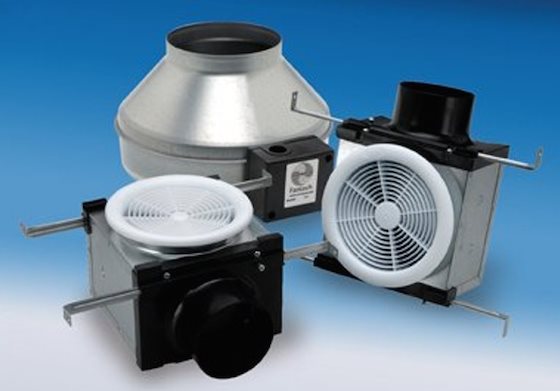
Here's a typical Fantech bath exhaust fan setup. The odd cone-shaped metal thing is the fan. The two boxes that have the round white covers are place up in the ceiling joists of the bathrooms. All you see are the sleek round white covers. They come with and without lights! I LOVED these in my last house. CLICK THE IMAGE TO BUY the SET NOW.
These self-flashing exit caps have a great flapper damper with a felt seal that really closes tightly when the fan is not in use. Virtually no air works its way back down my exhaust pipes so long as the flapper is checked annually for dirt and debris buildup.
CLICK HERE to get FREE & FAST BIDS from a bath-fan installer in your city or town.
What About Insulating Metal Exhaust Pipe?
It is also a great idea to insulate the metal pipe in any unconditioned space where it passes. If the metal pipe is not insulated, the moist humid air in the pipe will condense on the side walls. Often this water finds its way back to the fan and drips into the bathroom. Many a homeowner thinks they have a roof leak, when in fact the issue is condensation inside the pipe.
I prefer to spray the metal exhaust pipes with foam insulation. This insulation is available in aerosol cans and is quite easy to work with. Be sure to clean the exterior of the metal pipe with soap and water as the metal pipe often is coated with a fine film of oil from the manufacturing mill. Wear very old clothes when working with the spray foam. Many foams have a urethane component and if the urethane foam gets on the clothes and dries, you can't get it off.
Be sure the entire length of the exhaust pipe is insulated all the way from the fan to the underside of the roof where it exits the house. This insulation will provide a secondary benefit by preventing or minimizing condensation inside the exhaust pipe. Many people think they have a roof leak during winter months as the exhaust fans operate. In most cases the water is simply condensation that forms against the cold sidewalls of the exhaust pipe and then runs downhill back to the fan.
WATCH these Bath Fan VIDEOS:
Not all exhaust fans are created equal. Some have low-powered fans that can barely push open the first flapper damper much less the second flapper at the roof. As with many consumer products, the things that work better and are more reliable often cost more. When you shop for fans you will be shocked to discover it only costs a little more money to get a very high-quality fan.
Can I Install a Remote Fan in an Attic?
You can install a remote fan in an attic. The advantage is the fan noise is not above your head in the bathroom. The remote fan can be 10, 20, or 30 feet away from the bathroom.
If you want the best bathroom exhaust fan, I recommend you get the Fantech fan that I had in the last home I built. I loved them so much, I had two of them, one for the master bathroom and another one exhausted the air from two back-to-back bathrooms in my home.
Do I Need a Makeup of Fresh Air Intake?
Your house should also be equipped with a makeup or fresh-air intake vent. When exhaust fans, clothes dryers, central vacuum cleaners, fuel-burning furnaces and water heaters and fireplaces operate, they consume vast amounts of air. It is entirely possible that back drafting is happening in the bathroom fan exhaust pipe as it becomes the point of entry for air needed by another appliance that is sucking air from the house.
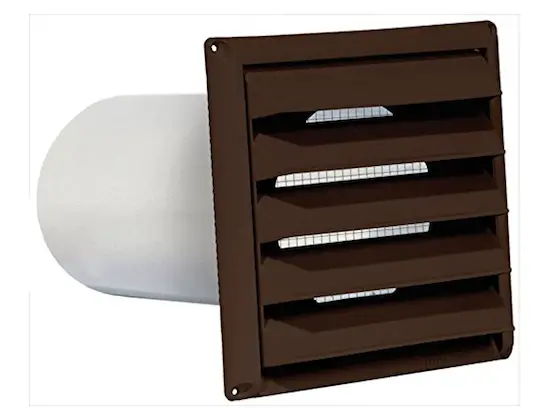
This fresh-air intake vent will do a great job. You may need several to get enough air indoors to satisfy all fuel-burning appliances. Pipe them with solid 4-inch metal pipe. CLICK THE IMAGE TO ORDER THIS VENT NOW.
Makeup air intake ports can be as simple as a clothes dryer exhaust cap that has holes drilled in the flapper. I have also seen small hoods where the flapper is removed and small galvanized hardware cloth is inserted in its place. These makeup air intake points should be located in the utility room where furnaces and water heaters are located.
CLICK HERE to get FREE & FAST BIDS from a bath-fan installer in your city or town.
Column 594

Tim built custom homes and did ultra-custom remodeling for 20+ years before launching his Ask the Builder media presence. He was selected as one of the Big 50 by Remodeling magazine in 1993. This award gave birth to Ask the Builder in October 1993. Tim also operates https://DrawPlumbingPlans.com. His @askthebuilder YouTube channel was the first home improvement channel on YouTube.
Hi, We have water leaking through our bathroom vent only when it is cold outside. We do not take showers in this bathroom. The voting pipe goes straight up from the bathroom then approx. 16ft throughout the attic to the roof. We have completely insulated the pipe. It is still leaking like crazy through into the bathroom and now there is water leaking into the kitchen but only when it is cold outside. Our kitchen ceiling is now covered with wet splotches. What do we do now??
The water is almost certainly condensation - this means that warmer, more humid air (i.e. the air inside your house) is escaping through this exhaust vent.
Hot air rises, so your home's warmest, most humid air is always up at ceiling level, seeking a way to get even higher. It'll use any crack it can find... and apparently your exhaust vent pipe is a nice open highway for air that wants to escape.
As it goes, up, it cools and the water condenses on the inner sides of the pipe and makes its way back down.
Basically, you've re-invented a distillation still, only instead of making moonshine you're making ceillng water 😉
Your base problem is that air can escape the house via that vent too easily. It sounds like the pipe has nothing to act as a damper/flapper. That's why these dampers exist; to make sure the pipe is "closed when not in use".
Fix the air escape by installing either an internal or rooftop damper.
Tim. We just bought this home and have a gas fireplace . When it is windy out the vent has something outside that bangs. Hope you can help.. Jean
Yes, I can help. Get up and see what parts are banging and fix them.
Get up the roof, bring some neoprene screws from Lowe's.
The damper on the bathroom fan broke off, do i replace the whole fan or is there a way to fix this piece (damper)
My house has a bathroom fan duct that was installed to point toward an eave vent to let the exhaust air out. The fan seems to clear air from the room, but outside air can seep in when it is not running, e.g. cold air seeping in in the winter. The fan is a good Panasonic one, with louvers by motor in the bathroom ceiling. I'd like to have an outside louver installed at the eave vent, but the standard outside louvers are 6" on a side, and the eave vent is only 3-1/2" to 4" tall, so the standard is too big. Is there a smaller outside louver that would fit, or else what do you recommend?
Problem with dampers on current bathroom exhaust fans. They bang during windy days. The vent is on the exterior under the soffits. Cold air also seeps in during winter. How should the vent be installed in such a very windy location?
Hi Tim,
I just move into 16th floor condo Vancouver, BC, Canada. Just wonder why is my laundry room ventilation goes on when i am not doing laundry. It goes on for 15 to 20 minutes and then cut off for 5 to 10 minutes and then on again. This goes on for maybe i guess 2 hours. When it is on, i can feel the cold air coming in. Please advice what is wrong. Thanks.
Ask the building facility manager. Perhaps you're on a GROUP vent system that's got a remote fan.
Tim, I recently finished a large addition above our newly build garage. I installed a bathroom exhaust fan and rigid duct work. It is a very long run (30') over the hallway and new master bedroom out the gable end. It was the best option- shorter runs would have involved 3 90 degree elbows and we were trying to avoid the roof vent. It is a straight run with no turns and the fan company verified the fan is powerful enough to ventilate properly. The fan and first 6' is in a warm insulated attic space. However I forgot to wrap the rest of the duct run with insulation which is in a cold New Hampshire uninsulated attic space. There are two dampers- one at the fan and one on the outside vent. I did slope it to the outside so any condensation could drip if it doesn't freeze of course. Unfortunately all the ceiling sheetrock in. Did I royally screw this up? It is such a long run and I don't believe there is enough clearance for me to cut an access door and crawl through there to wrap insulation around the duct. So I think I'd have to cut multiple ceiling holes all along the 24' of run to reach the ductwork and then patch everything back up. please advise to how bad this problem might be!
It's going to be BAD. You should have installed 4-inch PVC pipe and glued all the joints so any condensate gets all the way to the outside.
Good luck. Report back what you decide to do.
Hi Tim, we have a WhisperWall 70 CFM wall mounted fan in our bathroom that is on the NW side of our house. When the wind blows we get a lot of air blowing back into the house which is not only noisy but also lets in cold air in the fall and winter. We resorted to taping a bag over the inside vent grill and putting a magnet on the flapper to help prevent it from opening on windy days. Unfortunately that n order to actually use the fan we have to take the inside cover off when we run the fan. The magnet also makes it harder for the flapper to open normally when we turn the fan on to vent steam from the bathroom after taking showers. Would the No-Pest Dryer Vent Hood you show in your article be a better solutiuon?
Hello Tim: I have a Nutone fan/heater in my bathroom. It comes with a flapper that we could not install as the ceiling joists are only 11' apart. However, that flapper is only plastic and so it would not have been of much benefit. We put a 4" sheet metal exhaust, that we insulated with wrap, thru the roof and so that double door dryer flapper may not be useable on a vertical pipe. We have a cone shaped roof cap that protects the exhaust. Since we have already installed that cap, we can't install one of those ones with a flapper on it. Also, I prefer not to remove the existing cap unless there is no other choice. What do you suggest we use to prevent back draft?
Hi Tim,
I recently replaced an old bathroom exhaust fan and ever since it has not worked properly. It is a 5’ x 8’ bathroom and I like to take hot steamy showers. Afterwards I notice a drip from the vent. I was advised to put a bend in the vent in order for moisture to collect however I do not believe that is a fix. I feel like that is just asking for more problems after the ceiling is redone. I was also told by the manufacturer that I should leave the door cracked in order for it to get more airflow and I told them that was not an option for a fix. It never did that before why should it now. It is a 70cfm fan that I bought which should cover the square footage however I was thinking maybe I need a more powerful fan. They told me that a higher power fan would make the problem worse What are your thoughts?
Hi Tim,
I'm installing a new bathroom in the basement. My contractor says he plans to attach the bathroom exhaust to the heat recovery ventilator exhaust, and use a backdraft damper in addition to the one in the fan itself.
Is this acceptable? What will let more cold air in, backflow leakage from the HRV exhaust or the vent to the outside?
I'd never do it that way.
Tim, We are having the opposite problem. We live in Central PA and in the summer it can be very humid. We built our home in 2012 and spent the extra money to have our home energy star certified...well that has caused us some challenges because our home is too well sealed. The issue is that when our furnace runs it has no where to pull air from...so it pulls air down our chimneys and thru our exhaust fans...which causes massive amounts of condensation and hooray...black mold on our ceilings around our bathroom exhaust fans. What can we do to resolve this issue that won't cost tens of thousands of dollars to put an air exchanger on our heating system...nevermind that most HVAC individuals in Central PA have no idea how to install one. Your help would be greatly appreciated...I only figured out what was happening based on your reply to another individual in regards to drilling holes to allow air to come back thru when the furnace kicked on in the winter.
Hi Tim - The flapper valve on the outlet of our bathroom vent fan ofter stays open after it is turned off. This can be seen from the outside of the house. It is difficult to get to in order to see if there is a screen behind the flapper valve. If not, when it stays open, bugs and maybe larger varmets can enter this vent tube. Do all flapper valve assemblies have a screen at the outlet before the flapper valve. Thanks
I have no idea. I've never looked at all bath fan flappers.
Existing house with a hot air gas furnace (pulse system, separate intake and exhaust on side of house), fireplace that is never used and 'closed', one bathroom exhaust fan. High / raised ranch - downstairs is 2 car garage, half bath, 'big' room / play room, bedroom used as computer room / office, that area partially below ground. Upstairs is main living area with kitchen (with hood vent and exhaust fan also).
Where in general terms would you put in a fresh air intake vent and what if anything would you connect it to? How would you prevent it from causing a cold draft in winter, and bringing in hot humid air in summer?
One more thing - I always wanted my bathroom exhaust fan to be on timer or on a humidity sensor to shut of automatically. My wife said no, so it's just a normal on off switch. What should it be? Hint - electricity is very expensive on Long Island.
Thanks Tim!
what trade installs bath fans? what trade installs dryer duct fans/boosters? what trade installs kichen fans?
I can't seem to find anywhere why all 3 of my bathroom exhaust fans make a drip sound almost like water is dripping from the roof, but I don't see any. Please help! There's PVC vertical vents going into the roof and the noise is driving me mad!! It doesn't happen when the fans are on so please help.
Hi, thanks for the information. Reviews on your recommended vent outlet (double door) seem to indicate it is pretty flimsy. Your thoughts?
I really like the LAO289W - LAMBRO 289W 4 Dryer Vent Seal. This too (in my opinion) can be used as a bathroom vent. It is pretty heavy duty and the cup does a good job sealing (if you take it out and lightly remove the rough edges on the floating cup)