Repair Cracked Concrete Slab
DEAR TIM: The ground level concrete slab in my 30-year old split level home has a few large cracks in it. These cracks are up to 1/4-inch wide and they move up and down with the change of the seasons. Over the past five years, the cracks seem to be getting bigger ever so slowly, but there is no evidence of structural problems on any foundation wall or at any other part of the house. I would like to install wood or cork flooring over the concrete, but I realize the crack must be repaired. What is the easiest thing to do and will give lasting results? Is there a way to stop the seasonal movement of the slab? Lisa P., Boulder. CO
DEAR LISA: Although you don't see any structural problems, they may be present or in the early stages of development. Hiring a residential structural engineer, to do a field visit to your home, may be a very smart thing to do before you move forward with any repairs. The seasonal movement is a strong clue as to what might be happening. Your house may be built on an expansive clay soil.
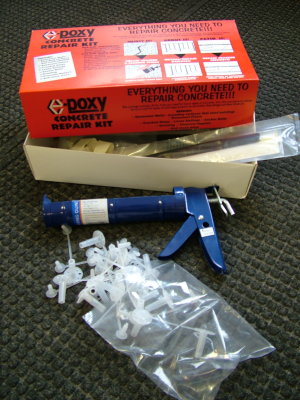
These epoxy-injection products weld broken pieces of concrete together. If you follow directions, the repair can often be permanent. PHOTO CREDIT: Tim Carter
As I was working to get my college degree in geology, I quickly discovered that certain rock formations create clay soils that can expand and contract dramatically in response to moisture content. These expansive clays are also found in some parts of the USA that experienced continental glaciation. The pesky soils can wreak havoc with poorly constructed homes and cause minor irritation with well-built structures. But if you trick the soils into thinking that it rains every week, they calm down and stop moving.
In addition to calling the structural engineer, you might also call the local colleges and universities in your area that have a geology department. Once you get this far, ask for a soil scientist. If you run into a dead end, you can open the Yellow Pages and look for geo-technical engineers. I am confident you will find one. Ask the geology professor, and/or the geo-technical engineer, if your house is located in an area know for expansive clay soils.
If it is, you need to think about stabilizing the soil before you proceed with any repairs. One method, that works well in my area, is to drill two-inch diameter holes 18 to 24 inches deep into the soil around your home. Space the holes about three feet away from the edge of the foundation if possible and drill one hole every six linear feet. Fill the holes to the top with small rounded gravel that is 1/4-inch in diameter. Lay a soaker hose over these holes and allow water to run for 24 hours so water soaks deeply into the ground. Run the water once a week during your dry seasons.
Once the soil is stabilized and you see that the slab is no longer moving, you can proceed with permanent repairs. Since the cracks are 1/4-inch wide, the job should be fairly easy. You can purchase high-strength epoxies that are designed to be injected into cracked concrete slabs from special concrete supply businesses. If you follow the directions and do the job right, the repairs can be permanent.
The finished epoxy repair is very similar to a welded seam between two steel plates. Often the weld is stronger than the actual steel. The same is true for the epoxies as they can have fully cured-strengths in excess of the actual concrete.
After the epoxy has fully cured, you may have to install a thin concrete overlay over part of the slab to mask any unevenness between the cracked portions of the concrete. This overlay mixture is made from one part Portland cement and 2.5 parts of fine sand. Be sure the slab is dust free and clean. I would recommend you lightly wet the slab immediately before applying the mixture of cement and sand.
Want perfect concrete work? Find a pro by using my Concrete Work (Sidewalks, Driveways, Patios & Steps) Checklist. I offer a 100% Money Back Guarantee.
Use a six-foot long straightedge to create wide feathered areas of overlay on either side of the crack. You can use a regular steel trowel to finish this stucco-like material as it begins to set up. It is important the floor be as smooth and even as possible as imperfections can telegraph through cork flooring.
If you have seen mud puddles dry up in your area and large cracks develop in the still-moist clay, you live on or near expansive clay soils. What most people do not realize is the clay is not only shrinking from side to side, it is also losing volume up and down. This seesaw movement is not appreciated by materials such as concrete that are rigid and crack when stressed.
Smart builders who build houses with shallow foundations or houses on slabs can install piping under and around the foundation that allows homeowners a method of getting water into the soil quickly and efficiently. The trouble is, most builders don't have a geology degree and most building codes do not require this inexpensive piping.
Related Links
October 3, 2021 AsktheBuilder Newsletter
Column 596

Tim built custom homes and did ultra-custom remodeling for 20+ years before launching his Ask the Builder media presence. He was selected as one of the Big 50 by Remodeling magazine in 1993. This award gave birth to Ask the Builder in October 1993. Tim also operates https://DrawPlumbingPlans.com. His @askthebuilder YouTube channel was the first home improvement channel on YouTube.
Thank you so much for this. I did take enough geology in college to understand exactly what you're talking about. The suggestion of keeping the clay a bit moist to stabilize is excellent. I wish the piping existed, I mean they could've simply piped the gutters into the under-slab piping. It makes no sense for building codes to ignore the environment the house is going into. I wonder if this issue could be fixed or minimized if a large deep area were dug up and prepared so that it wouldn't expand or contract before a slab is laid. In NC, where I am writing from, all the soil is red clay, there are pottery artists all over the place here. And now I know where those disgusting centipedes were entering my house. The cracks in my slab go all the way out and continue onto the patio. I do see alot of argument about expanding polyurethane versus epoxy. I would appreciate some updating here about that issue because it's impossible nowadays to google this issue without bumping into that argument. I assume you're talking about low pressure application either way, so it would be the same process as polyurethane but using epoxy as the filler? Thank you for helping me understand why this happening in my area and why builders around here just "bah" about cracks and ignore them. I'm really not the type to ignore problems.