Cathedral Ceiling Framing
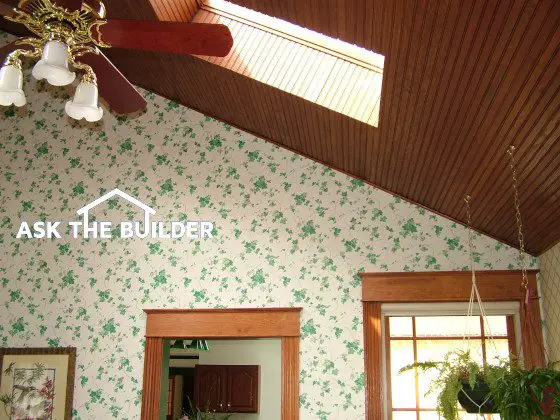
Cathedral ceilings can be a dramatic look. The ceiling can be covered with wood or drywall. PHOTO CREDIT: Tim Carter
DEAR TIM: My ranch-style home was built in 1968. It has dreary low ceilings. I would love to create a cathedral ceiling. This past weekend, I poked my head into the attic to see how the roof was built. The roof was not framed with modern prefabricated trusses. All I could see were 2 x 6 rafters that meet at the top where they rest against a center-ridge board. Can I take out my flat ceilings and attach a finished ceiling to the underside of the rafters? Is it possible to install skylights at the same time? Stacy J., Tulsa, OK
DEAR STACY: The simple answer is you absolutely can create cathedral ceilings in your home and install any number of skylights. But before you start tearing out the flat ceiling and cutting away the flat-ceiling joists, we need to talk. The modifications you want to do are structural in nature, and if you don't adequately brace the roof, you can cause serious structural damage. In the worst case, your roof will collapse on top of you.
Traditional roof framing consists of two slanted rafters that are connected at their base with a horizontal piece of lumber. When fastened together, these three pieces of framing lumber create a very simple triangle that can be exceedingly strong. But the strength of the triangle relies on each and every one of the three pieces of lumber. Your existing roof consists of a series of these triangles spaced at either 16 or 24 inches on center.
You didn't mention seeing a bottom piece of lumber, but it is there. You didn't see it, because it is either covered by attic flooring or buried in insulation. The existing ceilings in your home are nailed to this flat lumber that forms the base of each triangle.
If you cut this horizontal piece of lumber, the force of gravity, along with the combined weight of the roof rafters, roof sheathing and roofing materials, immediately starts to push the roof structure down. The result is that your slanted roof starts to transform into a flat roof. This process can happen over a period of years, months or even seconds, depending upon how the house is built.
There are any number of satisfactory structural solutions that will allow you to create the cathedral ceiling. One solution is to install a properly sized beam just under the peak of the roof, where the top of the rafters connect to the ridge board. This beam will carry all of the roof load, but the ends of the beam must be supported by columns that rest on a solid surface. This surface might be a concrete footer in a floor, a steel I-beam that is used to support the floor of the home, or even the top of the foundation. A residential structural engineer can help you determine how to properly size and support this beam.
You can also install smaller, horizontal-framing members, called collar ties, that can be exposed as part of your cathedral ceiling. These collar ties are installed higher up than your current flat-ceiling joists, and they create a new bottom base of the triangle. Once again, the engineer can offer suggestions as to where to install these and how to properly fasten them to the slanted roof rafters.
Plywood gusset plates can also be installed high up in the rafters near the peak of the roof. These plywood pieces are cut in a triangular shape to match the slope of your roof. They are glued and nailed to the sides of the roof rafters. You would be surprised how small these gusset plates can be, yet they provide sufficient strength to prevent a roof collapse. If you use these gusset plates, you will end up with a small, flat ceiling area near the peak of the cathedral ceiling.
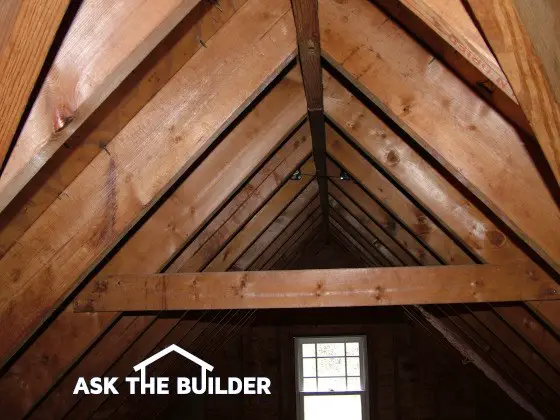
The slanted pieces of wood are actual roof rafters. The horizontal piece of wood is a collar tie. You can see how combined, all three pieces of wood make a strong triangle. This collar tie is not at the base of the rafters, yet it still imparts great strength. PHOTO CREDIT: Tim Carter
Whichever structural solution you choose, you must install it before you cut away all of the existing ceiling joists. If this is not feasible, then you will have to install temporary supports or collar ties that will provide support until such time as you install the permanent engineered solution. The engineer can assist you with advice about how to safely support the roof as you proceed with the work.
Once the new cathedral ceiling supports are in place, and the flat ceilings have been removed, you need to think about how you are going to insulate the ceiling. Do not fill the entire cavity with insulation, unless you happen to use newer breathable open-cell spray-foam insulation. If you use traditional fiberglass or cellulose, you need to create a 2-inch air space between the insulation and the roof sheathing. If you do not have ridge ventilation in place, you will need it after the job is complete.
Remember that the skylights need to be installed before any insulation work is performed. The engineer needs to know about the skylights, because you may have to strengthen the existing roof framing along each side of the new skylights depending upon their overall width.
Column 615

Tim built custom homes and did ultra-custom remodeling for 20+ years before launching his Ask the Builder media presence. He was selected as one of the Big 50 by Remodeling magazine in 1993. This award gave birth to Ask the Builder in October 1993. Tim also operates https://DrawPlumbingPlans.com. His @askthebuilder YouTube channel was the first home improvement channel on YouTube.
did an add on room 20' x 16' would like to leave the ceiling open . how would i tie the wall in to the ceiling .right now all i have is the roof and walls up .dont these wall need to be tied in to the rafter some how?
You need to talk to me on the phone. http://shop.askthebuilder.com/categories/Consult-Tim/
I am changing the flat ceiling in a one story ranch with a 4 pitch to a cathedral ceiling. I want to know the best way to do it without taking off the roof. The room is 24 wide by 28 deep. the roof rafters are 15 feet from the wall to the ridge.
I can do better than that. I can call you. Look at the new 500-Second Consult for fast solutions. http://shop.askthebuilder.com/categories/Consult-Tim/
I have a room 24 by 14. I would like to raise the ceiling a couple feet. The rafters are presently 2/6 and 104" from plate to ridge. I will be doubleing up the 2/6 with 2/8. I will also be installing new 2/8 collar ties 1/3 of the way down from the ridge. If I carriage bolt the collar ties can I use the collar tie height as my new ceiling height?
Without being there, I'm going to say Yes! You know the correct size to drill the holes for the bolts, right?
I have a capecod house. My kids are older and ovin out one y one, and ther is no need for the upstairs bed rooms. I am thinking about removing the upstairs floor on the left side of he house to make it a cathedral ceiling and other side as open loft. Is it possible structure wise?
Yes it is possible! Hire a structural engineer before doing this and allow him to draw up a plan of what needs to happen in WHAT order.
Hello, I am turning my garage ceiling into a cathedral ceiling and I had an engineer come and tell me that, to take out the ceiling joists, I could place rafter ties 2/3 up as long as I stiffen the rafters by sistering 2x8s to them. He said that the rule of thumb is to place the ties only 1/3 up BUT if you stiffen the rafters, you can place the ties 2/3 up. i can't find anything anywhere that recommends this practice. 99% of what I read says the ties can't go farther than 1/3 up. On the other hand, I'd like to be able to go 2/3 because I will have a higher ceiling.
any thoughts?
Many thanks
1/3 rafter tie rule
I am turning my garage ceiling into a cathedral ceiling and I had an engineer come and tell me that, to take out the ceiling joists, I could place rafter ties 2/3 up as long as I stiffen the rafters by sistering 2x8s to them. He said that the rule of thumb is to place the ties only 1/3 up BUT if you stiffen the rafters, you can place the ties 2/3 up. i can't find anything anywhere that recommends this practice. 99% of what I read says the ties can't go farther than 1/3 up. On the other hand, I'd like to be able to go 2/3 because I will have a higher ceiling.
All things considered here. How stiff and strong each rafter is. Because all wood will flex from the pull of gravity. Whether it takes 5 years or 100. A board will begin to bow over time. A beam is likely to not bow compared to a 2x. So if you are simply using a collar tie in the upper 1/3 section of a rafter, you are doing nothing more than securing the upper half of the rafter. The bottom half becomes subject to the flex of the lower 2/3 of the rafters. Its dependent upon the weight of the whole roof in relation to the secure condition of the walls. A simple solution is to have a few tie beams running from one wall to another. Holding them in place. Then use those beams as a way to hold lights, fans, or for style. Then you wont have to worry about flex as much. If the roof pitch is low, then you DO have to worry somewhat. Because low pitch places a whole lot more tension of the rafters. And the only way to counteract that is to either have a lighter roof or use thicker or wider rafters. Remember. Its easier to bend a board than it is a tree. Thicker and wider is always better when Mr Gravity is constantly pulling hard on everything.