Removing Ceramic Tile
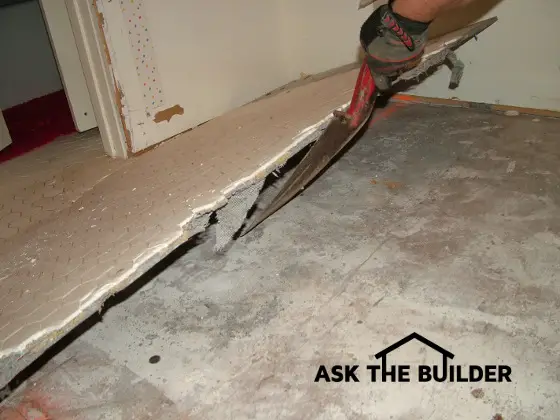
Removing ceramic tile and removing tile floor is easy with the right tools. © 2018 Tim Carter
"The first thing to do is stop hitting the tile with a hammer... Each hammer strike creates conchoidal fractures in the tile. The resulting shards have smooth curved edges that are just like a chipped-flint arrowhead and come at you like a bullet."
Removing Ceramic Tile TIPS
- Do NOT use a hammer removing tile floor
- Chip off tile at a low angle
- Stiff wide putty knife superb
- WATCH Tile Removal VIDEOS Below
- CLICK HERE to Get Tim's FREE & FUNNY Newsletter!
DEAR TIM: It's time to remove the 18-year-old ceramic tile in one of my bathrooms. The tile is a smaller octagonal tile that is adhered to a cement board which is nailed to my wood subfloors. I need to know how to remove tile from a wall.
I tried breaking the tile with a hammer, but the tile shatters into what look to be pieces of glass.
Is there a way to easily remove the tile from the cement board? What is the fastest and easiest way to remove the ceramic tile? What about wall tile? Debbie P., Wilmington, NC
Related Links
Remove Grout from Ceramic Tile
Repair Wall After Tile Removal
DEAR DEBBIE: I don't know if there is a best way to remove the ceramic tile. Each tile reacts differently to force, and the different types of adhesive can make the chore difficult to nearly impossible.
Over the years, I have taken up more than my fair share of ceramic tile, and there are several tricks that I have learned. I've got two great wall-tile removal videos for you below!
Free & Fast Bids
CLICK HERE to get FREE & FAST BIDS from local handymen who can remove ceramic tile for you.
Should I Use A Hammer Removing Tile Floor?
No, don't use a hammer when removing the ceramic tile.
The first thing to do is stop hitting the tile with a hammer. Based upon your description of the tile, it sounds as if you are dealing with porcelain tile. Porcelain tile is extremely hard and has a very high quartz content. These characteristics cause it to react as if it were glass. Each hammer strike creates conchoidal fractures in the tile. The resulting shards have smooth curved edges that are just like a chipped-flint arrowhead and come at you like a bullet. These edges can be razor sharp, so be extremely careful.
What are Good Tile Removal Tools?
The following is a list of good tile removal tools:
- stiff-bladed 3-inch putty knife
- 20-oz hammer
- flat garden spade
- iron pry bar
- wrap-around safety glasses
- medium to heavy leather gloves
Click the image below to BUY all, or some, of the tools in the above list.
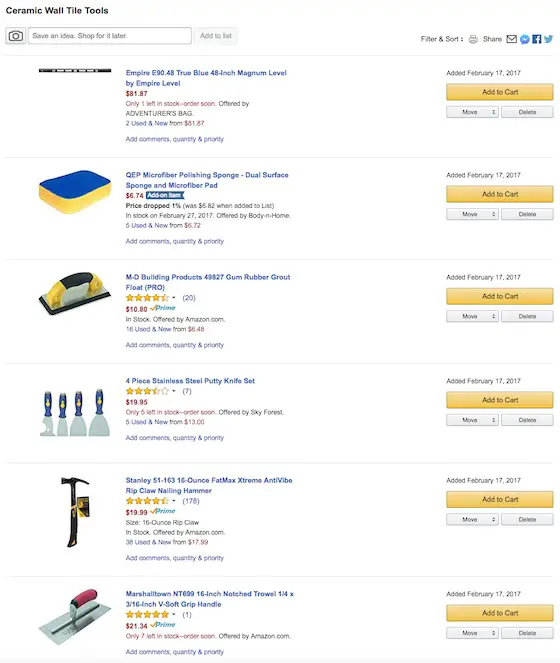
CLICK THIS IMAGE NOW TO ORDER ALL THE TOOLS YOU NEED TO DO CERAMIC TILE.
How Do You Remove Tile From Cement Board?
There are a few ways to remove tile from cement board. Watch this video for an easy way.
You're in luck that your tile has adhered to cement board. This will make the job somewhat easy.
Many years ago, ceramic tile was commonly adhered to fresh concrete that was poured between the floor joists of houses.
The tiles were actually mortared to the concrete mix, and once cured, the tiles and concrete became one unit. The only way to remove this matrix of material is to use a four-pound hammer and lots of muscle power. It's miserable work.
How Do You Remove Cement Board?
You can use a flat spade to pry up cement board. You can also use a wicked tool that resembles a trident. Watch this video to see the technique of driving the tool under the cement board.
If you are trying to remove the tile so as to save the cement board, it is a waste of time in my opinion. It is grueling work to try to remove ceramic tile in an effort to salvage inexpensive cement board.
Get this Honey Badger Demolition Fork you see in the video above. CLICK or TAP the image below to have it delivered to your home.
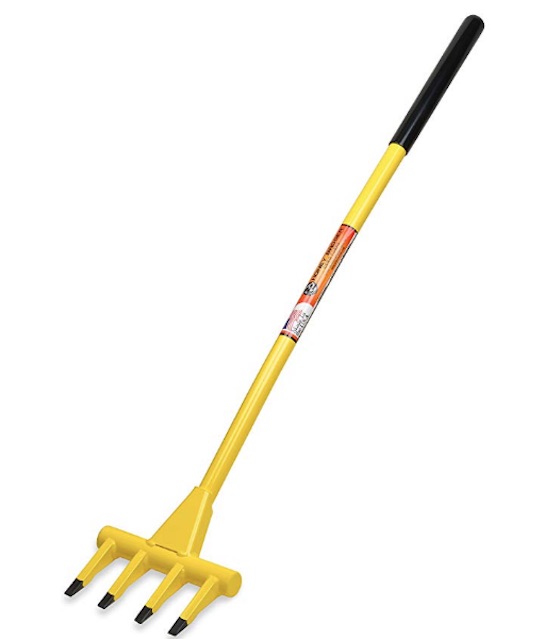
CLICK or TAP here or the image to have this Honey Badger delivered to your home.
I feel it is a far better idea to remove the cement board and tile all at the same time. You want to start removing tile where the ceramic tile ends and a different flooring material, such as carpet or hardwood flooring, begins. Don't try to start this job in the middle of the ceramic tile floor.
How Do You Get the Tool Under the Cement Board?
To remove the cement board and tile at the same time, you may have to remove some of the tile and cement board separately at first. I use the small hammer and putty knife for this task. Individual ceramic tiles come off a floor or wall with less effort if you remove the grout surrounding the tile.
The edge of the stiff putty knife can be used to pulverize and remove the grout. You can also use small electric tools with special grinding wheels to do the same thing.
CLICK HERE to get FREE & FAST BIDS from local handymen who can remove ceramic tile for you.
What is the Best Angle When Removing Tile Floor?
It's best to drive a tool under the tile at a low angle.
Once the grout is removed from around a tile, try to pop the tile off the cement board by driving the stiff putty knife under the tile at a low angle. The blade of the putty knife should be nearly parallel with the floor. Strike the end of the putty knife gently with the hammer.
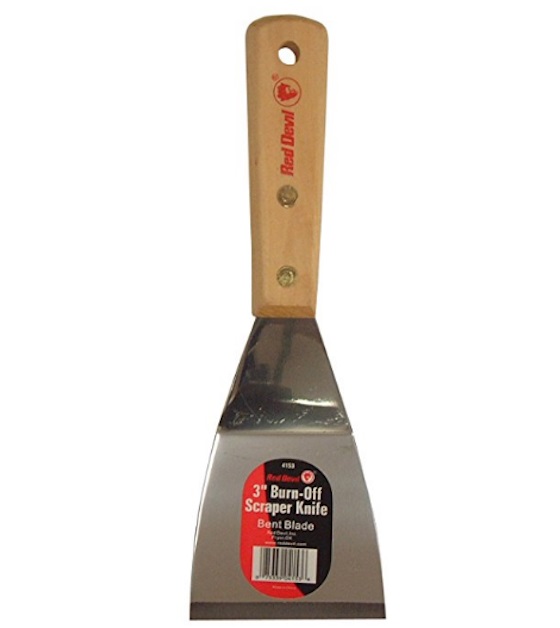
This is an excellent bent-blade 3-inch putty knife. It's got a chiseled edge to get a bite right away. CLICK THE IMAGE NOW TO BUY IT.
The tile will either break in several pieces, or it may pop off all at once. Try to remove an area of tile from the floor that is about 8 inches wide and perhaps 2 inches from the flooring material that touches up against the tile.
How Do You Create A Hole in Cement Board?
Strike the cement board with your hammer to pulverize it. It will take a few hammer blows to achieve this, but the cement board will disintegrate. Remove the debris so the wood floor is exposed. I prefer to use a wet-dry vacuum to get up all of the small debris.
Removing Ceramic Tile With a Garden Spade
Take the flat garden spade and drive it between the wood subfloor and the cement board. Try to get about 6 inches of the spade under the cement board. Lift up on the handle to lift the cement board.
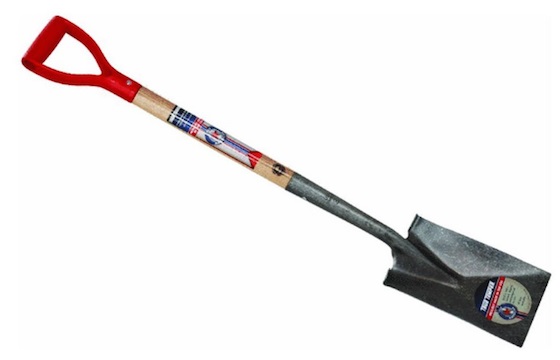
You can't get a better garden spade. It's got an arched back so it won't bend. CLICK THE IMAGE NOW TO BUY IT.
Move the spade left or right if possible to start to pop up the cement board from the wood subfloor. Once you get the cement board to move up, it will readily detach from the wood subfloor as you drive the spade farther under the cement board and tile.
The roofing nails used to attach the cement board to the wood subfloor will be somewhat problematic. You will feel them as you try to move the spade under the cement board. When this happens, move the spade left or right to try to bypass the nails.
Are Cement Board Nails Easy to Remove?
Yes, cement board nails are easy to remove if the nails have a smooth shank.
They will offer little resistance to lifting forces. The trick is to create a gap between the cement board and the wood subfloor. Once you can get the cement board to lift up, it is only a matter of moving the spade farther under the cement board and then using the spade as a lever to pry the cement board off the wood subfloor.
If the tile contractor screwed down the cement board and used thinset under it to fill hollow spots, you're screwed. You'll be beating it all out with a 4-pound hammer.
Wall Tile Removal Videos
CLICK HERE to get FREE & FAST BIDS from local handymen who can remove ceramic tile for you.
Column 620

Tim built custom homes and did ultra-custom remodeling for 20+ years before launching his Ask the Builder media presence. He was selected as one of the Big 50 by Remodeling magazine in 1993. This award gave birth to Ask the Builder in October 1993. Tim also operates https://DrawPlumbingPlans.com. His @askthebuilder YouTube channel was the first home improvement channel on YouTube.

Tim,
I am going to help my sone remodel his 1960's bathroom. Tackling the shower first, It looks as though the wall tiles are set into mortar. Was this a common practice back then? I'm thinking that mortar was applied to a mesh backing to create a surface connected to the studs. If this is right, I'm assuming ewe just have to muscle the walls out, with a heavy hammer, until were down to the studs. Am I right in assuming this?
Mike, Yes. Lots to talk about. I can discuss it on the phone if you want.
Wow! Thanks, Tim. I have this very issue in my bathroom and have gotten every opinion from my fellow DIYers like, tile over top of the tile, remove the tile and leave the cement, to "Cement in the bathroom? What???"
I am more of a remove it all and start clean kind of guy and this little tutorial was very enlightening. I defiantly feel confident in my initial assessment of getting rid of the subfloor and lay down a new one.
Hi Tim,
I want to redo the small hex tile in the bathroom of the apartment I just bought. It was built in 1916 (and for what it's worth, I'm on the third floor). There were numerous small cracks running all over the floor, and several loose tiles. It looked like concrete was underneath the handful of tiles that had come off entirely.
After doing some research, I thought I could do it myself (though I haven't done this before). Using a cold chisel and a mallet, I took off a 8x4 inch section of the tile to see exactly what I'd need to redo. What I found was confusing.
The tile is firmly adhered to about an inch of concrete, and I can't remove the tile without breaking off this layer. Underneath the concrete I found pipes that connect in a T shape. Next to them (i.e., on the same level) were 2 corners of some flat material (I think wood, but it was hard to tell) nestled into the corners of the T between the crossbar and downstroke. Between the wall and the top of the T, there seems to be just inches of dusty, gravelly fill. I can't dig all the way to the bottom, but it definitely goes down for at least an inch or two. (I have a picture, since this is hard to describe.)
Have you seen this before? Do you have any advice on figuring out the solid part of the subfloor? And do you think there's any chance this is still a DIY project?
Krista
Krista, you need a phone consult.....
Same problem with the tile on the walls in a old bathroom. Concrete is underlying the tile with wire on studs. How to remove without tearing the wall down.
I'm wanting to take out the ceramic tile in my breeze way. It was put in with the thick cement grout strait on top of the main cement floor. No base floor between. Would this method work for me?
Yes it would! Be prepared as it's lots of work.
Our cement board was put down with screws. Will we use the same method to remove our tile or will it be a bit more difficult?
I'm not quite sure I understand what you're trying to do. Can you explain it a little better?
I have heard that it is easier to remove ceramic tile from plywood using dry ice. What is your take on this? We have been using the conventional way that you have advised and a good part of the floor is removed. Someone mentioned the dry ice method and I googled it discovering that this has been used. On the other hand I value your opinion over these do-it-your-self individuals. Would it be an easier method or should we continue with the hammer and chisel?
Clara
You can try dry ice. Be SURE you have great ventilation. You can DIE if too much CO2 builds up and you pass out. Dry ice works GREAT for releasing vinyl tile that was put down with organic mastic. If the ceramic tile is down with thinset, the dry ice will do NOTHING.
I tore out old tile walls around the bathtub. Put in Hardibacker walls and started applying new ceramic tile. All was going great until the last wall where the plumbing is. Somehow, probably because the tub is not perfectly level in my 100 year old house, I started going a bit off level from the tub and up the wall. My question is, can I remove the tile from this wall without damaging the backer board? I just put the tile up 2 days ago.
Hi Tim
I need ur help !! So in reading ur posts above .. Apparently I have an unfortunate job ahead. I have approx 84 sq ft of what looks like a red clay 8x8 tile covered in porcelain of the most unfortunate pattern circa 1978 that has been mortered directly onto the concrete pad that shares my garage. Now .. I'm a pretty handy girl& have just finished putting in a new kitchen & hardwood in multiple levels , but this has me stumped. I've tried several things & about 1&1/2 hrs of hammer & pry bar & I barely can get one tile removed. Some blokes I work with said I can't rent a jack hammer because it will damage the concrete pad. What do I do ? I can't tile over because it won't leave enough variance for the closet door ( even after I raised them ). Thanks for ur help
Bree
Oh oh Tim,
Earlier you mentioned this "Many years ago, ceramic tile was commonly adhered to fresh concrete that was poured between the floor joists of houses. The tiles were actually mortared to the concrete mix, and once cured, the tiles and concrete became one unit. The only way to remove this matrix of material is to use a four-pound hammer and lots of muscle power. It is miserable work."
This s
Is my situation and it is a bit over 600 aq ft of tile and I have worked hard to get up 5 percent of that!! Help!! I rented a 109 lb tile ripper and I think the tile won that round. It looks like they did use. Trowel in many places but the mixture looks to be the same material as the cement they poures in the floor joists. We thought of jack hammering but are worried what would haooen to the concrete beneath the tile. We replacing the tile mostly with 3/4" hardwood tongue and groove Brazilian walnut. We were told to remove tile and then lay 1/4" subfloor (assuming smart board or ply wood would love to know for sure what material help)? The mill said to use stainless screws in the tongue lay the beautiful Ipe floor and they said it could not be glued. We are taking out a lot of carpet that is adjacent to file floor so ideally we could remove the tile in such a way that Our concrete floor remained. This is a second story which is our main floor.
Hi Tim,
We were given an estimate to remove tile from a small bathroom. They told me that I had to remove the toilet and vanity myself and they would come in to retile. I did so and when the tillers came in they said that it has the mortar underneath, as you had mentioned earlier. They tripled the price for removal and now I am stuck with a master with no toilet or vanity and this mortared tile. What should I do as I have purchased another home and we are trying to sell this one?
Tim, I would like to know where I can purchase one of those Trident looking scrappers. I have a big tile removal job at my house and those scrappers look just like what I need. Thanks for your time and any help you can offer. Chris
Chris,
It's the Honey Badger! CLICK or TAP the following URL to get one delivered to your home:
https://amzn.to/2T8L3QG
You asked a question to the name of the tool being used to remove tile. I was surprised to find what this tool is called Demolition Fork made by Honey Badger and yes it can be found on Amazon and comes in different length and a choice of 4 tine or 2 tine.
What would be the best way to remove tile from 1 inch of cement over plywood? The cement contains hydraulic heated lines which I'd like to keep. The floor was laid about 1999.