Privacy Fence
DEAR TIM: I desperately need a privacy fence that will allow me to sit outdoors, and not make me feel like I am in an aquarium. Is a vinyl privacy fence the best one? How high should this fence be? What can I do to make the fence good-looking instead of a harsh exterior wall? Do you think it is possible for me to build a wood privacy fence by myself? Stephanie B., Narberth, PA
DEAR STEPHANIE: Once your new privacy fence is constructed, you are going to have a new comfort level when you are outdoors. I am also sensitive to neighbors who might watch me as I walk around my yard, work on my laptop on my own patio or sleep in my hammock. A privacy fence, or even short sections of fencing, can create cozy micro-environments within your yard that protect you from prying eyes of neighbors or strangers.
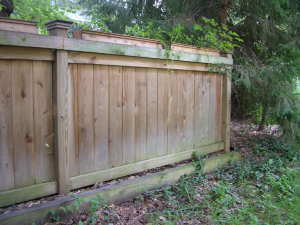
This privacy fence does not extend the entire property line. It is just a 25-foot-long barrier that creates a cocoon of solitude for my neighbor's patio and screened porch. PHOTO CREDIT: Tim Carter
Many privacy fences are usually only 6 feet tall. You may be able to construct a privacy fence around the entire perimeter of your yard, but my guess is that it may only be effective if you live on top of a hill. If the lots around your home are higher than yours, then people above you may have a line of sight that allows them to see you as they look over the top of the fence. This is why a smaller privacy fence near the location you are sitting, sunbathing or snoozing often works best.
Before you run to the lumber yard or fencing store to buy materials, stop by your local government offices. Locate the zoning department. Many zoning codes regulate fences of all types. Not only is the height of fencing an issue, the fencing material and the direction the fence faces is often covered within the code. Zoning codes can be highly restrictive when it comes to fencing. Also be sure there are no subdivision or neighborhood association rules that might govern privacy fences.
Your choices of materials for the privacy fence are many. Wood, vinyl and metal immediately come to my mind. But there is a more natural fencing material many people often overlook - evergreen bushes and trees. One of the advantages of using bushes and trees is that they are commonly a loophole with respect to most zoning codes. For example, your zoning code may not allow a fence over 4.5 or 6 feet tall. But you can readily purchase bushes or trees that will grow to over 20 or 30 feet in height. The trick is to plant the bushes and/or trees close to one another, and select a variety that has dense vegetation.
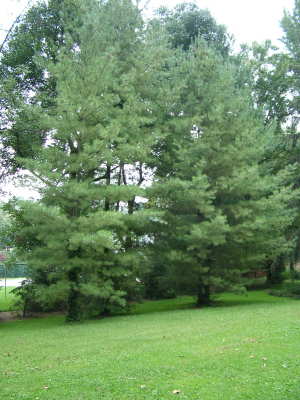
These white pine trees make a great privacy fence in my yard. There are actually four trees that are staggered. The barrier would be ideal if the deer would not eat the tender shoots off the lower branches! PHOTO CREDIT: Tim Carter
To me, evergreen bushes or trees make a gorgeous privacy fence. I have a row of staggered white pine trees in my own yard that create a wonderful sense of privacy. But, if you decide to build a traditional fence with wood or some other material, you can add beauty with flower boxes that sit on top of the fence or hang on the face of the fence that you see. Plant flowers or vines that overflow from the boxes towards the ground so you have a waterfall of color when the plants are in bloom.
If you decide to build a traditional privacy fence, I feel you can do the job by yourself. Each piece of the fencing system is not too heavy, and the process of constructing the fence is not complicated. But wind is your enemy. A privacy fence not built well, can be blown over by strong wind gusts. The main fence posts need to extend into the soil at least 2 feet for privacy fences that are 6 feet or less in height.
If you use wood, be sure to choose a species that is rot-resistant. Otherwise, select wood that has been chemically treated to resist rot and damage from insects. All wood fencing materials should be treated with a synthetic-resin water repellent or painted. If you decide to paint your wood privacy fence, the paint job will last a long time if you paint all pieces of wood after they are cut to length but before they are installed.
If you fully paint all surfaces of each piece of wood used in the privacy fence, water will have a hard time soaking into the wood. Water that gets into unprotected wood is the primary reason paint peels from wood fencing. Be sure to use stainless steel or hot-dipped galvanized fasteners to attach the wood fencing. You don't want rust to spoil all of your hard work.
Before you go to all of the trouble to build or plant a privacy fence, erect a test one to see how effective it will be. This can be done with some old bed sheets and a few temporary sticks that are placed in plastic one-gallon milk bottles filled with water. Do this on a calm day with little or no wind.
The purpose of this is to just show where the starting and stopping points of the privacy fence need to be. Don't hesitate to put a few 90 or 45-degree bends in your design to cut off viewing angles, and to add interest to your design. Picture in your mind those old-fashioned accordion changing screens people used in movies and television shows when actors would change clothes in a scene.
Column 639

Tim built custom homes and did ultra-custom remodeling for 20+ years before launching his Ask the Builder media presence. He was selected as one of the Big 50 by Remodeling magazine in 1993. This award gave birth to Ask the Builder in October 1993. Tim also operates https://DrawPlumbingPlans.com. His @askthebuilder YouTube channel was the first home improvement channel on YouTube.
I recently purchased a property that has a wood privacy along one side of the yard. A property boundry so to speak. No one seems to know who originally erected the fence, is there some visual way of establishing ownership?