Outdoor Fountains
DEAR TIM: Outdoor fountains have always put a smile on my face. But what should I look for in outdoor water fountains now that I am ready to install one? I am most interested in outdoor garden fountains and outdoor wall fountains. How do you make sure you get the right pump to provide just enough water flow? Are there any special things I should do when I install my new outdoor fountain? Marie M., Ocean City, NJ
DEAR MARIE: Fountains and outdoor living go together like a hot dog and a bun. My wife and I have had numerous outdoor fountains over the years, and several still work well each year when spring arrives. These garden accents provide us with great visual and audio pleasure when the water falls and splashes.
There are thousands of styles of outdoor fountains made from a multitude of materials. I have used fountains made from concrete, plastic and dense foam. Metal outdoor fountains and ones made with natural stone can be purchased with little effort.
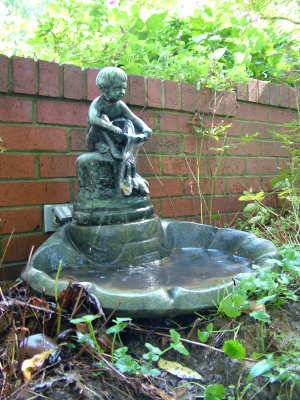
This smaller outdoor fountain is a center point near our lower patio. Its gentle flow of water provides soothing sound, and a great place for birds to get some water. PHOTO CREDIT: Tim Carter
Unless you have an uphill stream on your lot, you are probably going to need electricity to power the recirculating pump that moves the water to the top of the fountain. Once there, it can flow down only to start its journey again and again as the water recirculates. Solar outdoor fountains allow you to use free energy, but remember that you will need batteries to power the pump at night and on cloudy days.
The pumps for fountains are very important. They must be durable, waterproof and sized correctly to match the desired water flow rate. The company that sells the fountain usually provides a pump that is made for the fountain. Many pumps are also equipped with water-flow regulators that allow you to fine tune the water flow once your fountain is set up.
If you live in a cold climate that experiences freezing temperatures, then you need to keep in mind that your outdoor fountain probably needs to be winterized. At the very least, I would consider removing the pump, and bring it indoors where it will not freeze and burst. I would then empty all water from the fountain and either store it a garage or shed or cover it with plastic so it can't refill from rain water or snow melt. Some outdoor fountains can resist freeze-thaw cycles, but others might be damaged. One of the precast concrete fountains I had crumbled in just three years.
Smaller outdoor fountains are easy to install and need little support. Often a level precast-concrete walking-path pad will suffice to give the needed support. But as fountains get larger, not only do they weigh a considerable amount, but so does the water used to fill the fountain. Very large fountains can weigh well over a thousand pounds, maybe more.
These large fountains need a substantial support base made using steel-reinforced concrete. The concrete pad must be perfectly level, and have a foundation that extends below the frost line if you live in a cold climate. Frost heave, in rare occasions, can actually tip over a poorly-supported outdoor fountain. At the very least, frost heave, over time, will make a poorly-built concrete pad unlevel.
If you do not like the look of concrete for the base under your fountain, keep in mind that the concrete can be covered with paving brick or natural stone to give your garden a softer or more pleasing feeling. You can add color pigments to the concrete if you like or buy do-it-yourself stamping kits to add texture while the concrete is getting hard.
Many outdoor fountain pumps require high voltage electric (120 volts or higher) to power the them. Be sure the electric circuit and all outdoor electrical components are installed according to the National Electric Code. Electricity and water make for a lethal mix if the electricity is not treated with the utmost respect. Do not cut corners. Have the work inspected to ensure the safety of you and your loved ones.
Many outdoor fountains are colored with pigments, some of which can fade in the sun over time. When talking with salespeople, ask about color fade. Be sure your fountain comes with a color-fade warranty.
If you would like to use your outdoor fountain during the winter months, and it does drop below freezing where you live, I suggest you look into a heater to help keep the water above the freezing point. I have used a small heater for years in my bird baths that prevents the water from freezing even when the air temperature falls below 0 F. In very cold weather, the water can freeze on the cold surfaces of the fountain and create an ice buildup. Watch for this, and only operate the fountain when the water does not turn to ice.
Be sure to use stainless-steel fasteners when mounting an outdoor wall fountain. Stainless steel will not rust over time as traditional galvanized steel can. Many good hardware stores sell a variety of stainless-steel bolts and anchors.
Column 642

Tim built custom homes and did ultra-custom remodeling for 20+ years before launching his Ask the Builder media presence. He was selected as one of the Big 50 by Remodeling magazine in 1993. This award gave birth to Ask the Builder in October 1993. Tim also operates https://DrawPlumbingPlans.com. His @askthebuilder YouTube channel was the first home improvement channel on YouTube.
I am having trouble finding a solar water pump for a small water feature wee are wanting to install. Where would you suggest I look to purchase one?
I prefer to look for things like this at Amazon.com.