Installing Cement Backer Board
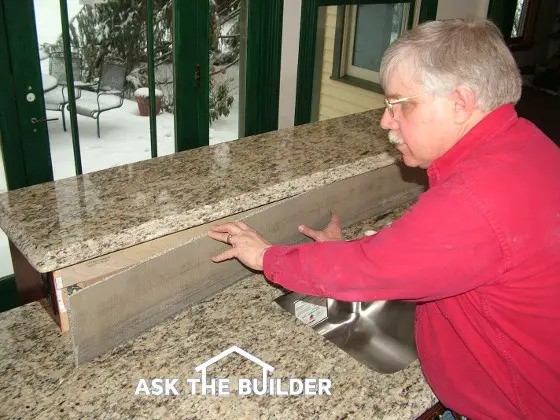
"But when it comes to tile and what it should be applied to, I feel that cement might be the standard to a large degree. Cured cement is not damaged by water. You can immerse a piece of cement board in water for an indefinite amount of time, and it will never fall apart."
Backer Board Install Is Something You Can Do
- Backer board is waterproof
- Wall must be flat and in the same plane
- Different easy-to-cut products
- Leave a gap between pieces and caulk
DEAR TIM: I have a ceramic-tile job coming up and want to use cement backer board. I have never installed this product before, and wonder if it is really worth it.
It seems hard to work with and I'm tempted to just use a water-resistant drywall. Is cement backer board really worth the trouble? What tips can you share to make the job go easier and faster? Jackie L., Pleasant Hill, CA
Related Links
Top Tips for Working With Cement Backer Board
Step-By-Step Fast Cement Backer Board Installation
Free & Fast Bids
CLICK HERE to get FREE & FAST bids from local contractors to install your backer board.
DEAR JACKIE: There are all sorts of different tile backer board products out there. Some are cement-based, some are gypsum-based and others have a mix of ingredients. The cement-backer-board products can be a little tough to work with during the installation process, but in my opinion, they pay you back in spades for the effort.
Is Backer Board Better Than Other Products?
I am not against new technology when it comes to building products. There are countless examples of where a new product is much better than existing products. Plywood and oriented strand board (OSB) are excellent examples of this. Before plywood and OSB, carpenters used to deal with smaller pieces of wood that were not as dimensionally stable as plywood and OSB. Plywood and OSB also makes very good use of wood as a natural resource.
But when it comes to tile and what it should be applied to, I feel that cement might be the standard to a large degree. Cured cement is not damaged by water. You can immerse a piece of cement board in water for an indefinite amount of time, and it will never fall apart.
Cement board is MUCH BETTER than green board. Green board is a gypsum product. It's drywall that has some silicone in the core and a more water-RESISTANT paper. It WILL FALL APART over time.
Is Backer Board The Same As The Cement Mud Of Old?
There are tens of thousands of ceramic-tile installations all over the world that are hundreds of years old that are still in great shape. Almost all of these are installed directly over concrete or some cement-based material. Many older homes still standing in the USA have ceramic tile firmly attached to cement stucco that was applied over wire mesh by true craftsmen.
All that being said, there are indeed other high-performance backer boards for ceramic tile. This past summer I decided to test a newer one in my daughter's bathroom. It has a rough fiberglass face and a waterproof gypsum core. It was easier to cut than cement backer board, but the installation of the product to the wood studs was the same as far as I was concerned.
Does Backer Board Need to Be Flat?
If you want a gorgeous ceramic-tile job, you need to be sure the backer board is in the same plane and the walls are perfectly plumb. In the old days, the tile setters installing the wet cement stucco took the time to get the stucco perfectly plumb and flat, even if the wall studs were crooked, bowed or bent.
CLICK HERE to get FREE & FAST bids from local contractors to install your backer board.
With modern cement backer board, you must get the framed walls perfectly plumb and flat. Since the cement backer board is thin and a uniform thickness, when you attach it to the studs, it simply conforms to the shape of the stud wall. This means twisted, out-of-plumb frame walls will lead to twisted, out-of-plumb ceramic tile. No one wants that.
How Do You Cut Backer Board?
The cement backer board can be cut with a circular saw with an abrasive blade, but that process creates clouds of choking dust, and can cause great damage to the saw motor. You can score the cement backer board with a hand tool that has a carbide tip. You make numerous passes along the cut line, and then apply pressure to the other side of the cement backer board along the scored line. It usually snaps the backer board in two quite nicely along the desired line.
Do You Need A Waterproof Membrane Behind Backer Board?
I also recommend a water-resistant barrier between the backer board and the wall framing. You can put overlapping layers of asphalt felt paper or go with a large sheet of plastic commonly used for a vapor barrier. This layer helps protect the wood framing from wood rot in that rare case where water would soak through the cement backer board.
When installing the cement backer board, I like to leave a 1/8-inch gap between pieces. This gap is then filled with pure silicone caulk before the ceramic tile is installed. I never allow the cement board to rest on top of a bathtub edge. If water gets to the cement board, capillary attraction can cause water to wick up into the cement backer board. I always leave a 1/4-inch gap between the top of the tub and the bottom edge of the backer board.
How Do You Fasten Backer Board To Walls?
The cement backer board can be screwed or nailed to the wood framing. Always follow the instructions printed by the manufacturer. I use hot-dipped ring-shanked nails if I am nailing. Corrosion-resistant screws can also be used. You need to make sure the cement backer board will never fall off the wall at a later date. Inferior fasteners can cause catastrophic failure if they rust.
CLICK HERE to get FREE & FAST bids from local contractors to install your backer board.
Column 661

Tim built custom homes and did ultra-custom remodeling for 20+ years before launching his Ask the Builder media presence. He was selected as one of the Big 50 by Remodeling magazine in 1993. This award gave birth to Ask the Builder in October 1993. Tim also operates https://DrawPlumbingPlans.com. His @askthebuilder YouTube channel was the first home improvement channel on YouTube.
im going to be tiling ceramic trying to make 2 rooms into one first has wood subfloor other was an addition at one time has concrete floors i was thinking about putting backerboard over entire floor before tile do you think i can scew down backer boards to the concrete with the proper screws this way my floors will be level
Anthony,
Way too much to type. You need my 15-Minute Consult.
The top of my tub has a flange on it. This flange curves into the top of the tub and therefore is not perfectly straight. When you say "I always leave a 1/4-inch gap between the top of the tub and the bottom edge of the backer board." does this mean leave a gap between the backer board and the top of the tub or leave the gap between the backer board and the top of the flange? I am afraid of going over the flange because I want to put shower doors in and need this to be as square as possible.
Chad, you need to schedule a 15-Minute call with me. There's simply too much to talk about and type.
Hello everyone. I have a quick question. I'm remodeling my shower and the contractor I hired decided to add a paper sheet called Aquabar B ( is a moisture vapor retarder ) on the stud walls. After that he put a cement layer on it, and he 'll finish with other 2 coats of cement and then tiles. In my opinion ( but I'm not a contractor ) I think a cement backer board is necessary between paper and the cement for the tiles. Does anybody have advice? Thank you so much
Marco, your question requires lots of typing, plus I have some questions for you so I can give you the correct answer(s). I only do pithy answers here in the comment section. If you want to protect the investment you have in your house and not waste time or money *hoping* you make the right decision, you should talk to me on the phone for just 15 minutes. It'll be the best investment you've ever made in your home!
Can I glue cement board to a concrete floor to cover old adhesive?
I have installed cement board over metal studs to tile around a fireplace. But my concern is that the cement board seems to have flex to it. Do I need to remove the cement board and sturdy up the framing somehow or does cement board have natural flex? If I need to sturdy up the wall, what would be the best way?
We are replacing the tile in our bathroom. It is on the 2nd floor so it is over wood flooring. We are removing the old mortar and planned to use cement boards. Do we need to pull the wire mesh before we lay down the cement board or can we lay them down over the wire mesh?
The cement board must be on a solid surface in the same plane. Read ALL of my cement board columns please.
This site is very informative.
Yet I have an unusual question about re-applying some tile over a new piece of cement board I put in place of a section of old backer-board I cut out because it was rotted about half a foot up the wall near the back-end of my tub. The new piece of cement board I installed is 30" wide all the way to the corner of my shower wall. I removed four rows of 4"x4" tile upward from the back wall of my shower.
I must admit, that I never intended for this job to become what it is now, since initially, I wanted to remove and replace the old moldy caulking from around the edge of where my tub meets the tile wall, however, once I noticed the rot behind the tile and tugged at it only a little bit, it started coming loose. That is why I cut-out the tile and old backer-board about a foot and a half up the wall, because I thought it would be useless to simply apply new caulking, only to have the same problem again down the road.
To be fair, I know that a bathroom this old, should probably be completely re-done, however I just don't have the money to invest in that right now, but now that I come this far, I'm just hoping to make this smaller repair as complete as possible until that time comes.
I've already attached the new cement board to the studs (making sure of course that there is about a 1/4" space at the bottom between the board and tub), however, I've noticed a rather unique thing-------that part of the wall has bowed outward in the middle (not a whole lot, but enough that where the new seams meet (between the old backer board and the new board I installed), the old backer-board protrudes about an 1/8" of an inch past the new board underneath it. This protrusion spans about one foot horizontally across this seam.
My question is this:
Could I simply place a couple of layers of seam-tape over the top section of the new cement board near where it meets the old backer board to make up for this small difference, or is that not a good idea? Would it cause integrity problems with the tile adhesive by double-layering the tape on this small section of the board?
FYI: (I'm not talking about taping over a seam, but across the top section of the new cement board where it meets the old board but un-evenly.)
Any insight would be much appreciated.
Jeff
August 31, 2015
Hi…I have installed the hardibacker in my stand up shower (it is embedded 1/2 inch into deck mud..sorry…I know this no longer recommended but I used an outdated diagram from Oatley (slope is great though). However, my plumbing fixture comes out almost 1/2 inch too far, so the handle piece will not press close enough to the cover plate once it is tiled (my fault). Can I add a second layer of 1/4 inch backer board to that wall using longer backer on screws? I guess my other options would be to remove the board (which is embedded…ugh) and add furring strips to studs and redo..or last resort change the plumbing. Recommendation would be greatly appreciated! Thanks
recently purchased a new home. the builder installed ceramic tile in the bathrooms and kitchen, but did not use any backer board. What problems can we expect to see over the years?
Is "Green Board" the same thing as cement board? Which do you recommend for the horizontal surface for the top of a ceramic tile covered barbecue outside cabinet.
Thanks
No. Green board is a gypsum product.
Use cement board for all outdoor applications.
Can I put 1/4 inch foam panels behind 1/4 inch cement board? One of the walls of my shower is an exterior wall, and get extremely cold in the winter.
You can do whatever you want. You get ONE CHANCE to get this RIGHT. Go to the following page and READ what Bill has to say. It's just below the bullet list:
https://shop.askthebuilder.com/15-minute-phone-or-video-conversation-with-tim/
What do you do/use to get the walls perfectly flat? I am adding a shower into an existing building and the studs are not all flat.