Undermount Kitchen Sinks
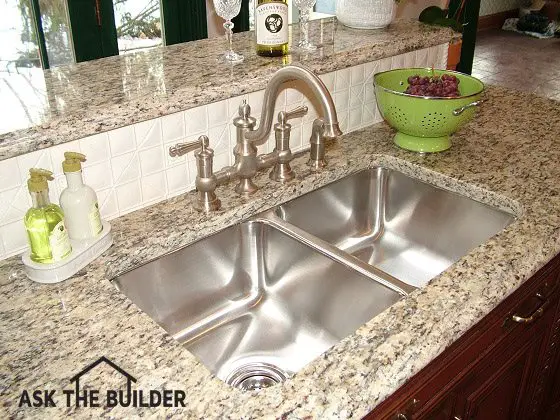
Undermount Sink Installation | This is my own undermount kitchen sink at my own home. My wife loved this countertop and sink. We sold the house and moved to New Hampshire. It's harder to install the above sink than it is to install a wall-hung sink bracket. © 2021 Tim Carter
"I think it's reasonable for a person to wonder how in the world the sink will stay permanently attached to the countertop with this kind of weight regularly trying to pull the sink down into the base cabinet."
Undermount Kitchen Sink Checklist
- Sink anchors epoxied into underside of countertop
- Bad installers use caulk
- Wait one day before installing strainer, disposer and drainpipes
- WATCH my Sink Strainer VIDEO Below
- CLICK HERE to Get Tim's FREE & FUNNY Newsletter
DEAR TIM: Are undermount kitchen sinks a good idea? I have never had one, and am worried about leakage where the undermount sink contacts the underside of the countertop.
I want a granite undermount kitchen sink, but am worried the sink will pull away from the granite countertop. This would be a nightmare, especially if the sink was filled with water.
What undermount sink installation tips can you share that will allow me to buy one with complete confidence? Christy F., Flemington, NJ
DEAR CHRISTY: The first thing I can tell you is an undermount kitchen sink will give you a lifetime of leak-free performance if it is installed correctly. I have several undermount sinks in my own home, and they simply do not leak where the sink touches up against my granite countertops.
Related Links
Repair an Undermount Kitchen Sink With Ease
Stainless Steel Sinks Are Superb
It's important to note I felt the same way you did about undermount kitchen sinks. It was the plumber in me that made me a Doubting Thomas. After all, a standard double-bowl sink that has a disposer on one side and is completely filled with water weighs well over 100 pounds.
I think it's reasonable for a person to wonder how in the world the sink will stay permanently attached to the countertop with this kind of weight regularly trying to pull the sink down into the base cabinet.
CLICK HERE to Get FREE & FAST BIDS from local countertop installers.
How is the Undermount Kitchen Sink Attached?
High-strength epoxies, anchors and clips, and silicone caulk are used to attach the sink to the underside of the stone tops.
The undermount sinks are held in place with metal anchors that are glued to the underside of the stone with a two-part epoxy that cures rapidly and has incredible tensile strength once cured.
Furthermore, a bead of silicone caulk helps bond the sink to the stone to prevent water leaks between the sink and the underside of the countertop.
What is a Great Epoxy to Use?
PC-7 is a great epoxy that will not sag or drip when installing the anchors to the underside of a stone countertop. Remember, blow out all the dust from the holes before applying the epoxy.
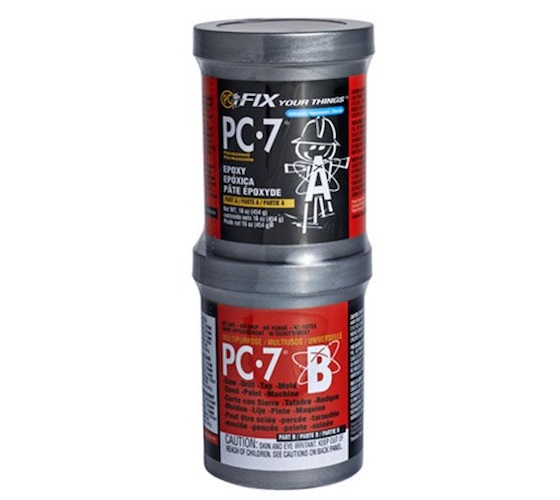
I've used epoxies made by this company for both inside and outside projects. PC Products makes a superb epoxy right here in the USA! CLICK THE IMAGE TO ORDER SOME NOW.
Does the Stone Need to be Dust-Free?
Another key point is to make sure the underside of the stone countertop is dust-free. Dust will cause the epoxy bond to fail.
Any installer worth his salt will take a brush to remove stone dust from underneath the countertop. Dust in this location is a strong possibility because of the cut made to create the hole for your sink.
How is the Sink Cutout Created?
It must be remembered the granite countertop fabricator had to cut a special-shaped hole in the stone top to create the hole for your undermount sink. The undermount sinks come with a cutout template that's traced onto the stone.
Once the cut is made, the fabricator has to polish the rough stone edge.
What Generates the Thick Dust Under the Top?
Cutting out the hole for the sink and polishing the edge generates thick dust under the top.
The water that is used during the polishing process gets very small pieces of stone in it, and this slurry can roll to the underside of the countertop. Once the water component of the slurry evaporates, the stone grit or dust is left behind.
There's no real standard as to how much overhang the stone should be beyond the actual sidewalls of the sink. I always tried to have no less than 1/8 inch for an overhang and certainly no more than 1/4 inch.
CLICK HERE to Get FREE & FAST BIDS from local countertop installers.
Will Caulk Hold a Sink In Place?
No, caulk is not to be used as the adhesive to hold the sink to the stone. Caulk is just used to create a waterproof seal between the sink and the stone top.
Most undermount sinks come with very clear written installation instructions. Every set of instruction I have seen calls for a bead of clear silicone caulk to be placed around the flat lip of the undermount sink. This continuous bead of caulk acts as the waterproof seal between the sink and the countertop once the undermount sink is pressed permanently against the stone countertop.
Every month or so I get an email from a homeowner who's undermount sink has crashed down into their cabinet. Each autopsy report shows the idiot installer cut corners and just used caulk to hold the sink. They never bothered to use anchors and epoxy.
How Long Does it Take To Install the Sink?
Most professional installers can install an undermount kitchen sink in 30 minutes or less. The tools required are a 2x4 longer than the sink cutout is wide, one or two bar clamps, the special two-part epoxy and the caulk and caulk gun.
Once the installer knows the underside of the stone top is dust-free, he applies the silicone caulk to the sink lip. The sink is then pushed up against the underside of the stone top and centered under the polished cutout.
The 2x4 is then placed on top of the countertop spanning across the sink. One end of the bar clamp goes through the large drain hole in the sink and the other end goes on top of the 2x4. A double-bowled sink needs two clamps, one for each drain hole.
The clamps are partially tightened and the reveal of the sink is checked to make sure it is even around the entire cutout of the granite. The clamps are then fully tightened.
It's now time to mix the two-part epoxy and apply it to the small bolt posts that are glued next to the lip of the undermount sink. The installers are on their backs in the sink base looking up when they do this.
What are Different Undermount Kitchen Sink Anchors?
There are several types of anchors that can be used to mount an undermount sink. One type you have to drill holes for.
Another anchor has a wide round base at the bottom of the threaded stud. This base has holes in it that allow the epoxy to ooze through. These are very good if you make sure the underside of the stone / granite is dust-free. Here's a good example of this anchor. CLICK HERE to see all the different types of anchors.
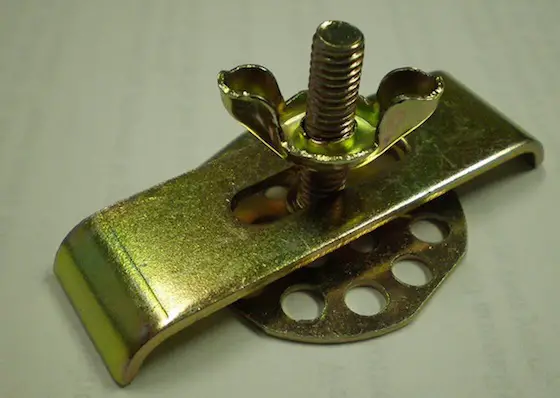
This is a common undermount sink anchor and clip. You can see the round base of the threaded stud. Use this type with the PC Products epoxy above. CLICK THE IMAGE TO SEE MANY ANCHORS.
The epoxy sets rapidly, usually in ten minutes or so. After this wait period, the rest of the hardware that clamps the sink to the bolt posts is installed. It is good to wait at least one day before the plumber arrives to connect any drain piping or a heavy disposer to the undermount sink.
Before the drain piping is attached to the sink, it is wise to tighten the nuts that hold the clamps in place. Do not over tighten. Simply make sure they are snug. The adhesive properties of the silicone caulk in conjunction with the epoxy hold the sink permanently in place.
How Long Should the Epoxy Cure?
The epoxy should cure at least 24 hours before you apply tension forces to it.
The biggest mistake you or an installer can make is trying to rush the job. All too often an aggressive plumber, remodeler or homeowner will try to finish the entire job the same day.
They will wait six or seven hours thinking the epoxy is plenty hard, only to discover that the weight of a heavy disposer pulls the sink away from the countertop.
The bolt posts and nuts are not common items found at hardware stores or online. CLICK HERE to see a wide assortment of great undermount sink anchors.
Is There a No-Epoxy Method to Install a Sink?
There's another way to support an undermount sink and it doesn't involve using epoxy. The undermount sink is supported by a wire harness that's snugged up against the bottom of the sink using an ingenious drawbar.
It's called the Hercules Universal Sink Harness Kit. CLICK HERE to ORDER IT NOW.
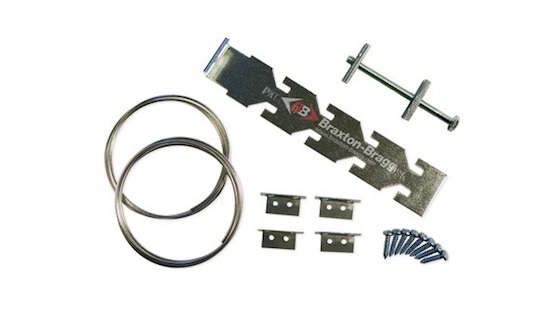
Here are all the parts for the Hercules Universal Sink Harness Kit. You just need a simple screwdriver and a wrench to install it. EASY! CLICK THE IMAGE TO ORDER ONE NOW.
Hercules Universal Sink Harness Install VIDEO:
CLICK HERE to Get FREE & FAST BIDS from local countertop installers.
Column 662

Tim built custom homes and did ultra-custom remodeling for 20+ years before launching his Ask the Builder media presence. He was selected as one of the Big 50 by Remodeling magazine in 1993. This award gave birth to Ask the Builder in October 1993. Tim also operates https://DrawPlumbingPlans.com. His @askthebuilder YouTube channel was the first home improvement channel on YouTube.

We need to remover our undermount sink and replace it. Our countertop is silestone and we hoping to do this ourselves. How do we accomplish this.
Ellen,
By invoking my 15-Minute Consult. Far too much to type.
My contractor is going to install a very heavy cast iron double sink in my new house.
The countertops will be 5/8" plywood with 2cm Silestone over top.
What kind of reinforcement should we do before the installer comes?
Our cabinets are maple and well made but I dont' think they are sturdy enough.
Gloria,
You'll be fine. I see no issues at all. I've installed countless cast-iron sinks like this as you describe and have never had a problem.
Hi,
My stainless stell under mount sink came unglued from granite counter top on one side. I wanted to reglue the sink with 100% Silicon by scraping off the old glue. My question is, if the job is properly done will I see the same issue infuture? If this method if ok, then how do you suggest I support the sink from below while the silicon is adhering?
Thanks for your time.
Roopa, your question requires lots of typing, plus I have some questions for you so I can give you the correct answer(s). I only do pithy answers here in the comment section. If you want to protect the investment you have in your house and not waste time or money *hoping* you make the right decision, you should talk to me on the phone for just 15 minutes. It'll be the best investment you've ever made in your home!
I want an undermount sink. I started paying attention to undermount sinks in other peoples homes and business. I've noticed the seal looks messy in every single one of them. By messy, I mean there's not a smooth seamless feel to the sillicon seal. Is there a way to make sure I get a seamless feel, or is that just the nature of the beast?
Leata, your question requires lots of typing, plus I have some questions for you so I can give you the correct answer(s). I only do pithy answers here in the comment section. If you want to protect the investment you have in your house and not waste time or money *hoping* you make the right decision, you should talk to me on the phone for just 15 minutes. It'll be the best investment you've ever made in your home!
why is our undermount 33" cast iron sink now [after granite counters were installed] only 28 3/4"?
Eileen, your question require lots of typing and I have some questions for you. You should consider investing in a 15-Minute Consult with me. Look at my cart for that. Lot's to discuss. I just do short pithy answers here.
Hi,
We just purchased a 32in undermount sink from Amazon. We are getting new granite counter tops. Anyway, the cabinet is 351/2 inches wide, and I was looking at the specs later that said a 36" cabinet is required. Will the installer be able to modify or do we have to get a different sink? Would appreciate your help. This will be a hassle and the timing is not good.
Tim, you should consider investing in a 15-Minute Consult with me. Look at my cart for that. Lot's to discuss. I just do short pithy answers here.
Hi,
I have a white porcelain undermount sink, but I want to replace it with a stainless steel undermount. Is it possible to replace it without damaging the granite countertops and cabinets?
Denise, Walter, this is what my 500-Second Consult is all about. Click the Shop icon at the top of the page!
I have an under counter
sink in my bathroom with granite counter held by epoxy. The sink fell out. Should clamps have been used?.
Yes. Read my past column on this and watch my video.
Just replaced our stainless steel,sink that fell off of granite! Silicon dried up and rotted away. Put the board across counter top with the clamp on through the sink hole. Now we have a dent In sink from clamp being too tight. What's the best way to remove this dent. It's right in front of sink hole. It's more like a "bubble" effect then a dent. No crease in sink either.
Same problem here. Using clamps to hold the sink up is terrible advice. The bottom of a stainless sink is not strong enough to prevent a reverse dent. Prop it up with some wood from underneath while the silicone dries.
can you recommend a fabricator in the chicago area. My sink is separating from the granite countertop. There are so many advertisements, but I'm not so sure. I've had a lot of bad experiences in the past.
Rose Scott
I don't know fabricators, but I know how to find the best one. Look at the Hiring Guides in my shopping cart. CLICK the SHOP icon at the top of this page.
My under mount sink just pulled off the countertop. Of course, it was full of water but miraculously, not a drop spilled. House is 9 years old. Good help was hard to find back then. Not a happy camper!
My undermount sink (attached to granite) is leaking. The seal is starting to fall out. (I found this out after the plumber charged $400 for a new garbage disposal that was not the problem.) Is there a way to reseal it ourselves? It looks like the installer did not use brackets. Instead there are wood shims glued around the edges to reinforce the mount.
Take the sink out and put it in the right way. Any attempts to seal it with it flexing all the time will be futile.
Hi,
I have just had a plumber around who said it is very difficult to remove a sink stuck to granit by glue. I seemed a little opposed to the idea, as surely there are thousands, if not millions of sinks built like this. Surely its a case of just being careful removing the glue. Additionally is there some sort of spirit that may be able to melt it.
I guess are the telling the truth, or should i look for a new plumber!
(in the UK btw)
Thanks
We had a granite particle double sink installed in the kitchen when counters were replaced with a solid counter top from the local Big Box store. Not granite, but the solid surface stuff made from particles in a base of...something. This was done about 10 yrs. ago.
This morning, I came down to the kitchen & found my under mount sink was only attached at the front, was hanging down from the counter underside in the back by about an inch. The heavy clips had fallen down, the caulking was separated.
I sure hope this can be fixed to STAY fixed!
I have an old Kohler cast iron deep 3 bowl DROP IN sink that I do not want to part with. I am in the process of purchasing quartz countertops and was wondering if my sink can be used as a drop in rather than top mount.
Hey,
I was looking for something very similar to this. Glad i stumbled upon this Blog. Very Informative. Thanks.
We want to use formic in our kitchen because of the available integrated back splash (solid surface has it as well but scratches to easily ), to be used with an castiron undermount kitchen sink. We've been told that you can't do that, why not? Ando can the reason be overcome.
The problem with undermounting a sink from a formica countertop is the exposed edge of the whole that will be cut in the counter. The formica material is only about 1/8th of an inch thick and it is glued to a plywood substrate about 3/4" thick. The plywood will be exposed from the cut out and there is no technique I am aware of for covering the plywood - both for protection from water and for aesthetics.
Hi, I looked everywhere for a 3 bowl white sink, finally found one in USA. Now I find that it may be too deep for standard 600cm worktop, it is 2ft deep and the granite cutters say no can do. Is it really impossible 🙁
I recently purchased a large composite granite undermount sink that was installed with my new quartz counters. I believe they installed correctly with the clamps and hypoxy. I have noticed over the last year that the sink is starting to show a crack. It feels like a scratch but it is getting longer (toward the side the disposal is on). Should this have been installed with built up support as well? Should I try to reinforce with wood support under the sink and fix the crack with a white epoxy? Hoping to save the sink and my counters if possible!
I would have absolutely installed a crib to hold the sink. Watch my two videos about installing my own apron sink that's similar:
http://www.askthebuilder.com/apron-sink-video-part-1/
and
http://www.askthebuilder.com/apron-sink-video-part-2/
We are having a Wilsonart laminate counter fabricated with a Karran Edge320 undermounted Stainless steel sink. I am concerned since this is a new product. Do you have any experience with them and are there any things we need to know to ask either the fabricator or the installer? The counter will be delivered with the sink already attached to it and we will have a contractor place it on the cabinet.
And does the Wilsonart warranty specifically say it's OKAY to install und undermount sink to it? How do they protect the wood core from water damage and swelling? Do you have it in writing that's it's okay to do this and have you read the Wilsonart written instructions to see HOW to properly do an undermount sink - assuming they say it's OKAY?
I turned my water off on the side of my house that goes into my house not from the street and as I turn it back on we haven't had water from any of the faucets in the house all day now I'm wondering if it's because my kitchen faucet is not connected yet and there's a huge pipe that goes from that into my wall or cabinets?
Tim,
We have been using the Universal Sink Harness on our stone/quartz top installs for years at Nisbet Brower. They're great, an awesome job. I have not seen fail.
Keep up the great work! Happy New Year!!
Kind regards,
Kevin
Our under mount kitchen sink is fine. The caulk? Is starting to peel away. What’s the best to use to replace?
My under-mount sink was installed by Larry, Mo and Curlie, Inc. It failed within the first year. What is the best way to remove the residual silicon caulk stuck to the bottom of the granite? I addition, I think they used some polyurethane caulk during one of the attempted repairs. How do I clean this off the bottom of the granite as well?
Thanks,
Steven Mathews
806-239-3939