Solar Powered Attic Fan
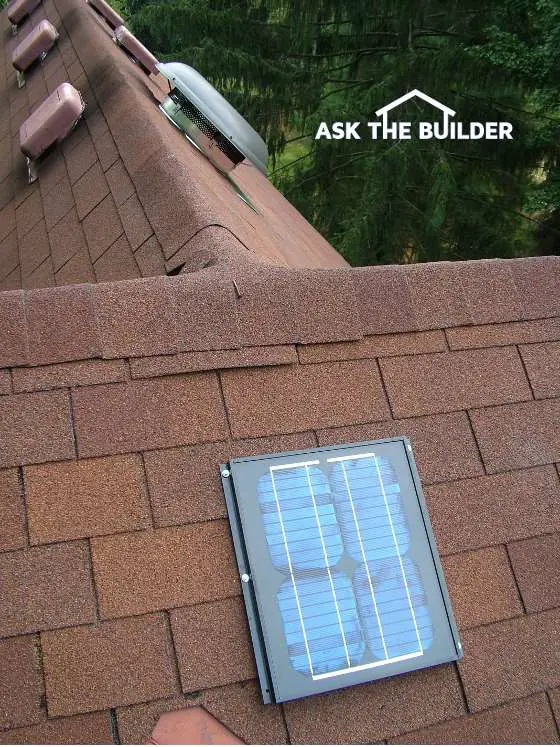
This solar panel produces enough electricity to power a spinning fan in the round ventilator on the roof at the top of the photo. See it? But the fan only works when the panel is basking in sunlight. The fan does not lower the temperature in the attic at all. I feel solar fans are a waste of money. Copyright 2018 Tim Carter
"But after seeing my solar-powered attic fan work, I have a long list of cons."
Solar Powered Attic Fan Checklist
- fans don't move lots of air
- fans slow down or stop when most needed
- there may never be an ROI!
In Tim's July 7, 2019 Newsletter, he ponders on why solar-powered attic fans are, for the most part, hype and a classic case of an emotional fuzzy-feel home improvement purchase in all too many cases.
DEAR TIM: My attic space gets as hot as blue blazes. I saw an advertisement for a solar-powered attic fan and that seems like a great way to remove heat and reduce my carbon footprint.
Do these fans really work, and are they hard to install? Will the fan significantly reduce the temperature inside my attic? What are the pros and cons to these solar attic fans? Brad L., Phoenix, AZ
Related Links
Turbine Vents Best Vents of All
Cool Your Attic FAST - DO NOT SHARE - Secret Info Here
DEAR BRAD: I installed a solar-powered attic fan last year to see how well it would work. The installation went like clockwork.
When is The Best Time to Install the Fan?
I had decided to do the work early in the morning while it was cool on the roof. Within an hour after installing it, the sun hit the solar panel and the fan blades started to spin. It was almost magical to see the solar attic fan work.
You're a pretty clever guy to get the sun to do double duty. It makes perfect sense to make the sun cool your attic space, since it is the source of the problem in the first place.
Free & Fast Bids
CLICK HERE to get FREE & FAST BIDS from local attic fan installers.
Are Solar Attic Fans Really Earth-Friendly?
As for reducing your carbon footprint by not using electricity from a power plant, I can't tell you if the solar fan you might buy will be that environmentally friendly. The manufacturing process used to make your solar fan might actually be quite carbon positive. But in any event, you might be doing the right thing by trying to use a solar-powered fan.
Are There Pros and Cons to Solar Powered Attic Fans?
There are pros and cons to solar-powered attic fans. Here's a list:
- they work for free using the suns rays
- they do exhaust some hot air
- the solar fans do not require the services of an electrician to connect
- they are also very quiet
What are the Cons?
But after seeing my solar-powered attic fan work, I have a long list of cons:
- My fan only works when it is getting direct sunlight on the solar panel
- If a cloud drifts through the sky blocking out the sun, the fan stops spinning immediately
- As the sun sets, the attic is still hot and my solar fan stops spinning
- The fan I have moves only 800 cubic feet of air per minute (CFM) when the sun is shining directly on the solar panel
Does the Fan Spin at Different Speeds?
Yes, the solar powered attic fans spin at different speeds.
If the angle of the sun is lower in the sky (morning and late afternoon) or the sun's rays are trying to cut through thin clouds or haze, the fan spins slower moving less air.
The single solar-powered attic fan I have has not lowered the temperature in my attic at all. I took precise before and after temperature readings.
How Much Air Must Move Through the Fan To Cool an Attic?
To significantly reduce the temperature in your attic, you need thousands and thousands of cubic feet per minute (CFM) of air moving through the attic space.
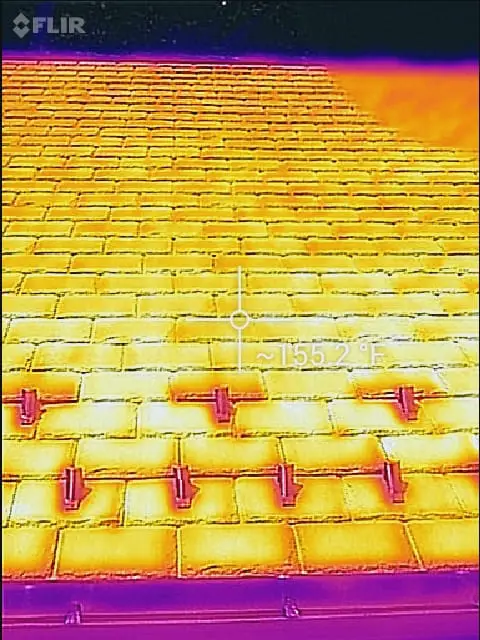
This is an infrared photo of my own roof. See the white crosshairs and temperature reading? 155F That's blazing hot and it's possible it can go as high as 170 F. The entire inside of the attic can reach this temperature. Copyright 2018 Tim Carter
What's more, this air needs to continue to move through the attic space after the sun sets to remove the residual heat from the roof framing lumber, roof sheathing, roofing materials, and the attic insulation. Yes, the insulation in your attic gets very hot during the day and then holds that heat long after the sun sets.
Chicken growers know all about this. Chicken farms in any area of the world that gets hot MUST HAVE enormous fans moving tens, perhaps hundreds, of thousands of CFM of air through the growing houses to keep the chickens alive in hot weather.
It's all about moving vast amounts of air in your attic if you want to lower the temperature inside your attic space. Period. Solar-powered fans don't do this.
CLICK HERE to get FREE & FAST BIDS from local attic fan installers.
How Hot is it in an Attic?
Attic temperatures in the summer on a hot day can easily get to 140 F. In late June early July with the sun passing through the least amount of atmosphere in the Northern Hemisphere, an attic could get up to 160 F, or more.
How Many Solar Fans Do I Need to Cool my Attic?
If you are going to go solar, I urge you to by several solar-powered attic fans. You will need them. You may need fifteen or more to move thousands of CFM of air through your attic.
Where Should the Solar Panel be Located?
The solar panel should be located away from the actual fan. In the Northern Hemisphere, you want the solar fan pointing due south.
My solar fan has this neat feature. This allowed me to put my solar fan on the rear portion of my roof so you don't see it from the street, while the solar panel is on the part of my roof that faces due south.
Should the Fans be in Direct Sunlight?
You want the solar panels located on the roof where they will not be shaded by trees, and where they will get direct solar power from Noon until sunset. This is the hottest part of the day, that part where you need the fan blades spinning at full speed.
Do I Have to Cut a Hole in My Roof?
Solar-powered attic fans require a hole to be cut in the roof, possibly two if you purchase one that has the remote-panel location feature. If you do not know how to properly flash these fan housings into the roof shingles, then you should hire a qualified roofer.
It's not hard to do the work, but there are very important steps that must be followed to have a leak-proof installation.
Do These Fans Require Caulk?
When installed properly on a roof with standard asphalt shingles, solar-powered attic fans do not require caulk, roofing cement or any other product to prevent leaks. A great roofer will cut the shingles and lace the fan housing into the shingles so that rain will stay outdoors where it belongs.
How Much Air at a Minimum Needs to Move Through My Attic?
If your attic space is over 1,800 square feet, you will need enough solar fans to move 8,000 CFM. You need that amount of air, if not more, to get any sort of cooling benefit from the fans.
Intense sunlight can create heat faster than one or two small fans can cool an area. If you want to see how to properly cool attic spaces, visit a chicken farm. These farmers use giant fans that move tens of thousands of CFM of air that keep the chickens alive.
CLICK HERE to get FREE & FAST BIDS from local attic fan installers.
Column 676

Tim built custom homes and did ultra-custom remodeling for 20+ years before launching his Ask the Builder media presence. He was selected as one of the Big 50 by Remodeling magazine in 1993. This award gave birth to Ask the Builder in October 1993. Tim also operates https://DrawPlumbingPlans.com. His @askthebuilder YouTube channel was the first home improvement channel on YouTube.

I sell whole house fans, not solar fans, and not radiant barrier. But I have personal experience with the power of radiant barrier. I installed 500 square feet under 1/4 of my roof and the change was dramatic. The bottom side of the roof was 102 degrees at 11 AM in July last year.After installing the atticfoil.com radiant barrier the temperature on the underside of the barrier (stapled to the bottom edge of the rafters) was 85 degrees! It is a bargain at about 15-20 cents per sq ft.
Also, one whole house fan can dramatically reduce attic temps and cool the attic at night for very little cost.
Kurt, I've written extensively about radiant barriers here at the site. They work GREAT at first, then their performance diminishes significantly as they get DUSTY. So watch what happens over time - unless you have a plan to keep the barrier dust-free in your attic.
When I brought this topic of radiant barriers up with some friends, one person mentioned that they may well cool the attic space, but the reflection back to the roof materials may in fact cause premature failure of the roofing materials. Have any studies been done on this? The idea intrigued me, but truthfully, the logic of the intensity of the heat being concentrated on the roof itself concerns me even more. Any source materials (3rd part preferably) you can point me to would be greatly appreciated. Thnx!
Google P2000 reflective insulation. Someone in the Maritimes, Canada, installed 5/8th" P2000 on the outside of his roof, strapped it with 1x4s and layed metal roofing on top. He cut his electric bill in half on his 3500 sq.ft house with a cathedral ceiling. If you can find it on their website, check it out under testimonials. You will also find my name there too. I live in Manitoba where the winters are COLD. I have only 1" of P2000 for attic insulation, for 9 years now, and my total electric bills range from $1700 -$2200 per year. I heat a total of 2900 sq.ft ( 1420 on main flr) using GeoThermal. Very satisfied; very comfortable during both heating and cooling seasons.
Perhaps you aren't aware of Thermal Control Membrane (TCM) by the Arizona company SaveNRG.com. It comprises a triple layer of radiant barrier with a separation grid between the layers. It has a lifetime guarantee for no performance degradation. When the top layer gets dusty, there are still two more layers which cannot get dusty because they are protected by the top layer.
I have had this in our attic since 2007, and here in the Phoenix Arizona area the summer sun is intense. The radiant barrier has made an important difference. The radiant barrier should not be fastened to underside of the roof because it will exacerbate the deterioration of the roofing due to increased temperatures because the radiation is reflected back into the roof.
With the radiant barrier on top the other (fiberglass, etc) insulation above the ceiling the radiation is reflected back into the attic, heating the air. Therefore, it is important to have a powerful attic fan to remove the heated air that is being reflected up by the radiant barrier because it can't get through the ceiling. As the air mass above the radiant barrier becomes hotter, heat will begin to enter the rooms below via thermal conductivity, rather than radiation. With the good ventilation by a powerful attic fan, the temperature of the air in the attic has never exceeded ten degrees above the ambient outside air. I have a remote thermometer in the attic to monitor the temperature there. The attic fan is controlled by a thermostat set to turn the fan on when the temperature reaches 108°F Setting it lower would cause the fan to run too much of the time.
With the radiant barrier on top of the insulation above the ceiling, moisture can be trapped in the insulation. I would be very concerned about that.
In Newnan, GA I prefer continuous ridge vent and same on soffit.
A few years ago UL did a evaluation & determined that attic fans could cause negative pressure in the attic and then draw conditioned air from the house.
Those a/c powered attic fans require the motors to be lubed with oil. . . now who is going to do that.
I think passive ventilation is best.
It makes me go into paroxysms of distress whenever I see one of those HGTV shows making a attic into a room and spray foam insulation into the rafter cavities with no provision for air movement to cool the shingles.
A few years ago I discovered in the house bonus above the garage the Styrofoam channels they put in the rafter cavities were actually blocked with Fiberglas insulation. I had a old stove downdraft fan and located it in the west facing dead space and got a section of flex duct & cut holes at each bay to blow air up. Put it on a timer. . . & at least I feel better anyway. The east facing side has no way of access.
As Jim said above I prefer a balanced passive ventilation system in an attic consisting of a (high quality) ridge vent system that is baffled and good soffit ventilation. On houses with no overhang I have used a product called Edge vent with great results for intake air as well. It amazes me how many soffit jobs I see contractors do and use all solid soffit or maybe a vented panel every 4th or 5th piece! I use a soffit that allows almost 10 sq. in. of N.F.A. per sq. ft. of soffit and a ridge vent with 18 sq. in. of N.F.A. per linear ft. of ridge. This system works great and I've seen temp. differences as much as 30 degrees on a hot day in the attic. On houses with hip roofs without enough ridge I really like some of the hip vents that install like a ridge vent but are designed to be used on hips. There are a few more steps to install properly but I've never seen one leak and I've installed a least 2 dozen over the last 15 years.
After I posted I saw I forgot what I was going to say about the solar fans. I've never really been impressed with the air movement of them as Tim pointed out but to be fair Tim the pic of your install won't work well anyhow. When the fan is on it is going to pull air from the path of least resistance which is the flat vents right next to it. This intake and exhaust situation next to each other at the ridge is not going to pull air from the soffit and won't move much air in the rest of the attic. I see different types of exhaust vent used together all the time and it is incorrect to install that way. If you have a power vent (whether solar or wired) you can't have flat vents or a ridge vent. Another mistake I see often (I even watched an episode of This Old House where they were doing it wrong) is install a ridge vent and flat vents together. The baffled ridge vent is trying to pull cooler air from the soffit and the flat vents create a "hole in a straw" effect and diminish the pull from the soffit. I always tell customers to make sure you are getting AT LEAST 1 sq. ft. (144 sq. in.) per 300 sq. ft. of attic floor space! With 50% in the soffit and 50% near the ridge. You can have far more ventilation in the soffit than the ridge but not vice versa. In a 30X60 ranch house you would need 432 sq. in. N.F.A. in both the soffit and roof to meet this requirement. The products I talked about above would give you 1,160 sq. in. N.F.A. in the soffit and 1,080 in the roof which far exceeds the minimums. This is assuming a 12" overhang.
Walter, where would I be able to find reliable, comprehensive info about venting attic space, much like your comment? Including how to calculate it? The combo info you posted is new to me and I'd like to research that as well. Otherwise, excellent info you've posted!! thnx!
Lauren, the 1/300 ratio I gave is only for a well balanced attic ventilation system. And it is a minimum standard. Otherwise it should be 1/150 ratio which is double the 1/300. The example I gave above still exceeds this by quite a bit. You can find this in the 2009 International Residential Code (IRC) section R806.
R806.1 pertains to vaulted ceilings where the ceiling attaches to rafters.
R806.2 pertains to minimum area of ventilation.
R806.3 pertains to minimum insulation clearance which is another problem I see often. People will have soffit ventilation but when they insulate the ceiling they stuff insulation against the roof sheathing at exterior walls and basically block most or all intake ventilation.
Walter (and others),
Who would I contact to come out to my house and do an energy audit and make recommendations to my attic insulation, fans, radiant barriers, insulation, etc., in order to more effectively cool my home? I live in Tampa, FL.
Shame you live so far away. I'm a fourth generation home builder in new Jersey and I see it done wrong all the time.
Hi, James. I live in NJ and am looking for someone to do an energy audit as well to recommend insulation options for my attic. What parts of Jersey do you serve?
Thanks!
Hi, James. I live in NJ, Bergen County , and am looking for someone to do an energy audit as well to recommend insulation options for my attic. What parts of Jersey do you serve?
Tampa Electric does free energy audits.
It is my experience that ridge vents only relief the pressure from the hot air in the attic. Ridge vents have a very tight insect screen. The volume of air flow decreases with friction. The amount of friction is proportional to the radius of the tube. Therefore, I do not understand how any air can go through the insect barrier. Practical example: I tried several times to cool down living areas in late summer nights, where the outside temp. can be much cooler than the living areas. With the windows open, no air came through the window screens.
My AC keeps continuously running from sunset til 11.15pm, I like the solar fan systems which circulate air after sunset. I have to-do more research on these systems.
I bought a solar attic fan for my 1000 square foot house thinking it would be more energy efficient in the long run. I also purchased a solar controller to assist after the sun went down for continued cooling. My contractor did not think it was necessary to have a solar attic fan here in south Florida near the east coast because it is breezy and the turbine moves enough air. He said that a turbine should be good enough if soffits and vents are good. Am I wasting my money on the solar attic fan or will the solar fan prove to help lower my AC costs more so than a turbine. Monica, West Palm Beach Florida
Monica - I say the addition of a solar powered attic fan is always a benefit. One thing they help with is reducing humidity buildup, thus keeping those roof trusses/wood drier than if you didn't have them. I have installed several of these as a small independent contractor in California, St. Louis, Austin, Raleigh and EVERY time my clients have loved the resultant changes. Best part is they cost you absolutely nothing to operate; so once you've paid the install and acquisition(s) costs you're done. My home in St. Louis where the humidity was atrocious in June-August, was WAY less uncomfortable when I would come home at night after installing the solar powered attic fans. I didn't have good R14 insulation up there since home was built in 1948 and that was part of the problem. But even the other cites (Raleigh of note) plenty of success in reducing bills/temperatures. I don't agree with the folks who say it sucks out the conditioned air in your house etc. If you have leaks/poor construction of that magnitude, you have a problem way beyond blaming the solar attic fan. And EVERYthing is repairable, so sealing up wall joints (caulk) and electrical outlet foam pads (easily installed) can take care of this.
Tim
I added a solar fan to my hip end that faces south, so far it seems to be working, my electric bill usage is less for this summer as last years with similar temp days. I researched many and went with Broan.
The main reason I don't like electric is being on a fire dept. we had a few attic fan fires per year, they malfunction and the fire gets a good start before noticed.
Studies conducted by the Oak Ridge National Laboratory (ORNL) and the Florida Solar Energy Center (FSEC), both unbiased research facilities, concluded that recovering the cost (in energy savings) of installing two attic solar fans totalling $850 would exceed 20 years. $425 was FSEC’s cost estimate for each fan and installation). FSEC found that you can expect about 460 KWH per year savings and at $.12 per KWH in Florida, that equates to around $60 per year or $5 per month savings. A number of Florida companies charge as much as $1295 per fan installed. Most homes having more than about 1500 sq ft require at least two fans. To recover the two fan cost ($2600) in electric bill savings would far exceed 20 years heading towards 40 years based on these calculations. FSEC concluded that even at the $425 cost per fan installed, the “payback is not very favorable".
If radiant barriers didn't work, Nasa would not have called it its: "super-insulator".
They work great for radiant heat, which is exactly why NASA loves them. There's not too much conductive heat transmission in the vacuum of space, you know. (Er, not any.)
Based on some of the ridiculous, rigged sales examples/demos I've seen from the guys selling radiant heat barriers, it does seem like the barrier would work pretty well on a house -- that is, if you put them OVER the roof to protect from that huge 5800k heat source above, not under it where it's far, far lower-energy infrared radiation and lots of convective and conductive heat transfer.
Ah wait, but with the radiant barrier over the roof, and then you install a vacuum between that and the roof (grin), now you've got the excellent NASA super-insulator model, and yep, you'd love the insulating qualities of that setup, too.
Good , practical and useful consumer information. Thank you.
I had a solar powered fan installed about 10 years ago and it is no longer working. I’m not interested in replacing it as I don’t think the ROI is worth it as you mention.
Should I just leave it as static ventilation unit or should I replace it with a spinning turbine or another static vent.
I have radiant barrier installed and
R50 amount of blown in insulation.
Thank you.
Hi Tim. I have had really good results with the solar-powered gable vent fan I bought a few months back.
https://quietcoolsystems.com/attic-fan/solar-gable-attic-fans/
Not only is it solar, but also has a built-in inverter so you can plug it into a 120v outlet for when the panel isn't getting direct sunlight, but the attic is still warm. I really should've taken before and after install temperature readings, but I can say definitively that that the attic is much cooler now. I can even notice quite a difference in the house temp & humidity too!
I installed the fan myself and it was a (excuse the pun) breeze although I paid an electrician to wire-up an attic outlet. The hardest part was enlarging the gable vent. What was cut-out behind the decorative grill/louvers was actually much smaller than the grill. I have heard less than stellar reviews on some lower power/lower CFM fans, but this one is worth the $$ in my opinion.
Tom Tynan used to say that solar fans offer 1 advantage, and it is not removing heat. It is removing moisture from the attic. Moisture is what will cause your insulation to fail (if you have insurlation). The solution he offered is a ridge vent. I had this put in and my attic measures only 15 degrees difference from the outside temp.