Granite Tile
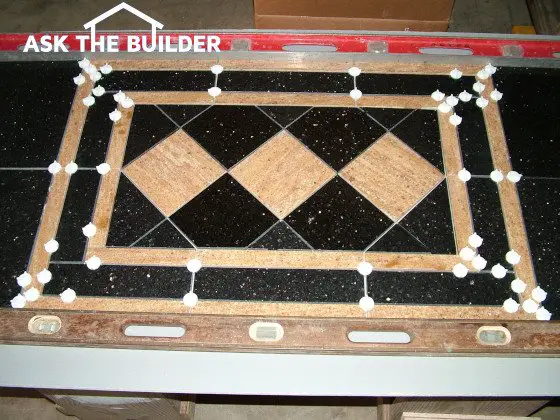
This stunning geometric design was made by cutting up a few pieces of standard granite tile. PHOTO CREDIT: Tim Carter
DEAR TIM: Granite tile looks like it would be excellent flooring or a wall treatment. Is granite flooring a good choice or will it scratch easily? I am thinking of installing granite tile in several places, but wonder if I can do it successfully. Can you make different designs with granite tile, and if so, how? How hard is it to install granite tile on floors or walls? Karen S., Mount Laurel, NJ
DEAR KAREN: I'll go on the record right now. You are going to love the granite tile you will be installing. Granted (no pun intended), I am not as objective as I should be since I am a college-trained geologist and granite happens to be my favorite rock. You should be forewarned now. When you visit a real stone supplier that has a full assortment of granite tiles, you will be mesmerized by the colors, patterns, different-sized mineral grains and beauty of the granite.
The stone suppliers I visit stock granite flooring in 12-inch by 12-inch tiles. The tiles are about 3/8 inch in thickness and precision cut so the sizing among different tiles is very uniform. This is an important thing to consider as the finished grout lines will readily call out granite tiles that are too large or too small.
One thing you will notice quickly is that granite tile is very heavy. After all, it is solid rock. You need to take this into consideration if you are installing the granite on walls or some other vertical surface. Gravity will be constantly tugging at the granite tile and if it is not attached securely, it will fall off the wall. In fact, the substrate like cement board or waterproof gypsum board must be expertly attached to the wall studs or the granite can pull it from the wall as well. You can't use too many screws to attach these products to the wall studs.
Granite is a very hard rock. A geologist will tell you that it is an igneous or metamorphic rock that is highly saturated with silica. Silica when combined with oxygen makes the mineral quartz, and it has a hardness of 7 on the Mohs scale. Suffice it to say there are not too many things that will easily scratch granite tile.
I can't think of one place where I wouldn't install granite tile. It can withstand just about all the abuse you can throw at it. It is ideal for exterior applications as many of the early roads in the USA were made from granite cobblestones. I have granite stones in my own driveway and they are unaffected by heavy trucks or freezing weather.
You can successfully install granite. When granite tile is installed on floors, one of the most important things to keep in mind is that the subflooring beneath the granite must be solid with no flex in it. Granite tiles are strong, but as with any stone product, it can crack if it is put under tension. A hollow spot beneath a granite tile or a flexing subfloor can cause the granite flooring to bend and crack. Be sure the floor beneath the granite tile has all low spots filled and any high spots ground down. You want the subfloor to be in the same plane.
I prefer to install granite tile using cement-based thinset mortar. This product is very sticky and will bond very well to the granite and the wall or floor surface. Consider using a crack-isolation fabric between the granite tiles and any flooring to prevent cracks in the finished granite. The lines between each granite tile can be grouted with unsanded wall grout if the joints are 1/8 inch or less in width. Joints wider than that should be grouted with sanded grout.
Use a diamond wet saw to cut the granite tile. In fact, that is just about the only tool you can use unless you want to spend days sawing the granite tile by hand. If you get a powerful diamond wet saw, you can cut the granite tile into any shape you desire. I made an interesting geometric design for my daughter's shower wall using standard granite tile. It takes a while to layout and make the precision cuts, but it is absolutely worth it. These designs look stunning when you use different colored granites to complete the design.
Granite tile does not come with self-spacing lugs on the edges of the tile. This means you have to space the tile by using your eye or incorporating plastic spacers as part of the installation. The spacers are easily removed once the thinset mortar has cured.
Thinset mortar comes in two common colors: gray and white. I urge you to use white thinset for lighter-colored granites. Be sure to ask the stone supplier for the exact product to use to secure the granite tile to the floors or wall. Avoid the organic mastic products that look like cake icing. Often these do not have the strength needed to hold granite in place permanently.
When installing granite tile on walls, it must be supported well until the thinset cures. The granite is so heavy, it will slide down the wall. This is especially true as you start to stack pieces on top of one another and the combined weight is hundreds of pounds. If the granite moves as the thinset is curing, it weakens the bond between the wall and the granite significantly.
Column 699

Tim built custom homes and did ultra-custom remodeling for 20+ years before launching his Ask the Builder media presence. He was selected as one of the Big 50 by Remodeling magazine in 1993. This award gave birth to Ask the Builder in October 1993. Tim also operates https://DrawPlumbingPlans.com. His @askthebuilder YouTube channel was the first home improvement channel on YouTube.
We are putting down granite tiles on the floor in our entry. We are halfway done and the tiles we started with look wet... Like they've absorbed the thin set beneath... Is this normal? Will the tiles go back to the light color they were originally? HELP!
Jill
I am going to lay granite floor for my house. Kindly give me ideas & border,desings using alternate colors.
Sure. Read all my past flooring columns and look at the photos.
Hi Tim,
Great article. We're installing 12x12x3/8" granite wall tiles for a wall behind our wood stove, and one thing I'm not clear on is how to support the tiles until the thinset cures (last paragraph of article). Any ideas on how to do that?
Thanks,
Andrea
I am putting granite tiles on a fireplace hearth, I removed the bricks from the hearth and now have a 2 1/4" hole. My plan is to fill it in first with mortar.
But what depth do I fill it to given 3/8" tile plus 1/4" of thin set.
I don't know how much the thin set compresses,
I need to make it even with the hardwood floor.
Thanks
Hi Tim- we are installing a granite tile countertop. We chose a light granite and they now look like they are absorbing liquid from somewhere and are dis colored. Do they ever go back to normal?? Help!! I can't find anything online to help!
Stephanie,
Did you SEAL the granite before putting things on it? You MUST seal granite with amazing high-cost sealers.
If the stain is from oil, you'll need to try my Stain Solver Certified oxygen bleach to remove the oil.
It could take multiple applications. When you get the small sample size, there will be a small paper in with it with a secret number you can use to text or call me for instructions.
Retailing my bathroom floor.I already have salt n pepper 12 x 12 granite tiles. Was gonna use a dark grey or silver grout. What do u recommend and for a small bathroom how much space should be between the tile.Thx !
Hi Tim, We're wanting to install absolute black polished granite tile for our kitchen floor. We're a bit afraid of moving ahead, as we've read about some granite tile being doctored, or cheap granite where the polished finish wears off. We'd like to order online to save, (from Stone and Tile Shoppe for example) but we really don't know a lot. Can you please advise? We would so appreciate it!
I'm a college-trained geologist and granite is my favorite stone of all. My house is built on the Meredith Porphyritic Granite here in NH.
You bet I can advise you. We do it via a phone call. Go here to set it up:
http://shop.askthebuilder.com/products/15-Minute-Phone-Conversation-with-Tim.html
Hi Tim,
I plan to use 12x12x3/8 granite tiles for shower walls (1/16" grout line). The tile is polished and is medium grey salt-and-pepper in appearance. A small puddle of water on the polished surface will begin to darken after ~4 minutes. Once wiped up, the darkened area quickly returns to the original color.
My question is in regard to sealing. The big-box tile/flooring manager is suggesting that I seal the tiles before setting them on the walls. Is this necessary? Is there a significant advantage to sealing before vs. after?
Thanks, in advance.
-Peter
I might be inclined to seal the polished surface before the install. I would NOT get the sealer on the unpolished edges where the grout contacts the granite. Do NOT seal the grout afterwards.
Sealers interfere with water-based CLEANERs that you might us down the road to clean the grout.
Stain Solver is the best grout cleaner:
http://www.StainSolver.com