Home Heating
DEAR TIM: My home heating bills are going up faster than a jet at an air show. Settle a debate among my fellow employees. Some say it is better just to leave the thermostat at the same temperature all the time as it costs so much to bring a cold house up to temperature. Others say to use a programmable thermostat. Still others feel you should set the thermostat down to 50F at night and while at work. What is the best way to save money on home heating? Marylyn O., Victoria, British Columbia CA
DEAR MARYLYN: Home heating oil prices as well as many other heating fuel costs are going up with little relief in sight. The smart person like you is starting to think about how they can save as it is insanity to waste money on home heating when it is so easy to save.
The first thing you need to realize is that this is a very complex issue. There is no magic silver bullet or one-size-fits-all spandex solution that will allow you to save lots of money and keep everyone within your home comfortable. I am reminded of a neighbor who wanted to save money. She kept her thermostat so low, I nearly turned blue when my wife and I would visit for dinner.
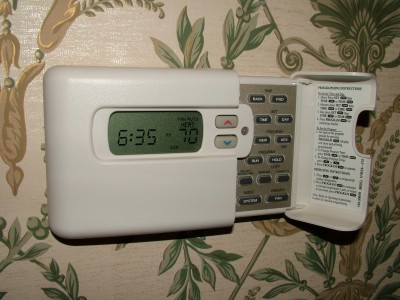
A programmable thermostat, when used correctly, can save impressive amounts of money on your home heating bills. PHOTO CREDIT: Tim Carter
If you want to save a really significant amount on your heating bills, then set back the thermostat to 60F for the entire heating season while you are awake and then set it to 50F when you are asleep. Go out and buy some long underwear, a hooded sweatshirt and maybe some light gloves. This is a drastic change in your at-home lifestyle, but the savings will be amazing.
Here is the science behind this complicated situation. Most homes are very different from one another. Each one losses heat at a different rate, the well-insulated homes being a better bargain. But each home can have a drastically different source of heat and the rate and amount of heat produced can vary significantly. Keep in mind that furnaces, boilers, heat pumps, etc. are like shoes; they come in all different sizes.
To make things even worse, the heat produced at the point where you and I can first feel it, the floor or wall register or radiant source, can be as cool as 98F with a heat pump or as high as 125-130F with an oil furnace. Natural gas heat can also produce high plenum or register temperatures.
So imagine letting a drafty house heated with a marginally-sized heat pump drop down to 55F and the outdoor temperature is at 0F or below. It might take hours and hours for the house to get comfortable with the heat pump running at full throttle. Compare that to what might happen to a super-insulated house that has a slightly oversized oil furnace. The oil furnace might get the house toasty warm in just 15 minutes!
Far and away the best solution to save money and remain comfortable while you are awake and at home are high-quality programmable thermostats. The best ones are outfitted with mini-computers that can figure out how quickly your furnace or boiler can bring your house up to the desired temperature so as to use the minimal amount of fuel but keep peace among those who want the house to be warm.
The trouble is, many people who have programmable thermostats do not extract the full amount of savings from them. You need to set them up to match your schedule and that of your family. The best thermostats have settings for each of the days of the week, vacation settings and temporary override settings. The people who save the most on their home-heating costs are those who make the furnace go up and down in temperature at least four times a day.
Keep in mind when programming the thermostat when you jump in bed each night. Since it takes the average house a while to cool off, you might set the thermostat to setback an hour before you slide under the sheets. There is no need to keep the heat on a higher setting up till the moment you fall asleep.
Do not underestimate how long it can take a heat pump to bring a cool or cold house up to temperature. Many people who have heat pumps complain how they produce a cold or cool heat. That may seem like an oxymoron, but you may agree when and if you place your hand over a heat-pump register as it is working at its best.
Also keep in mind that if you want to save on home heating, take the time to identify any and all air leaks. Air infiltration is a very significant source of heat loss. Caulk exterior cracks that allow cold air to enter your home. Think as if your home was a boat and the air was water. Stop all air leaks so you do not sink from a heating bill that needs a tsunami of cash to pay for it.
Column 704

Tim built custom homes and did ultra-custom remodeling for 20+ years before launching his Ask the Builder media presence. He was selected as one of the Big 50 by Remodeling magazine in 1993. This award gave birth to Ask the Builder in October 1993. Tim also operates https://DrawPlumbingPlans.com. His @askthebuilder YouTube channel was the first home improvement channel on YouTube.
Lately,my home furnace does not start when the temperature goes down.It takes along time after the house is so cold before the heating goes on.What could be the problem as had the furnace serviced 6 months ago.
Perhaps the thermostat is out of adjustment. When you rotate the dial or really turn it UP to request heat, does the furnace turn on within seconds? If so, this tells you the problem is in the thermostat.
The Google Nest thermostat will automatically detect when you are at home or not, and generate an appropriate schedule to keep your home warm for you.
As far as air leaks go, old, drafty windows can be a real heat sink. Modern windows are great in that regard and can improve quality of life even at the same temperature setting as before their replacement. It is one investment that has immediate ROI in comfort.