Ask the BuilderAsk the Builder
Ask the Builder's on:

Subscribe to askthebuilder's videos

Air Conditioning
Asphalt - Blacktop
Brick
Building Tips
Cabinets
Caulk
Ceilings
Ceramic Tile
Checklists
Chimneys
Concrete
Concrete Defects
Concrete Installation
Condensation
Countertops
Deck Construction
Deck Maintenance
Design
DIY
Doors
Drainage
Drywall - Plaster
DVDs
EBooks - EDocs
Electrical
Energy Savings
Engineered Wood
Fences
Fireplaces
Flooring
Foundation
Garage Doors
Glossary
Glue
Hardware
Heating Design
Home Builders
Home Depot Stories
House Plans
Hurricanes
Insects
Inspections
Insulation
Interior Walls
Kitchen
Lighting
Lots
Miscellaneous
Mold
New Construction
Newsletters
Online Courses
Outdoor Projects
Painting - Staining
Patio
Payments
Plumbing Design
Plumbing Supplies
Projects
Radiant Barrier
Remodeling
Retaining Walls
Roofing
Rough Lumber
Screened Porches
Sheds
Siding
Specialty Accessories
Stone
Storage
Structural
Stucco - EIFS
Tools
Trim Lumber
Vapor Barrier
Ventilation
Videos
Walk Throughs
Wallpaper
Windows


Tankless Water Heater
By Tim Carter
©1993-2008 Tim Carter
Summary: When it is time to replace your water heater, would a tankless water heater be the best alternative? Tankless water heaters cost more then standard hot water heaters. Be sure to consider the payback period on the tankless water heaters.

DEAR TIM: I wonder if a tankless water heater is the best thing for a new vacation home I am building in Michigan. Does a tankless hot water heater makes sense since the house will be vacant from November 1 to April 1 and occupied on a random basis the remainder of the time? For the seven months where we will be there from time to time, it seems that turning down a regular heater will waste energy. What would you install if this were your vacation home? Bob S., Amberley Village, OH

DEAR BOB: Each time I discuss tankless water heaters certain people get really hot. It is one of those topics that seems to polarize people, and I have come to realize that many consumers don't stop and ask all of the right questions before they get out their credit cards or checkbooks. It is impossible in this limited space to fully discuss the topic.

To answer your questions, I am going to stick to some basic facts. I gathered them from my own utility bill, tankless water heater manufacturers and websites that sell additional installation parts. I also am adding a pinch of high-school math. Let's state as many facts as the space will allow, and then start a discussion.

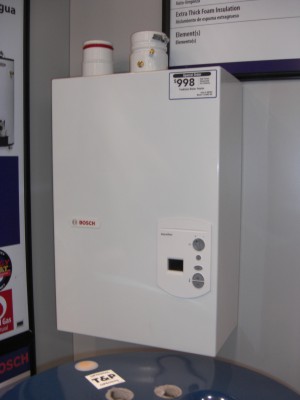
Inside this box is a tankless water heater. The other mystery is how long will it take for you to recapture the extra initial cost! PHOTO CREDIT: Tim Carter
A tankless water heater can cost up to three times a traditional storage-tank water heater. Some tankless water heaters that use natural gas or propane require expensive stainless-steel exhaust-venting pipes. The gas lines feeding the heaters need to be larger than a traditional water heater. This is not a challenge in new work like yours, but can add considerable expense in an existing home where the fuel lines might need to be redone.

Tankless water heaters are more energy efficient than traditional storage-tank heaters. A traditional storage-tank water heater might be 60 percent efficient while a newer tankless heater often can produce efficiencies of 80 percent or slightly higher.

I studied my August 2007 utility bill and discovered I spent about $36.00 on hot water using a traditional storage-tank heater for a family of five that was sometimes taking two showers a day after sweating to death doing outdoor work and activities. My winter hot-water costs could be expected to be slightly more, since the temperature of the incoming water is colder and must be heated longer to get to the desired temperature.

We use our water heater every day. You will be using your water heater for maybe 40 - 50 days a year.

If I were to switch to a tankless heater today, I might save $7.00 per month on the efficiency differential and maybe an additional $2.00 per month on the amount of energy lost while the heated water sits in the tank. This means a tankless water heater could save me $108.00 per year. Let's go ahead and be even more aggressive and say $125.00 per year.

I did a calculation and discovered that if my existing water heater failed today and I replaced it with a tankless water heater sized for my family needs, I would have to spend an extra $1,550.00. Using the most basic math, it would take me nearly 12 and one-half years just to break even. Remember, if you have to spend extra money on anything to save money, the savings part of the equation does not kick in until such time as you get the extra money back plus any lost interest or investment equity you would have made had you not spent the extra money. I did not include lost-interest income in my payback example above. Had I, the payback period would have been longer.

The bottom line in your case is that the economics are far worse. It could take you 30 years or more to break even, since the tankless water heater would sit idle in your vacation home for so many days each year. Tankless water heaters must work very hard each and every day of the year for them to make economic sense for many people.


When your vacation house is shut down for the winter, you are going to drain the heater and plumbing lines in case the furnace fails. You use no energy in those months. When you do occupy the house, turn the heater off when you leave to go back to your primary home. Do not use the "Vacation" setback thermostat setting. When you arrive back at the vacation house for each visit, turn the heater back on as soon as you walk in the door. Within 90 minutes or less at least you will have lukewarm water.

Tankless water heaters are marvelous machines if you want an unlimited supply of hot water. They do a splendid job of that and can provide lots of hot water if there is not a drastic difference between the cooler incoming water and the outgoing hot water. If you have a heated-water temperature of 110F and the incoming water is 75F, then some tankless heaters can produce 8.5 gallons per minute of hot water. But if that same heater has incoming water of 45F like I do in January, then you can only get about 5 gallons of hot water per minute.

But beware of buying a tankless water heater just to save money. I have received letters from people who spend more each month on both water and fuel. Some people end up using far more hot water than usual once they discover there is an endless supply.


Comments

Leonard Juska
21 Jan 2008, 11:09
Very good commentary, Tim. Thank you. Of course, if the price of fuel continues to go up, trade off time can come sooner or partially offset the interest/income loss.

Another, less noted advantage of tank water heaters in times of distress (earthquake, for example), is the reservoir for emergency. Most municipalities require heavy strapping for these, in case of motion. But at least you have 40 gallons or so of fresh water. Humans can last days without food, but not without good water.

For Mr. M. Thomas, I tried the link but I received the "404" page error. Thanks.

Best wishes to all,
Leonard Juska
Costa Mesa, CA
Doug Siebert
21 Jan 2008, 11:59
Tim,

Would Bob really need to spend $1550 extra on a tankless water heater for his vacation home? A water heater sized for a household of five like yours has to be a lot bigger than one for a vacation home, plus he might be able to get by with one of a bit lesser quality since it will see less use and it is perhaps not as big of an issue if it fails. After all, he is only there during the summer, so his family could suffer through a few days of cold showers over the 4th of July more easily than they could in January!

I see tankless water heaters sized adequately for one shower at a time for $500 which would probably be fine for that vacation home (3 gpm, 60* temp rise, 10 yr warranty) To me, the advantages of not having to remember to turn the heater on/off when coming and going, draining it for the winter, etc. are probably worth spending a few hundred dollars more versus the standard 40 gallon tank.

Also consider the space savings, since vacation homes are often a bit cramped as it is. Finally, I think that endless hot water is almost a must have in a vacation home where you bring friends and their kids and the floor is covered with sleeping bags at night. It doesn't matter how big the tank is or how quickly you make the kids shower, it always runs out before the last person takes their shower!
AsktheBuilder
21 Jan 2008, 13:12
Doug,
Bob actually emailed me hours ago after he saw the column. Believe it or not, he said it is a large four-bedroom home and he expects guests that would be taking showers at the same time. So much for your pint-sized tankless heater suggestion. Bob might spend at least $1,200 more in 2008 dollars. People really need to do the math. As I said, if money is not an issue and you want continuous hot water these things are the bees' knees.
MIchael Thomas
21 Jan 2008, 16:31
Hmm.... I see my contribution was deleted.

I thought it was useful - for one thing it included a link to the ONLY study I've ever been a able to find that evaluated tankless payback under controlled conditions simulating actual household use, and I wonder if whoever hit the delete button bothered to follow the primary link, or just assumed it was a SPAMed advert.

If anyone is curious you can probably GOOGLE it up, with was done by the / Exelon Services Federal Group (ESFG) for the Okaloosa Gas District.


AsktheBuilder
22 Jan 2008, 08:52
Michael,
They were deleted because the links didn't work........ It is not a conspiracy...... Instead of making everyone work to find it, can't you summarize in 100 words the findings? Just state the facts.....
Brett
23 Jan 2008, 20:12
Tim,
Perhaps another concern to be taken into account is that of tank water heaters exploding. My grandparents heard of a few such events while talking to people who have vacation homes in the Island Park,ID area. I don't know how often tank heaters fail and the exact circumstances that cause it but, it was a serious concern with my grandparents when they would leave their cabin for extended periods. I also realize you're comparing the costs of new tanks, not old ones. How much do you think, of a difference in safety is there, if any, over the long term?
Doug Siebert
23 Jan 2008, 22:13
Brett,

Newer water heaters have safety mechanisms to prevent that sort of thing, so it should be only older ones doing that. Mythbusters did a segment on that and they had to disable two separate safety mechanisms to get the water heater to go overpressure and explode. But when it did, it shot several hundred feet up in the air, you would not want to be home when one of those blew!

I would think the only risk of explosion with today's water heaters would be a gas explosion, which could happen with any gas fired water heater, with or without tank.
Michael Thomas
24 Jan 2008, 09:10
Even with *electric* water heaters you can get some pretty vicious events if things go wrong in the right way, for example this 5 gal electric unit demolished a considerable hunk of CMU wall at a high school

http://www.safteng.net/Accident%20Photos/Hot%20Water%20heater%20explosion.h tm
- or -
http://tinyurl.com/29hyyl

If someone is determined to run a gas fired unit at an unattended location, IMO an auto gas shutoff like the Watts 210-5 would be a Good Idea.


AsktheBuilder
24 Jan 2008, 15:14
Brett,
Ditto Doug. If the T & P valve and the gas valve fail, then explosion is a reality. I am not worried about mine.
A Rob
28 Jan 2008, 12:54
About a year ago, I had tankless systems installed at our house and at our vacation cabin.

At the house, we got a very large unit, a Rinnai. We have 3 teens and 2 exchange students so there is a lot of demand for hot water for showering and laundry. Bottomless hot water supply has really helped to get it all done without worrying about a showering schedule. We can start a load of laundry and hop in the shower, no problem. A side benefit which makes the economics work out is that by moving the hot water heater into a side closet, we gained a large pantry-size closet in a spot where storage was really needed. We could not have renovated to gain space there. Also, I do not have to worry about the tank leaking (which happened the day after we bought our first house, so I know it is possible!), ruining my pergo-style floors. The old tank was in an interior closet under the stairs. We had to move it to get a place to run the vent pipe.

At the cabin, we did have a water freeze last year, downstream from the water heater so its entire contents emptied into the cabin. This happened in an area which does not normally have a hard freeze, during a time when we go out there semi-weekly. We discovered it about 10 days after the leak happened, so we ended up in a major remodeling project which included tearing out a tub and replacing the subfloor under it. The insurance did not cover it because it was considered negligence. Bad surprise! I've switched insurance companies.

Anyway, the issue with getting a tankless system at the cabin was low water pressure because it is on a well that does not produce that much water. One plumber recommended against the system for that reason, but another plumber who installs these regularly said it would work because there was enough pressure to take a shower (he used a plumbing tool I don't own to determine the pressure). It works because we do have a tank for water in the pump house which is slightly uphill from the cabin and acts like a water tower. The brand we installed there is Noritz.

Anyway, it is great for cabin use. Like one commenter said, at a cabin you either have no use for hot water or you need great quantities of it. The tankless system is perfect for that. It does not take long to get hot water, so there is no great waste of water while you wait for the hot to get to the faucet. We can shower, run laundry and wash dishes all at the same time. I also was able to make one bedroom 3 feet larger by moving the heater to an unused closet in an adjoining room. The gain of this space far outstrips the cost of the heater.

One thing to consider is the electrical supply needed to start the system. We use an inverter and a marine battery if the power is off, but I believe there are other ways around it.

Water heaters do make good water storage devices for emergency use. You can get second hand ones cheap, possibly remove the element for better water quality, and store them out in the garage or some hidden area of your property in case you lose water. I wouldn't choose to keep a tank water heater just for the reason of emergency water storage. Based on my experiences at the cabin, you can go through a lot of water very fast by showering and doing laundry (we have a 1500 gallon tank), so one water heater is just a bare minimum supply.

In my case, I consider the units to be paid off already. I have gained storage space, living space, convenience, time, access to unlimited hot water when needed, and peace of mind that my tanks will not fail and get me involved in future emergency remodeling projects.

     View all comments
*Name:
Email:
Notify me about new comments on this page
Hide my email
*Text:
Security Image:

Visual CAPTCHA


Ask the Builder Comment Help

Helpful Comment Tips: If you need help with a problem, please try these things now before you type in a comment. You could discover your answer in just minutes.
  • Read ALL Comments Before Submitting One: If there are lots of comments that are already part of this column, there is a very good chance your question has already been answered by me or someone else.
  • Read Similar-Titled Columns First: The column above is almost always part of a two-or-three-part series. The answer to a question you may have is probably in a related column or in comments that are part of that column.
  • Read Columns in a Category: Take the time to read many columns in a category. The amount of information you will discover will amaze you.
  • SHARE a Story: Please share any tips or amusing tales of glory! Tell others what has worked for you. Maybe you have a disaster you want to discuss. Let's collaborate so we all learn together.
Don't show this alert again.