Patio Pavers
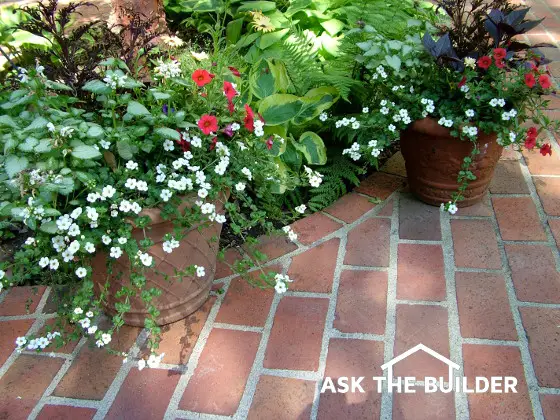
This is a patio at my last home that was built with traditional clay brick pavers. They could have been set in sand, but laying them in mortar creates a traditional look and feel. You can see how my wife has continued the tradition of potted flowers on the edges of the patio. She knows my favorite ones are the small red flowers. Copyright 2017 Tim Carter
Patio Pavers TIPS
- Concrete paving brick will fade in time looking ugly
- Clay paving brick have solid color through and through
- Set brick on concrete or a sand/cement blend base - SEE BELOW
- Mortaring brick to concrete is hard work but gorgeous
- CLICK HERE to Get Tim's FREE & FUNNY Newsletter!
DEAR TIM: I've decided to use patio pavers to build a nice outdoor space. Installing patio pavers seems easy enough.
I don't want to make a mistake, so can you tell me how to install patio pavers? What method would you use?
What should I be concerned about if I want a patio that looks good and is as maintenance free as possible? Kay H., Rochester, NY
DEAR KAY: Just before I was married, I got my first taste of patios made with paver brick.
Future Mother-In-Law Project
My future mother-in-law wanted a red-brick patio and discovered some used paving brick for the job. I installed them using some common sense and lots of luck and sweat. The full-sized brick were set on a compacted base of dry sand mixed with cement. Believe it or not, that patio looks like the day I finished it, and that was decades ago!
I built this patio in 1973 a year before I got married. We had our wedding reception at the house and many sat on this patio. The photos below were taken in September of 2016 when I visited the house to help close out the estate of my in-laws. You can see the patio is still in fantastic condition considering the simple base of coarse sand and Portland cement.
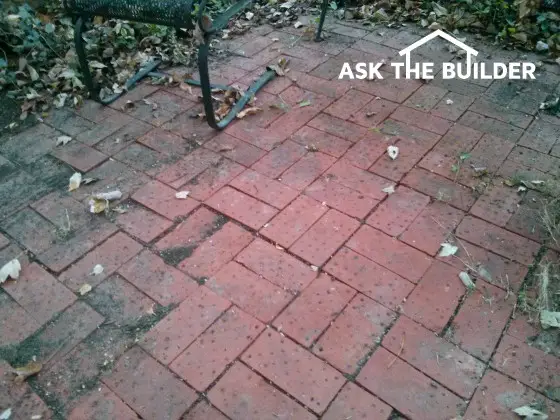
This is a wide shot of the patio. My mother-in-law at the time didn't want all the brick to be perfectly flat. She wanted a weathered look as if the patio had been down for a hundred years. When she was alive and had her potted flowers around it, it was gorgeous. Copyright 2017 Tim Carter RIP Mary Jane!
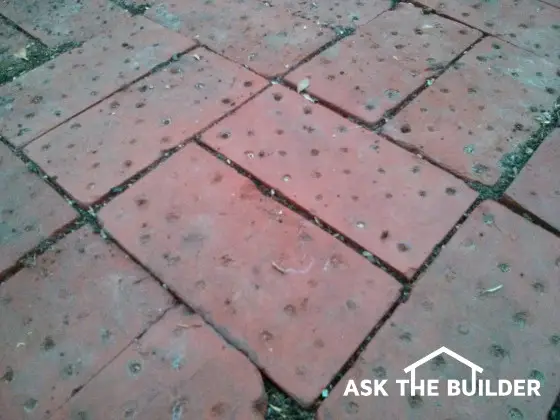
This is a close-up shot of the paving brick made with clay. These were salvaged from some other job and I chipped off the excess mortar from all of them. My mother-in-law used to sit on this patio each spring, summer and fall morning in good weather drinking her steaming hot coffee. Copyright 2017 Tim Carter RIP Mary Jane
Free & Fast BIDS
CLICK HERE to get FREE & FAST BIDS from local patio contractors.
Concrete Patio Brick - Not The Same
Since then, the concrete industry got involved in the patio business. I distinctly remember when colored concrete interlocking paving brick became the belle of the ball.
They were the rage, and are still quite popular. But I feel the mortarless concrete products do not have the character of a real paving brick made from clay. When you go the next step and add mortar in between red-clay paving brick, you really have a classic look. Refer to the picture at the top of this column.
Concrete Brick Patio Video
Here's a video I taped back in 2009 with a horrible Flip video camera. The camera is moving too much and it's hard on your eyes. But you can see a version of concrete paving brick and how it might fade over time.
Onions and Watermelons
What's more, you can't really compare traditional clay brick with the newer colored concrete interlocking pavers. The concrete brick start to lose their color as the colored cement paste begins to wear off the surface of the brick revealing the sand and gravel in the brick.
To me, traditional clay brick reminds me of watermelon because it's red through to the core. If you chip a traditional clay brick, the color is the same. I don't want my patio brick to change color over time.
Traditional Brick Requires Skill
But constructing a brick patio in such a way as to create a traditional look takes skill and lots of time. I know, as my wife had me do this on our two patios as well as our front sidewalk at two different homes!
First Attempt - Big #FAIL
The first time I did a paving-brick job at my own home, I tried a new method of setting the brick in sand. It was a dismal failure.
Weeds grew in between the brick and each time it rained, the water would bring sand up to the surface from between the small cracks. This sand got tracked inside our home making a mess of things. When the moles showed up and pushed up the brick, that was the final straw.
Redo
I tore up that sidewalk and taught myself how to install patio pavers over concrete. The sidewalk and patio I did at my second home are still in fantastic shape today, and get all sorts of compliments from the present owners as well as the neighbors.
Field Trip - Look At Patios
My suggestion to you is to talk with friends and go see if you can visit different patios that have been down for twenty or more years. See what they look like after Mother Nature has had her way.
As I said above, I don't like about the colored concrete paver patios because the brick change color.
The pigmented cement paste does wear off the sand and gravel in the concrete, and when this happens the color appears to fade. This color change is actually caused by you seeing the true color of the aggregate in the concrete.
CLICK HERE to get FREE & FAST BIDS from local patio contractors.
Fade-Free Clay
This is but one reason why I prefer traditional clay-brick pavers. The color never fades, as the clay is the same color through the entire brick. When you purchase paver brick that have been fired to resist weather, the color is locked in and does not change.
The clay in the brick actually becomes like rock, and weather and oxidation seem to have no effect on the appearance of the brick.
Mortar Brick to Concrete
To achieve a traditional look for your patio that will not produce loose sand and is mole-proof, you mortar the brick to a concrete slab. This process is time consuming and expensive, but it produces a stunning look that can last decades with no maintenance other than an annual cleaning to remove dirt and any algae.
Look At Old Patios
The key thing to remember is that all new patios look really good once they are complete. But I feel you should think about what will it look like in 10, 15 and even 25 years.
Why not invest in a patio surface that will have a rich and traditional appeal and be one that requires virtually no work once it is installed? That is what I have at my home and you could never convince me to install anything other than traditional clay paving brick.
Hard & Heavy Work
Installing any hard patio surface will be lots of hard work. There are new tiny excavating machines that allow you to dig with ease. Be sure to visit a tool rental store to see what kind of machinery will allow you to do the work with a minimum of effort.
Concrete With Steel Rods
If you decide to pour a concrete slab that will serve as the foundation for your patio, be sure the concrete is at least 4-inches thick and has steel rods in it. The steel minimizes cracks and holds the concrete together in one giant piece.
The half-inch-diameter steel rods need to be in the center of the concrete and spaced at 2-foot on center both directions. The steel mat should resemble an empty crossword puzzle.
Slope For Drainage
Be sure to slope the patio away from your house. The slope should be about one-eighth inch per foot. This slight slope will give the appearance that the patio is level, but is enough that water readily will flow out into the yard.
Plan For Utilities
Before you pour the concrete, think about installing any underground utilities. Now is the time to run conduit or new downspout drain lines.
CLICK HERE to get FREE & FAST BIDS from local patio contractors.
Column 727

Tim built custom homes and did ultra-custom remodeling for 20+ years before launching his Ask the Builder media presence. He was selected as one of the Big 50 by Remodeling magazine in 1993. This award gave birth to Ask the Builder in October 1993. Tim also operates https://DrawPlumbingPlans.com. His @askthebuilder YouTube channel was the first home improvement channel on YouTube.
Dear Tim:
I'm very interested in re-doing my patio exactly like the way you explain it in your article. I too have a brick patio, but the moles have been so busy tunneling underneath that bricks are no longer even, some have sunk noticeably or even been pushed up by moles trying to reach the surface. Not only is it aesthetically uninviting, but also becoming a safety issue. I especially like the idea of pouring a 4 inch concrete as your foundation, then laying the clay brick on top. I can't imagine anything would be able to tunnel through that. Can you provide more detail on how to go about doing this: i.e., like laying the steel re-bar for the concrete foundation, what you used on top of the concrete to level the clay brick (i.e., leveling sand, gravel, etc); whether to compact, and if so, would pounding leveling sand on top of the foundation cause the concrete to crack; and how you went about mortaring the spaces between each of the bricks. One contractor I spoke with told me he wouldn't recommend placing bricks on top of a concrete foundation because of drainage issues. I tend to believe in your article over the contractor, since you have proven that it can be done. I'm confident that I can do this myself with a little guidance. Thank you.
Steve, your question requires lots of typing, plus I have some questions for you so I can give you the correct answer(s). I only do pithy answers here in the comment section. If you want to protect the investment you have in your house and not waste time or money *hoping* you make the right decision, you should talk to me on the phone for just 15 minutes. It'll be the best investment you've ever made in your home!