How to Build a Retaining Wall
DEAR TIM: Can you tell me how to build a retaining wall? Are retaining-wall blocks a good choice when building a retaining wall? What mission-critical things do I need to know about these walls so that I do not have a collapse or other failure in the years to come? I have access to lots of large stone. Can I just stack them to make a retaining wall from stone? Janine W., Fort St. John, British Columbia, CA
DEAR JANINE: Retaining wall construction is an art that has been around for thousands of years. You can see them in just about any archaeological photo of ancient building sites. In almost all cases, these long-gone builders used stacked stone to build walls that still are in good shape today. All you have to do is understand what they perfected through trial and error.
Since you live in a cold climate, you have two primary forces of nature that try to make retaining walls fail. The one is gravity, and this affects all retaining walls. The second one is frost in the soil. Natural erosion is working at all retaining walls, but it can be very slow acting, so it is often not a factor.
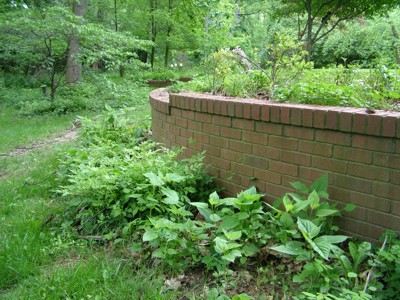
This retaining wall was built with lots of care and skill. It is still perfect after 20 years of harsh weather. PHOTO CREDIT: Tim Carter
The soil that you are trying to hold back is being pulled towards the center of the Earth, but there's also a down-slope component as well. You can readily demonstrate this with a small pile of dry sand. Build a small hill using dry sand, and if you take some away at the bottom or the middle the entire face of the hill moves down.
The retaining wall you construct has to be strong enough to offset the pushing force of the soil. Do not underestimate this force as a cubic foot of moist soil can often weigh up to 100 pounds.
Large stones that have lots of surface area touching one another can often do the job. The friction of the stones rubbing against one another works against the pushing force exerted by the soil.
Tall retaining walls are at the greatest risk of failure. As the retaining-wall height increases, the force trying to topple the wall increases by a large factor. For example, if you double the height of a wall, the tipping force may increase by a factor of three or four times!
My advice to you is to take a little road trip around your area to see if you can discover some old retaining walls made from stacked stone. See what kind of condition they are in, and study those that appear to be very old and in great condition. Measure the size of the stones, the height of the wall, what is above the wall and the construction method. Take lots of photographs as they will help you as you start to construct your wall.
Try to keep your retaining wall under 3-feet high. These small walls are fairly easy to construct, and the force of gravity against them is not too great. You may want to construct the wall so it leans back a bit and is not perfectly plumb. This technique offsets the center of gravity of the wall making it harder to tip over.
Frost damage to retaining walls can be sinister. As soil freezes it expands. On a normal flat area, this expansion force is normally in the up and down direction. Builders know this as frost heave, and water-works employees know that this pressure cracks water mains underground.
But the frost can push sideways when it is adjacent to a retaining wall. Frost will relieve its expansion pressure using the path of least resistance. Since the ground freezes from the top down, it pushes sideways against the top of the retaining wall where the leverage force against the wall is greatest. One way to minimize frost damage to retaining walls is to backfill the wall with a well-drained material. Rounded gravel is ideal. The soil itself needs to be well drained so that water can't build up behind the retaining wall.
Retaining walls can be constructed with many materials: wood, poured concrete, concrete block, decorative stackable concrete block, etc. The science and engineering of retaining walls is very complex, so do not try to do a tall wall without an engineered solution.
Loads on top of a retaining wall also must be considered. If you have a flat area adjacent to the top of a retaining wall and park a heavy vehicle on the surface, the weight of the vehicle also pushes against the wall.
Be sure the base of the retaining wall is set down in solid soil. Do not just install the first row of stone on the top soil. The organic material in the soil is not a sound foundation for the wall. Be aware of soil creep. The soil itself is being pulled down slope each year by gravity and frost.
Column 728

Tim built custom homes and did ultra-custom remodeling for 20+ years before launching his Ask the Builder media presence. He was selected as one of the Big 50 by Remodeling magazine in 1993. This award gave birth to Ask the Builder in October 1993. Tim also operates https://DrawPlumbingPlans.com. His @askthebuilder YouTube channel was the first home improvement channel on YouTube.
I have a 4 foot rock retaining wall that needs to be redone. It has dirt behind it. how should i keep the dirt from collapseing when i tear the rock down? should i place a tarp over it to keep the dirt from crummbling?
Chris, your question requires lots of typing, plus I have some questions for you so I can give you the correct answer(s). I only do pithy answers here in the comment section. If you want to protect the investment you have in your house and not waste time or money *hoping* you make the right decision, you should talk to me on the phone for just 15 minutes. It'll be the best investment you've ever made in your home!
I have a question. My yard seats on the bottom of a hill and a lot of water from my neighbor yard runs into my yard. I was thinking about building a retaining wall made out of center blocks and raise my yard to about three feet. Put a fence on top of the retaining wall for no one will fall over. Do you think this would work? Stop all the water from coming into my yard and hold the sand after I raise my yard up.
My husnad and I bought a 30 year old home that we are refurbishing with several 30 year old ( or at least they look like it) railroad tie retaining walls. We have a tri-level backyard and with railroad tie steps up the center of these. So basically 4 retaining walls. What can we put in front of these walls to hold them as they are rotting as well as the steps? I would love to send you a picture. We have spent so much time and money on the house that we are trying to be keep costs down on this possibly beautiful backyard. Thank you!
Nothing that will provide a long-term solution. Read ALL my past columns on Retaining Walls for the answer.
In the 1970's I built a retaining wall using railroad ties. It measured 70 feet in length with a height of 6 feet. However, the land sloped upward at each end. So I anchored one end behind a stone barbeque and the othe end behind a hedgerow of bushes. The base of the wall was set upon a trench measuring 3 feet wide, 3 feet deep and 70 feet in length filled with railroad ballast stone. Then a series of bridge ties were placed on top of the stone and anchored in place using 4 foot lengths of hardedn steel rod. On top of this were set a series of railroad ties, however, each set of ties were fitted with railroad spikes and flipped over and locked into place on top of the other ties creating a two inch set back for each row of ties. This wall is still standing although one of the new home owners has seen fit to bury this wall under landscaping. However, the wall has stood the test of time for over 40 years. A bit over-engineering, but then buiding in this manner ensures the project would last well beyond the norm of 10 years or so.
Forgot to mention that rail ballast stone was also installed a foot deep behind the wall to within 1 foot of the top of the wall. You could pour a 30 gallon pail of water at the top of the wall and hear it running down to the bottom of the wall before the container was fully emptied.
Our full brick home and brick driveway retaining wall was built in 1998. The house has a full basement and the retaining wall is over 6 feet high as it joins the house and tapers-downward in segmented steps as it gets closer to the street level to about 18” in height. I am guessing the wall is close to 20 feet in length.
Recently while trimming back some of the low-running juniper vegetation on top of the wall – I noticed more than one deep void along the inside of the brick wall. Some of these holes are over 2 feet in depth! I am not really sure how many tunnels/voids really exist or how they came about. The ground level juniper vegetation is dense and has been hiding this from me for almost 14 years. Glad I never stepped in one the holes!
Now that I know this condition exists, I know I need to do something to fill in these voids before it becomes a problem.
I am considering driving a few pieces of rebar down into these holes and then pouring a thin-based gravel mortar that will work itself down into some of the smaller and deeper voids. I would love to hear your thoughts /suggestions. thanks