How to Remove Brick Mortar
Remove Brick Mortar TIPS
- Muriatic acid is best - dilute it
- Scrape off excess mortar smear
- Wet brick before acid application
- Allow acid to bubble for minutes
- CLICK HERE to Get Tim's FREE & FUNNY Newsletter!
DEAR TIM: How can I remove brick mortar from the sidewalk I just constructed with paver bricks? My husband and I got the mortar smeared on the brick, and it looks terrible.
What methods can I use so the brick is not damaged?
Is there a non-toxic way to do this repair? Sarah H., Kingsport, TN
DEAR SARAH: Smeared mortar on brick pavers, as well as brick walls, is a very common problem. It seems to be a growing problem as many masons don't seem to take pride in their work. It's understandable for DIYrs to make a mess.
Simple Maybe
Depending upon the type of brick, the job can be simple or a nightmare. It's my hope that you don't have a deeply grooved wire-cut brick, as these have many small crevices that can make cleaning a career choice.
Don't Worry
Since you're concerned about the toxicity of different options, you may find it very hard to make a decision as to what chemical to use. You can use certain acids that are more aggressive than others, and the ones that work faster tend to be more toxic.
But don't panic as you may discover that an aggressive acid treatment may work for you if you work to control the amount of liquid used as you work. In fact, I'd recommend you use the acid just below, but do so in a conservative manner.
The acid will only harm you if you treat it with disrespect.
Muriatic Acid
Typically bricklayers will use muriatic acid to dissolve mortar from most brick. This is simply a form of hydrochloric acid.
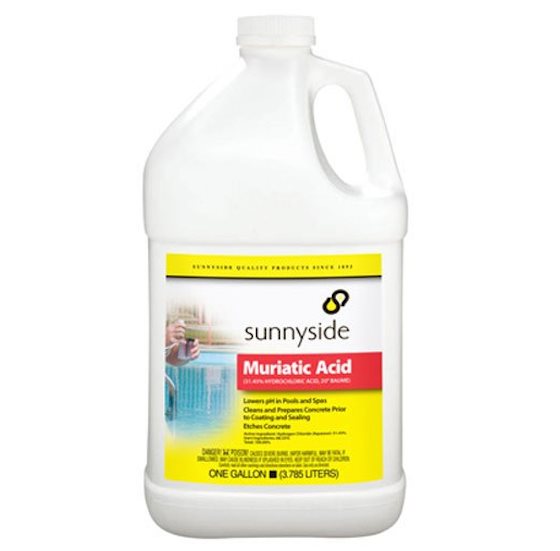
Muriatic acid is powerful and needs to be treated with lots of respect. CLICK THE IMAGE TO ORDER SOME NOW.
When you purchase this product it often has a skull and crossbones on the label. That's telling you it's a powerful chemical.
But these products can be neutralized. That's something all of us should have discovered in our high-school chemistry class.
The best part is the mortar does neutralize the acid as it works to dissolve the mortar paste. That's one of the benefits of choosing to use muriatic acid.
As long as you don't go splashing it around and use too much, it's not that toxic. Plus, once diluted with water, it becomes even more safe.
Weak Acids
There are other acids that will react and dissolve the alkaline chemicals in the mortar. Even white vinegar that's in your kitchen will work to some degree.
Since you eat vinegar in many foods, you know it's not a toxic acid.
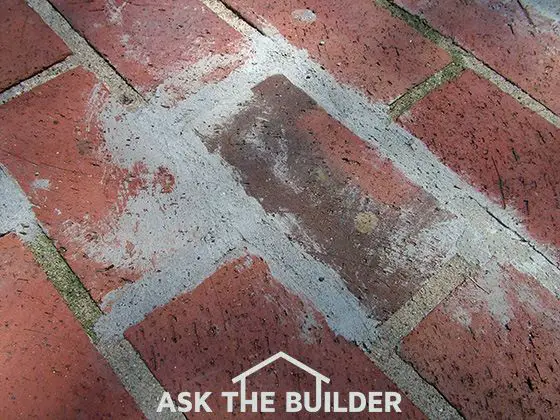
This is a pretty typical mortar smear on a flat patio brick. The wire-cut lines in the brick can be very hard to clean if the mortar gets in them. When laying brick, discover how to not be messy. ©2017 Tim Carter
Tough Choice
The challenge for you is finding an acid somewhere between vinegar and hydrochloric acid that will efficiently remove the mortar buildup.
If you're really worried about the toxicity of muriatic acid, and you shouldn't be, you should consider calling a physical chemistry professor at a local college or high school.
You can also visit a building supply company to see if they stock a non-toxic acid that will dissolve the mortar.
Remove Excess Mortar
The first step in the process is to remove as much of the mortar as possible with a scraper or chisel without scratching the brick face. Clear water flowing over the brick acts as an effective lubricant that will minimize damage to the brick.
I've had great luck using a 3-inch-wide stiff scraper with a chiseled edge.
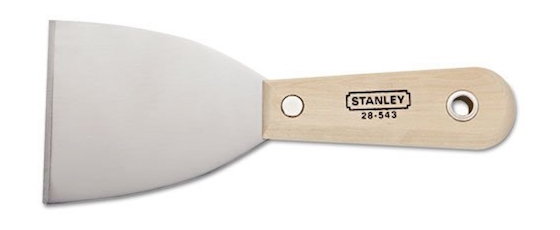
This is an all-around great tool to have. It's wonderful to mix sanded or wall grout. Keep it clean to last for decades! CLICK THE IMAGE NOW TO ORDER ONE BEFORE THEY'RE ALL GONE!
If you have to tap the scraper with a hammer, do so at a low angle with the face of the scraper nearly parallel with the face of the brick. You're trying to get the mortar film to a thickness less than that of a plastic credit card.
Bathe The Brick
Once the majority of the mortar is off the brick, you then should consider bathing the brick with a diluted acid solution. As mentioned before, muriatic acid is highly effective, and it works on most brick. However, you need to wet the brick before you apply the acid. See below.
Usually you mix one part of the acid with ten parts of clean water. Always read the instructions on the acid label and pay particular attention to all safety instructions.
IMPORTANT TIP: It's also a good idea to contact the manufacturer of the brick if you know who made it. Some brick can be damaged and discolored by acids. It's really worth the effort to call the brick manufacturer if possible.
Wet The Brick
I've found in most cases you should dampen the brick with clear water before you apply the acid solution. Always try this in an out-of-the-way area if you're unsure if the acid will harm the brick.
If you don't do this, it's possible to burn the brick. Some brick don't like muriatic acid and it can discolor them.
Be sure to TEST the acid on the brick. Don't take a chance.
Bubble & Fizz
If you use muriatic acid, you should see tiny bubbles forming where the solution contacts the smeared mortar. This tells you the acid is reacting with the mortar paste and is starting to dissolve it into the liquid solution.
Use a scrub brush to help remove the mortar. Wait five, ten or more minutes after the acid solution has been applied to the brick before you scrub. The longer you allow the acid solution to work, the less you have to scrub.
It can take multiple applications of acid solution to remove all of the mortar if the buildup is thick. Rinse the acid solution from the brick with lots of water. The more water you use, the better.
Powerful Jujumagumbo
Working with acid solutions is very tricky. You can hurt yourself, your clothes, your brick, the new mortar and vegetation around your home. If you have valuable vegetation and landscaping, you should try to stop any acid solution from getting into the soil.
Plastic sheets work well for this purpose.
Protective Gear
Be sure to wear all of the protective gear to prevent burns to your skin and eyes. Muriatic acid straight from the bottle is a wicked liquid.
The fumes are very toxic, and it can cause serious burns to your skin very quickly. Don't underestimate this chemical.
Wait 30 Days
I would not ever use muriatic acid on fresh mortar. Allow the mortar to cure a minimum of thirty days before you attempt to acid wash it. Each day the mortar gets stronger.
That said, if you get mortar on brick you should immediately try to scrape it off or brush it off. If there's a thin mortar paste that has no sand in it, it will easily and quickly be removed with mild acids like vinegar.
Harsh acids will attack the fresh mortar between the brick that you do not want to remove.
Column 735

Tim built custom homes and did ultra-custom remodeling for 20+ years before launching his Ask the Builder media presence. He was selected as one of the Big 50 by Remodeling magazine in 1993. This award gave birth to Ask the Builder in October 1993. Tim also operates https://DrawPlumbingPlans.com. His @askthebuilder YouTube channel was the first home improvement channel on YouTube.
Thank you excellent information. Will try with vinegar first just resently done, has been sitting about 4 weeks bulk of mortar has been removed only thin film over the bricks. Hopefully, that is all we need to do
I, too, really like the vinegar idea. I've been all over the Internet looking for tips and you're the only one who offered this great idea. Probably because it is rather mild, but my mason has already taken off any of the heavy spots. I'm gonna try it out first thing tomorrow. Thanks!
Hello Tim,
I have just bought my home, on the outside wall of the house there is about half an inch of cement on the wall that I am trying to remove. I have tried chiselling the cement and it I have lost part of the brick. The brick underneath is textured house brick.
Could you advise on how to handle this.
Thank you
I'd have to see a photo of exactly what you're trying to attack.
I was wondering if you had any recommendations on how to remove mortar dust from a slate stamped acid stained and sealed concrete patio. The patio was just installed 1 month ago and freshly sealed. Stone columns were built on this and there is some stubborn residual mortar dust left after multiple cleanings with soap and water. Any suggestions on how to remove this and get back that beautiful newly sealed finish? Can I just used vinegar?
I believe my contractor used a solvent based sealer btw.
Thank you
You can try my Stain Solver if you want.
If that doesn't work, try the vinegar but do it in a SMALL area with a cotton swab. Work in the shade.
Great advice;
I have a mortar build fire pit that when poured, the gas pipe inlet (T-handle square hole) was covered up. The good news is the pipe stick out on the inside to hook up the gas line and pan. I was thinking of using a circle saw to reach the gas turn on/off from the outside but I do not want to damage the gas pipe of valve etc.
Any recommendations - uuurrgghhh.
Thanks
Can you help with ways to clean mortar from bricks
Thanks
Gary
Apparently the mason the installed the brick either used too much water or troweled the some of the brick when it was too wet. A section is much lighter and has the mortar paste look. How can this paste be removed to make this section look like the rest?
I have the same issue with dried mortar on the brick. It’s been 2 years since the work was done, but due to multiple surgeries after retirement, I haven’t been able to get around to cleaning it up until now! Any pointers you may have to make the job easier would be greatly appreciated.
PS. Listened to your show many times when you still lived in Cincy. ALWAYS good advice!