Shower Head
DEAR TIM: I need to fix a leaking shower head. Is it difficult to replace shower heads? At first I was just going to fix the leak, but my wife wants a new shower head. Are there some secret tips you can share that will make it appear as if a master plumber did the job? Alan L., Jackson, TN
DEAR ALAN: I'll never forget my first shower head. I thought to myself that the job appeared simple, and was I ever wrong. I ended up with two leaks, a ruined shower head because I used the wrong tool and my parents banned me from doing experimental plumbing in their home.
Shower heads are like so many other home-improvement projects. It's not that the job is hard, it is that there are just some simple steps you need to take to ensure the job turns out as if a pro did it. In the case of a shower head, your biggest concern should be creating a leak behind the wall where the gooseneck pipe connects to the vertical water-supply pipe that is in the wall.
When you unscrew the existing shower head from the gooseneck pipe, there is a chance you can break the seal where that pipe connects to the water-supply line. The resulting leak can be large or a very sinister slow leak that only produces one or two drops of water with each shower. Either one can cause thousands of dollars of damage over time.
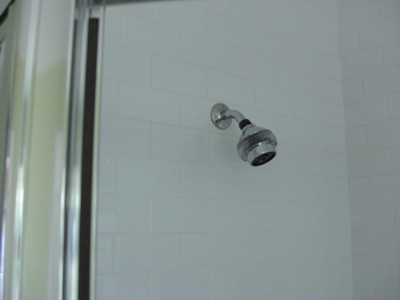
What could possibly be hard about replacing a shower head? If you don't know the tricks, leaks at the head and behind the wall are possible. PHOTO CREDIT: Tim Carter
Perhaps the best advice is to take out the gooseneck pipe as part of the job, and reinstall it with the new shower head. Use a small wire brush to clean the pipe threads. If the treads look corroded, then buy a new gooseneck pipe.
Many years ago the mistake I made when I installed my new shower head and gooseneck pipe is not using a pipe sealant on the gooseneck pipe threads. I was a very young man and had no idea what pipe dope or thread sealant was. If you do not use it, water will stream from the connection like an April shower!
There are at least two popular pipe-thread sealants. One is Teflon tape and another is a thick compound you brush on the male threads of the gooseneck. You need to put this sealant on both ends of the gooseneck pipe. If you fail to do this where you attach the shower head, water will leak from the connection and spray you and the walls inside the shower.
It really pays to use the right tools when replacing a shower head. The mistake I made was using a pipe wrench on the shower head. I didn't realize the fixture was made of chrome-plated brass. The teeth of the wrench ruined the finish on the shower head. If you look at most shower heads, you will discover at least two flat areas that are parallel with one another. These are made for an adjustable wrench that, when tightened correctly, will not mar the finish on the new shower head.
After you install the gooseneck pipe but before you install the new shower head, you should turn on the water in the shower. This will flush out any small debris and excess pipe sealant that may have gotten into the pipe. Failure to do this important step can clog the small flow-restrictor holes that are inside virtually every shower head. It can be a huge task to clean these out if they get clogged.
Don't over tighten the new shower head on the gooseneck pipe. Once it is hand tight, it should only take one complete turn to complete a leak-free connection. If you can't turn it that far, stop and test the connection. You can damage the shower head if you tighten it too much.
Talk to different professional plumbers about pipe-tread sealants and you will get polarized views as if you had entered into a political debate. Some plumbers prefer Teflon tape, while others love the brush-on pipe sealants. I happen to use the brush-on sealant that contains Teflon. That way I can be neutral in one of those discussions.
If you decide to use the Teflon tape, there is a special way to install it on the male threads of the pipe. If you install it wrong, the tape will unwind off the pipe as you turn the pipe into the fitting behind the wall. You may think you have a sealed joint when in fact you have a potential Niagara Falls.
One way to install Teflon tape that has worked for me for years is to use a piece of tape that will wind around the pipe threads three or four times. Hold the end of the pipe that you are wrapping so it is pointing at your face. Wrap the Teflon in a clockwise fashion so the threads are covered. It is that simple.
Column 737

Tim built custom homes and did ultra-custom remodeling for 20+ years before launching his Ask the Builder media presence. He was selected as one of the Big 50 by Remodeling magazine in 1993. This award gave birth to Ask the Builder in October 1993. Tim also operates https://DrawPlumbingPlans.com. His @askthebuilder YouTube channel was the first home improvement channel on YouTube.
I find the shower heads have a straight thread and the gooseneck pipe coming out of the wall is a tapered pipe thread. So it is a challenge to create a leak free installation. The shower head never really tightens properly. Using teflon tape and not overtightening is the about the only solution till they manufacture shower heads with pipe thread.
I made this mistake of not using a sealant, now there;s a leak in the shower on the cealing! what should I do shut off the water supply? I dont want it to cause damage to the walls
I had a plumber from my service plan come in to fix my leaking shower head. I was told that the parts (???) of my shower was American Brass - a discontinued product, but could be found at "some" plumbing supply companies. Its going to cost me $300.00 to repair!!!!!!!!.
I was stunned but agreed. I still don't understand why such a high cost and I don't understand what is going to be replaced.
My question which I did not ask or knew to ask at the time is why should I repair the shower with "parts that are no longer manufactured and can only be found at some of the older larger supply companies"?
Also I wrapped some teflon tape around the shower head my self and it still drips but not as much. The new shower head I put on has a washer.
My questions is why does the shower head drip at all, if it has a washer and the hot and cold water is turned off after a shower??
What stops the water from dripping or make it drip in the first place? Is it the handles that you turn on to get water to the shower head or something else?
I'm a master plumber Lelia. Your shower head is dripping because water is leaking past the valve. It needs a new washer or a new valve cartridge. Plain and simple. ALWAYS visit the following page at my website and READ the FIVE HACKS before you ever THINK of hiring a contractor. CLICK the text links at the bottom of the page to get FREE & FAST BIDS from MULTIPLE contractors within a few days. Go here:
http://www.askthebuilder.com/contractor-hiring-guide/