Framing House
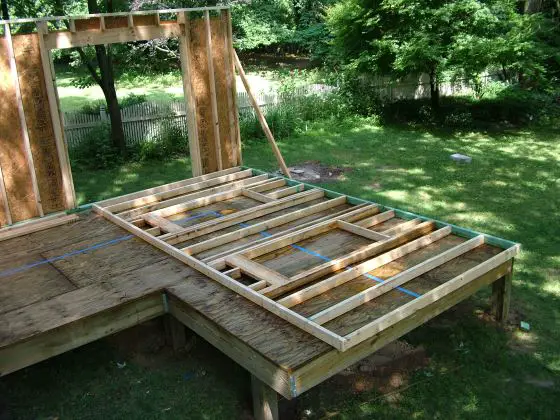
If you want to discover the depth of your ignorance about house framing, then start with a small project like an outdoor shed. PHOTO CREDIT: Tim Carter
DEAR TIM: Framing a house has been a dream of mine for years. My husband thinks I should get some professional help, and I am not talking about a construction framing crew. Do you think a woman can handle wood framing and framing walls for a new home? What is involved? Are the walls heavy? Is it hard to do floor framing? What advice can you give me to live my dream? Nicole A., Birmingham, AL
DEAR NICOLE: When you dream, you don't mess around! Framing a house is a daunting task, not for the weak or timid. It is hard, but rewarding work. I have framed many houses and have to tell you that I came home bone tired on many a day. Carrying around sixteen-foot 2x12's and large sheets of three-quarter-inch subflooring can really wear you out. Is it work for a woman? I say absolutely yes. You can do it, although it may take every ounce of strength you possess.
But don't let that stop you as there are all sorts of ways you can discover how to move heavy objects with minimal effort. You may not be the fastest framer, but you will accomplish your goal. To start you on the wood-framing pathway, I urge you to tackle a beginner project where you can get a taste of what you are up against. An outdoor shed is a perfect project as it has all of the components of house framing in a compact size. You can even learn roof framing with a shed-framing project.
Books have been written about framing a house, large books I might add, so it is impossible for me to give you all the direction you need in this small article. In my opinion, the foremost important thing to know is that you will never regret starting your framing project knowing it is both square and level.
The importance of the footprint of the house, the joist layout, the walls, etc. being square can't be overemphasized. When the floor and the walls are square, simple things like fitting the large sheets of subflooring, wall sheathing and roof sheathing become very easy. You know a rectangle or a square is square when the four corners are each 90 degrees. The floorplan of your house is almost always a combination of rectangles and squares that are bunched together.
There are all sorts of methods of wall framing, but I prefer framing the walls on the subfloor and covering them with the wall sheathing as they lay flat. Then you tilt them up as if they came from a factory. If you frame these walls taking the time to get them square, then they will fit together perfectly as you connect them together.
It is really important to stack the framing components. This means wall studs should line up directly above floor joists below. This allows loads to be transferred directly to the foundation. Your heating contractor and plumber will also thank you for this, as it makes it easy for them to install ducts and pipes. If you have a second story, the floor joists of the second story need to line up directly above the wall studs below.
You should absolutely become intimately familiar with the building code. There are many aspects of the code that deal with framing a house. You need to be aware of the span tables, notching and boring of joists and studs, beam construction and support, and many other things about connecting framing components together. Some things are obvious, while others are not. For example, my guess is that you might never think that you have to use special nails when attaching metal joist hangers to beams. Rookie house framers have been known to use roofing nails which is a gross violation of the building code.
Before starting your smaller test job on the shed, I would highly recommend that you go to the library to see if you can borrow several books on framing a house. I have my own extensive library of reference books, many from years ago. The old books contain some clever tricks I have not seen in modern publications. You can't absorb too much information on how to build walls and floors before you start to frame that dream of yours!
You can frame a house by yourself, but it is so much easier with a helper or two. You will need help lifting things, checking diagonal measurements, and holding things while you are bracing a wall. If you can get a helper that has some house-framing experience, you will never regret it.
Be sure to check wall studs and floor joists for crowning. A crown is a curve in the lumber. If you look at bridges, they all have a crown to them where the center is much higher than the ends of the bridge. All crowns in lumber should point up towards the sky. Lumber that is severely crowned should not be used. Set it aside for return or use it for small pieces of blocking.
Column 740

Tim built custom homes and did ultra-custom remodeling for 20+ years before launching his Ask the Builder media presence. He was selected as one of the Big 50 by Remodeling magazine in 1993. This award gave birth to Ask the Builder in October 1993. Tim also operates https://DrawPlumbingPlans.com. His @askthebuilder YouTube channel was the first home improvement channel on YouTube.
Dear tim, I am a young girl who reaslly wants to frame, but latley i am doubting myself. In my design class rigfht now we are doing a miniture model of a house. It frustraighting me because i dont know how to convert ft-in-cm...I fell really stupid, and would just like to know if you ever had troubles with things like that, should i give up now, or should i continue to try my hardest, im not gunna lie i dont want ot give up, but right now i dont know what to do :(..any advise?
Did you watch my video about reading a tape measure? You just have to practice and study.