Heating Cost
DEAR TIM: Winter is almost upon us, and what can I do to lower the heating cost at my home? The cost of heating is going up faster that I can pay the bills. There has to be a simple way I can lower my overall heating costs. What are you going to do this winter in your home? How do you plan to lower your heating cost? Carole P., Meredith, NH
DEAR CAROLE: You are not alone in your surprise, shock and concern about the rising prices of all fuels that many use to heat our homes. Last year we saw mind-numbing double-digit increases in the prices of fuels. The Energy Information Administration, a division of the U.S. Department of Energy, predicts more price increases, albeit not as high as happened a year ago.
Economic pressures on many of us have made it so there is very little extra money in the average budget. If this is where you find yourself, then you should think long and hard about spending large sums of money on a product or project that will save you money over time. Remember, when you spend money to save money you only start to see the real savings once you have completely paid for the service or product with the energy savings. In some cases this can take as long as ten or fifteen years.
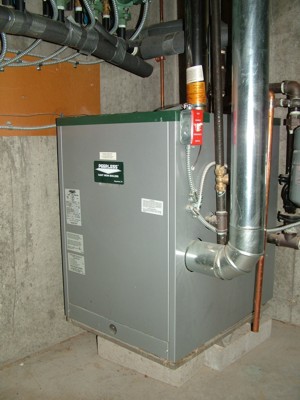
This boiler is fueled with propane, and has quite an appetite on cold windy days. PHOTO CREDIT: Tim Carter
I have a personal interest in this topic because I purchased a second home to live in while my new house is being constructed. My family is split between two homes, and I will be paying to heat two houses. You can bet that I'm taking as many steps as possible to lower the heating cost at the two houses.
There are all the obvious things you should do that require some time and small amounts of money. Among these are minimizing or eliminating as many air-infiltration leaks as possible. Caulk gaps around windows and doors both inside and outside. Look for gaps where the trim molding around both the inside and outside of the windows and doors contacts the frames and the wall surfaces. Air can sneak into these gaps and the cumulative total of all the gaps can create a significant loss of energy.
If you look at your energy bills, pay attention to your electric bill. You should note how the amount you pay in the winter can be substantial. The shorter days cause us to have lights on for longer periods of time. You can bet that lights at my houses will only be on in rooms where there are people. Consider switching to compact florescent bulbs one by one as you have to buy replacement bulbs. These devices really can help you save money over time.
But to really save big money on your heating costs all you have to do is use less fuel. This is something you can control with a flick of your wrist. Simply turn your thermostat down - way down. A programmable thermostat that can help you turn down the heat while you are away or asleep can pay for itself in weeks if you get really aggressive with the settings.
I feel that many of us have become spoiled with the comfort level in our homes. Our ancestors lived in drafty houses. Our forefathers lived in houses and cabins that had little or no insulation, weatherstripping or central heat. They obviously lived long enough to help sire our generation, so we know they were survivors of many a cold day and night.
Why not do what I plan to do? Consider turning down your thermostat to the lower 60's when you are in the house and into the mid 50's when you are asleep or away. When you are home, wear more clothes - hooded sweatshirts, long underwear and slippers with lambs-wool linings. Sleep with flannel pajamas and extra covers. These are all things you probably already own, so you do not have to spend money to make it through the upcoming winter. I have done these things for several years and am snug as a bug in a rug both day and night.
My kids run around my house in shorts, tee shirts and no socks in the winter and complain about being cold. I tell them to put on more clothes, and that there is no substitute for brains. No wonder they are cold, as they are half naked. If you dress lightly like this, you will be shocked at how warm you get by covering up your skin even while inside.
Remember that there are natural convection currents along exterior walls and near large expanses of glass. You may think air is leaking indoors when in fact it is air that is being cooled by the colder surfaces. This cold air literally drops to the floor creating a breeze. Reorganize your furniture so that you are sitting as far away from exterior walls as possible. You will realize immediate comfort.
If you don't like hooded sweatshirts, then wear a knit hat and sweaters indoors. Dress in layers, and watch how quickly you warm up. I purchased some flannel-lined blue jeans last winter and they quickly became my favorite pants to wear. They are so soft and warm I practically bake in them.
Column 744

Tim built custom homes and did ultra-custom remodeling for 20+ years before launching his Ask the Builder media presence. He was selected as one of the Big 50 by Remodeling magazine in 1993. This award gave birth to Ask the Builder in October 1993. Tim also operates https://DrawPlumbingPlans.com. His @askthebuilder YouTube channel was the first home improvement channel on YouTube.