Chainsaw

By Tim Carter
©1993-2009 Tim Carter

Summary: There are many considerations when purchasing chain saws. Be sure to get a chainsaw that meets your needs - length of the chainsaws blade and the weight. Always observe chainsaw safety guidelines when operating your chain saw.

DEAR TIM: I need a chainsaw and am flummoxed as to which type to purchase. I'm certain that I want a gas chainsaw, but wonder whether to get an 18-inch chainsaw or a 14-inch model. I've never used chainsaws before and am concerned about my safety. Can an average person use one with little fear? What tips can you offer about buying and working with these amazing tools? Laurel S., Lusby, MD

DEAR LAUREL: I can sure see why you are overwhelmed when faced with purchasing a chainsaw. Wow! There are so many brands, models and features, it's tough to separate what is really needed to do a particular job. But the good news is that I can help you as I just went through this myself. However, it's impossible to share all the knowledge you need to know in this short column.

Many moons ago, 414 to be precise, I used to operate a chainsaw regularly. My father-in-law owned a large tract of forested land that we harvested wild cherry trees for both woodworking and firewood. I used a durable chainsaw that had an 18-inch bar. This saw was fairly heavy, and it cut through hardwood trees with little or no effort.

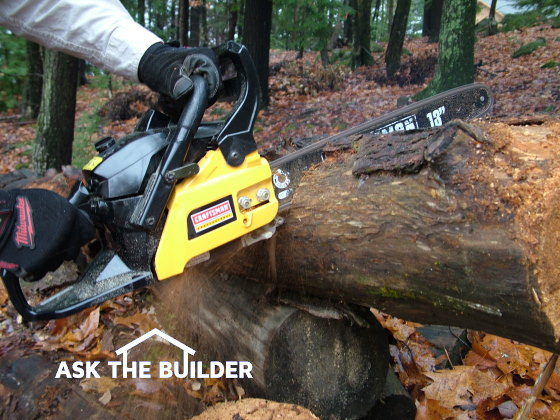
This lightweight chainsaw is really amazing. You would think it's a toy when you pick it up, but it chews through oak logs like they were butter. PHOTO CREDIT:  Brent Walter
This lightweight chainsaw is really amazing. You would think it's a toy when you pick it up, but it chews through oak logs like they were butter. PHOTO CREDIT: Brent Walter
I was never injured by the chainsaw, but my father-in-law was seriously hurt one day. He slipped while using it and proceeded to make a deep cut in one of his legs. Accidents happen, but this one may have been prevented had he been wearing chainsaw chaps. Chaps are special protective clothing that is an absolute must to have. Furthermore you need heavy gloves, safety glasses and a helmet with a cutting shield.

You can work with these magnificent and powerful tools safely. I urge you to inquire about training classes or demonstrations that might be offered at local stores that sell the chainsaws. There are also some excellent video and DVD products that many of the chainsaw manufacturers have produced that take you through a safety course. These mission-critical safety lessons must not be skipped.

I now own a fantastic 2.4 cubic inch, 40/cc two-cycle gasoline chainsaw that has an 18-inch bar. When I first took the saw out of the box I was disappointed. The saw was so light that I thought it was a toy. As soon as I started it and began to use it, I changed my mind. This saw is a beauty. The saw I used over 30 years ago was much heavier, and it would create arm fatigue before the rest of my body was tired. Pay attention to weight as well as any features on the saws that lessen vibrations.

When selecting a chainsaw, think long and hard about what you will really be cutting. In my opinion, you want a chainsaw that has a bar that's longer than the diameter of the wood you will be cutting. You absolutely can cut logs that have a diameter larger than the bar is long, but you take risks doing this.

Price is also a great indicator of quality. Chainsaws that cost more tend to have better parts and components, and they usually are more rugged. The extra money you spend will almost always give you a saw that will not let you down, and it can last generations if cared for. If you want recommendations about great chainsaws, talk to the owners of tree-trimming companies. They use the saws each workday and know what brands are dependable.

Cutting logs is a science. Be aware that a freshly cut tree has enormous amounts of tension in it as it lays on the ground. You can easily get the chainsaw bound up in a cut as the tree pinches the blade. Large portions of the tree can start to roll and trap you as you cut. You must always be aware of these dangers.

Be sure to read the owner's manual several times. Never take shortcuts with respect to the gas and oil that must be used. The bar needs oil to lubricate the moving chain. Use high-quality gas and oil for top performance.


Never let a chainsaw blade touch the ground or dirt. This will dull the blade very quickly. Cutting with a dull blade is both dangerous and puts lots of stress on the engine. Watch for dirt that gets trapped in the bark of older logs that you might find in the woods.

Sharpening a chainsaw blade is an art. The teeth of the blade must be ground to a precise angle to ensure the chainsaw cuts straight. Many tool-rental businesses will do a great job of sharpening chains. Don't underestimate this aspect of chainsaw maintenance.

Follow the instructions in the owner's manual for long-term storage if you want the saw to start after months of sitting idle. If you ignore these steps, you will be taking your saw in to get service.


Comments:

Graham Green
26 Nov 2008, 23:23
I empathise with Laurel. 3 years ago I hadn’t touched a chainsaw then I moved from London to rural New Zealand where taking care of woodland and clearing up after every gale became a big issue.

There is a huge difference in cost between the premium brands and China’s best but every time you start your saw you will know where that extra cash went. I can personally recommend Stihl and Husquvana. I would buy the biggest engine that I could reasonably afford and certainly more than a 14 inch bar so say a 50cc with a 16 inch bar as minimum. The weight difference between a 40cc and 50cc saw is less than a kilo (excluding bar). You can always fit a smaller bar and chain (at extra cost) but you will find that after just a short while you and your saw will become as one. (Cue mystical woodland music).

If you buy from a good store you can pick and choose what size bar you want and you’ll also need to factor in a couple of chains. Chains are priced by bar length. The store will also insist that you buy good (i.e. expensive) bar lube and 2 stroke oil) you have to humour them while your saw is under warranty. What they may also do is offer to refill your oils from their barrels at a reduced cost later on. With premium brand saws you’ll get a free first service by which time you will have had time to learn how to do it yourself. A big slice of the cost of a premium brand saw is going to the store so make them do a bit of work for you – ask them to show you how to do things if you aren’t sure.

It is financially worthwhile learning how to sharpen your chains. After a few false starts I settled on these gizmos (http://eze-lap.com/product/chainsaw.htm) which are American made and cheap as chips in the U.S.A. ($5). Use them with a Dremel at minimum speed not an electric hand drill, the Dremel has little torque so it forces you to have a delicate touch which will make your chain last longer.

A new saw comes with a fat book. Read it and make sure that you know what it all means.

Don’t cut costs on safety gear. Hard hat with visor, gauntlets and stout boots as well as chaps.

All the Best

g2

MF
30 Nov 2008, 20:33
I couldn't agree more with grahams advice. I purchased two cheap saws from a big box chain and both failed within a season. i spent an extra 100$ on a stihl and couldn't be happier. it starts on three pulls every time for the past five years. the thing is an amazing work horse.

one thing id like to warn against that i've seen attempted many times.... dont cut down dead trees. leave it to the pros (i've heard dead trees refered to as widowmakers). once the tree start to sway - weak, rotted branches begin to fall straight down. Even protective head wear wont protect you from the wallop.
SIR
21 Dec 2008, 20:05
The above comments are very helpful for a beginner but I would like to add a few things that some may know, some may not. I've used saws professionally for 30 years and for the average homeowner who only uses one a couple hours a year, buy an inexpensive one. If you will use one for a few hours a month go with a small professional model. The small details will make a huge difference in comfort long term. Good vibration isolation, good balance and the other features found in professional models will make long term use more pleasurable. An 18" bar is more than adequate for almost any backyarder. A 16" is probably better for the smaller cc motors. The shorter the bar the less power needed to turn the chain fast. I have used both Husquevarna and Stihl, both excellent saws. If you never bite the dirt or rocks with your chain, it should outlast your desire to use it. It should last many 1000's of hours of use, used correctly. A chainsaw course may be advisable but common sense will usually guide you through. Think about what you are going to do. IF I do this what will happen? Is it leaning? Is the wind blowing? Just be aware. Chaps and steel toed boots are a good idea for anyone. Never work past the point when you are tired as THAT is when accidents happen and with a saw you can lose a limb in a heartbeat. You can easily buy guides that show you the correct angle to sharpen your saw. Dremels work but a hand file is better. Much like a steel on a chefs knife, if you use it to "touch up" your chain every time you use it, it will cut like new. The problem with beginners using power tools to sharpen is they many times heat up cutting teeth by using it too long and take the temper out of the tooth. That softens the metal and it will dull faster.
It isn't rocket science and they are wonderful tools, but a healthy respect and a little knowledge will leave you smiling and not wanting to throw it into those trees, rather than cutting them up.
Graham Green
22 Dec 2008, 02:55
I would like to revise some of my earlier comments.
In north America there isn't a huge price difference between best and worst like there is in NZ - so do yourself a favour and either buy or rent the best.
I looked up buyers' comments on Sears saws and it wasn't pretty. (Sorry Tim hope your snow blower's OK) :-)
I run a cafe in the middle of nowhere in big logging country and a really stupid proportion of my customers have hooks in place of hands. Talking to these folks reveals an unexpected statistical fact (on my sample). Accidents happen because the saw operator looses their footing so make sure that you are very sure of where you are standing before you cut.
Having tried a lot of saws I really think that on a premium brand saw a fancy 'easy-ergo-recoil-start' system is a waste of time and a bit of weight that you don't need. Good saws start easily. I feel pretty much the same about 'easy tensioning' systems - I think a spanner is actually better.
Anyhow, that just my view.

Merry Christmas to one and all.

g2
Alan Stuart
22 Dec 2008, 17:55
I just want to say that I would never buy an electric chain saw until I bought one. I was surprised at how well it operated. You have to watch for the cord but you don't have to worry about gasoline leaking from the fill cap. It requires an extension cord but I bought it to cut up scrap for a fire pit in my own yard.
All of the same rules apply but when you release the trigger it stops. The one I bought is a McCullugh and my only regret is that it doesn't have a case. I have to keep it in the cardboard box it came in.
The chain is the same as the gas saws and it cuts the same. It still requires cutter oil but the bar is very short. And it still has kick, both good and bad. To me that is the greatest safety issue.
My first saw was a much larger Homelite i bought to cut up dead trees. But whether it is small or large, gas or electric I have a lot of respect for any chainsaw.
I've used the little saw to trim trees around the house and I would never attempt that with the large one.
Bob from Alaska
24 Dec 2008, 01:16
All the comments listed so far are good advice. If you only use the saw once or twice a year, then I support the idea of buying a saw for around $120 - $140, maybe a little more if it includes the case.
I operate a camp in a remote part of Alaska. It is not manned all the time nor is it secure. Chainsaws disappear from time to time so for me, cheap is good. Further, these saws can be abused by running low on oil, used with a dull chain and put away dirty. Often the fuel is mixed without a stabilizer added to it. Yet, these saws do the job. The last two I purchased several years ago I still have. They were 18" Poulans. I buy chains whenever they are on sale. Universal oil (from Home Depot) for the fuel and 30 wt or whatever I can find for the bar or even bar oil! The saws work all summer long. Each fall we have a wood cutting weekend. The big name saws all show up and yes, they will out perform the camp saws. But they are better maintained beside being bigger too.
So, it just depends on your needs for a saw. First time users should rent one to see if it's something they can handle. If you invest in a quality machine, that's fine too. But don't over look the little green or yellow ones. Properly maintained, they should do the job for a long time for a lot less investment.
And wear all the safety gear!
inTexas
30 Dec 2008, 07:58
Don't buy a Stihl. unless maybe you are going to buy one of their $800.

I bought a $300 16" and it broke after less than 50 hours of use.

Repair price would have been $300 except I talked Stihl into paying for the new oiler case. I guess the oiler failed which caused the clutch to go out.

I know too many people who bought Poulan's (sp?), or similar and are very happy with them.

I wish I had bought the helmet with the face shield instead of the helmet and the safety glasses. I don't use the helmet for ground cutting, but do for anything overhead.

Our situation is that we bought a house on a few acres and it came with plenty of trees that needed cutting--many are Osage Orange. We bought a fireplace insert to burn our wood thus saving money by not running the house heater. I could write an entire article on that experience.
Graham Green
30 Dec 2008, 17:52
Here is a link to a superb document on Stihl saws:
http://www.stihllibrary.com/pdf/SharpAdvice061301final.pdf
$300 US sounds like an incredibly low price for a Stihl - perhaps it wasn't entirely 'right'.
One thing that might be important is using Stihl oil, I think that I'm right in saying that German/Austrian bar oil is some kind of bio-degradable invention. I've only ever used expensive Stihl brand oil but maybe if you mix synthetic and mineral oils you get particulates gumming up the oil pickup.
inTexas
31 Dec 2008, 07:50
Graham,

Thanks for the file. It looks good. Better explanation on chains than the manual.

As for the price. They still sell the same model for that price and even suggested I might want to buy another one. It is an ms210c. I found it online here for that exact price: http://www.amickssuperstore.com/Stihl_MS_210C_Chainsaw_p/stihl%20ms%20210c- be%20chainsaw.htm

Interesting: I say it is too expensive for the quality/documentation, but you are surprised is is so cheap. Actually, that agrees with what other people have told me and I posted above. Stihl's very expensive saws are good, but the cheaper ones are no better than the half priced ones available elsewhere.

About the oil. We have only used Stihl oil and chains and Stihl dealer recommended procedures.

anotherview at g mx.c om

     View all comments
*Name:
Email:
Notify me about new comments on this page
Hide my email
*Text:
Security Image:

Visual CAPTCHA


Contact us to Advertise on this site.
Have a Suggestion?

Ask the Builder Comment Help

Helpful Comment Tips: If you need help with a problem, please try these things now before you type in a comment. You could discover your answer in just minutes.
Don't show this alert again.