Toilet Gasket
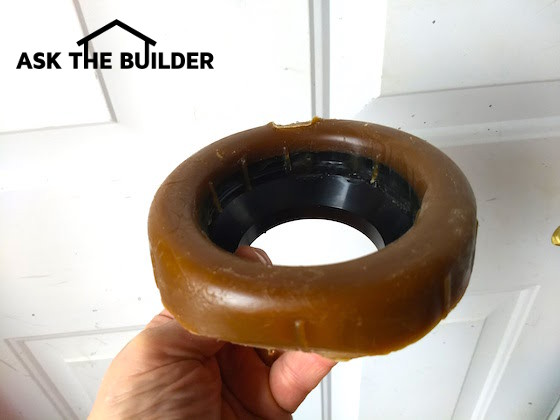
Sewer gas smell can leak into your home if this wax gasket has detached from the underside of your toilet. Copyright 2018 Tim Carter
DEAR TIM: My husband installed a new toilet gasket on the toilet in our master bathroom as part of adding a new ceramic-tile floor. He's pretty handy, but soon after I noticed a sewer gas odor in this room. He can't smell it, and I'm reluctant to have him do the job over.
The toilet doesn't move, the caulking is perfect so I can't imagine where the odor is coming from. For years, there was never an odor. What needs to be done to correct this? Vikki H., Henderson, KY
DEAR VIKKI: The toilet-bowl gasket was not installed correctly. The smoking gun is the fact no odors were ever present before your well-intentioned husband started the bathroom-remodeling job. I'm afraid that he needs to start over, but we need to discover what he did wrong so this second attempt yields a perfect result.
As for where the odor is coming from, many people forget that the holes where the toilet bolts pass through the ceramic toilet-bowl base are usually never sealed. The sewer gas that's wafting past the toilet wax gasket can easily seep past the bolts and the decorative caps. The caulking between the base of the toilet bowl and the floor will do nothing to stop the odor if these bolt slots are unsealed.
Thousands of homeowners who attempt to change toilet gaskets run into problems for any number of reasons. The seal between the toilet flange and the toilet bowl is mission critical. The toilet flange is the transition fitting that allows you to connect the toilet to the drain piping. Not only is there the issue of sewer odors, but vermin and water can also leak from this joint if the toilet gasket is not making positive contact.
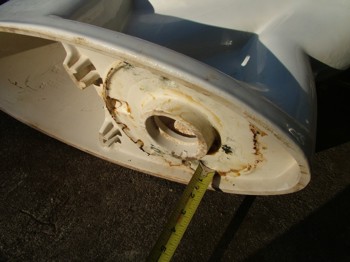
This is where the toilet gasket contacts the underside of a toilet. You can see the recessed area clearly. PHOTO CREDIT: Tim Carter
When you replace a toilet gasket, you need to pay close attention to many details. One thing homeowners, and some rookie plumbers, fail to look at is the recessed area under a toilet bowl. This part of the toilet is often about three-quarters-inch deep. This distance is measured between the bottom of the toilet bowl where it contacts the finished floor and the underside of the unglazed porcelain outlet where the wastewater exits the toilet.
The next thing you should pay attention to is the thickness of the toilet wax gasket. Most of them are no more than seven-eighths-inch high. I've measured many, and some are just three-quarters-inch high. You may be wondering why these dimensions are important.
For a toilet gasket to seal properly, the space between the underside of the unglazed fixture where the water exits the toilet and the top of the toilet flange should be no more than one-half inch. If you do a little math, you'll discover that this means the top surface of the toilet flange should be above the finished floor surface at least one-quarter inch. The top of the flange should be level, and the flange must be secured to the floor so it doesn't move.
It's possible that your husband wasn't aware of this important point. The top of the toilet flange may have been flush with the floor, or even sticking up too high. I've seen toilet flanges installed by inexperienced plumbers and homeowners that were an inch or more above the finished floor. When a toilet flange is too high, a poor seal can result because all of the wax gets squeezed out between the toilet and the flange as you secure the toilet to the flange.
In your case, I think a toilet-gasket autopsy will reveal that the toilet flange got buried by your new flooring. This is a very common mistake. A homeowner may install ceramic tile in place of a sheet-vinyl floor. By the time ceramic backer board is added and the new tile, the top of the toilet flange can be well below the finished surface of the floor. When this condition exists, it's entirely possible the toilet gasket never even touches either the flange or the underside of the toilet bowl.
Be sure your husband removes the toilet, and discards the toilet wax gasket he just installed. Clean the surface of the toilet flange as well as the underside of the toilet bowl. If the flange is not sticking up one-quarter inch above the surface of the ceramic tile, you can add an extender to the flange or use multiple toilet gaskets to achieve the seal. If you use an extender to create a new flange height, be absolutely certain the gap between the existing flange and the extender is sealed with a code-approved sealant. Failure to do this could create both water and sewer gas leaks once again.
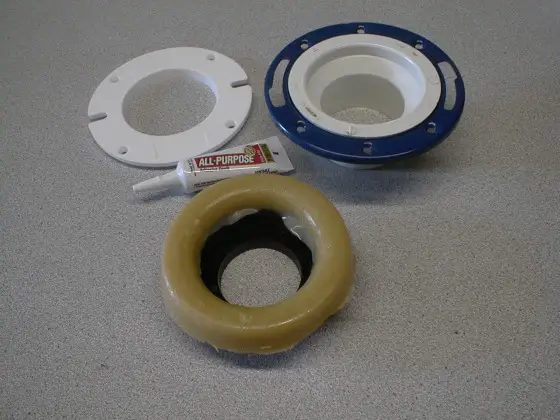
Another common mistake homeowners and rookie plumbers make is trying to level the toilet bowl as they install it. The toilet bowl needs to be level side to side and front to back, but this adjustment should be completed by dry setting the bowl over the flange without the toilet gasket in place. Use shims to get the bowl level. Then carefully lift the toilet bowl off the flange keeping the shims in place.
I've had the best luck over the years installing the toilet-bowl gasket on top of the flange instead of the underside of the toilet bowl. I use the toilet wax gasket to help align the long toilet bolts. I then carefully start to slowly drop the toilet down onto the flange trying to keep the bowl level as it drops closer to the floor. The shims ensure the bowl will be level.
If you attempt to level the toilet after the toilet gasket has contacted the flange and the underside of the bowl, you may break the seal as you lift one side of the toilet up to make the level adjustment.
Read about Helen's problem with a toilet wax gasket in my February 22, 2011 Newsletter. Ed has a toilet flange problem. Read his email in the DIY Bathroom Plumbing column.
Column 759
CLICK here to contact Tim to help solve your problem.

Tim built custom homes and did ultra-custom remodeling for 20+ years before launching his Ask the Builder media presence. He was selected as one of the Big 50 by Remodeling magazine in 1993. This award gave birth to Ask the Builder in October 1993. Tim also operates https://DrawPlumbingPlans.com. His @askthebuilder YouTube channel was the first home improvement channel on YouTube.
Would the gas smell be coming from the toilet area if the gasket is the problem? We also remodeled our bathroom (put in a new tile floor and vanity and replaced the toilet gasket) and then had a sewer smell coming from our sink. Would replacing the toilet gasket take care of that smell?
Thank you!
Hello-
I came across a new product, a closet flange that seals to the floor. I was wondering if you had heard of it, or had any experience with it.
Its called the Culwell Flange and it seals to the flooring making a seal so that water doesn't get under the flange, ruining the sub-flooring.
Website says it is made in the USA and that there isn't another product like this on the market.
Website is www,culwellflange.com I spoke to someone at the phone number listed and she was very nice & knowledgeable.
Just looking for a professionals advice.
Thanks!