Pocket Hole
DEAR TIM: Someone told me I could use a pocket hole jig to join two pieces of wood together instead of using dowels, biscuits or dovetail joints. What is a pocket hole? Is it an acceptable way to connect wood together? What is a pocket-hole system? Are these tools easy to use? Can you make really tight joints using pocket holes? What are some of the tricks you know about them? Loreli R., White Plains, NY
DEAR LORELI: A pocket hole is an ingenious invention thought up by some craftsman many years ago. I’ve seen them on antique furniture made well over 100 years ago. If you look under a table, inside a drawer or on the underside of just about any piece of furniture you may see an oval-shaped hole that has a screw head deep inside it. This is a pocket hole, and I have to tell you that they can be used to create strong joints that will pass the visual inspection of just about anyone who looks at the finished product. Expert woodworkers may scoff at a pocket hole as being a shortcut to a dovetail, mortise and tenon or lap joint, but everyone has their own preference.
" src="http://media.askbuild.com/legacy/780.jpg" width="350" height="262" /> The underbelly of this table shows how pocket holes were used to join the pieces of wood together. PHOTO CREDIT: Tim Carter
To create a pocket hole in a piece of wood, you need a pocket-hole jig. This is a simple device that clamps the piece of wood against a block so a special drill bit can precisely penetrate the wood at a low angle. The location of the hole is very critical as the screw that fits into the hole must exit the wood at a very specific location. If the screw exits the wood at the wrong location the resulting connection between the two pieces of wood will be weak. You can create strong joints between two pieces of wood without glue. Once you try it, you’ll become an instant fan of pocket holes.
Pocket-hole tools are affordable and readily available. The pocket-hole jig I own comes as a kit that includes the jig, the special drill bit, a clamp, and a handy case to store all the parts. There are other accessories you can buy that will allow you to extract all the power from the tool and make for perfect joints each time.
An often overlooked component to the pocket-hole system is the pocket-hole screw. The screws I use are special ones made by the company that makes the jig. These screws differ from regular screws in several ways. The tip of the screw is actually a miniature drill bit. As you turn the screw it drills its own pilot hole so the wood doesn’t split. There are even different thread patterns on the screws that have been developed to work with different species of wood. Don’t underestimate the importance of using the correct pocket-hole screws. If you use a drywall screw or some other screw stored in an old coffee can, you may split the wood or cause a blow out where the fat screw blasts apart the wood like a firecracker on the Fourth of July.
Recently, I used pocket-hole joinery to construct two small tables in just two hours. Before I started I had two pieces of birch plywood, uncut 1x4 pieces of poplar and legs my daughter had purchased from an online store. Using my miter-box saw, a measuring tape, drill, screwdriver and the handy pocket-hole jig, I had completed tables ready for paint well before lunch. The tables look as good as any you might find at a furniture store.
You can create a pocket hole, using the right jig and drill bit in seconds. The jig controls the angle of the hole and a special ring on the drill bit ensures the bit stops at the exact position to create the strongest joint. You’ll be assembling professional-quality joints in minutes. The two most important things I feel must be done are: 1. The cuts on the finished piece of lumber must be precise. 2. The wood pieces should be clamped together in the exact finished position as you turn the screw tight.
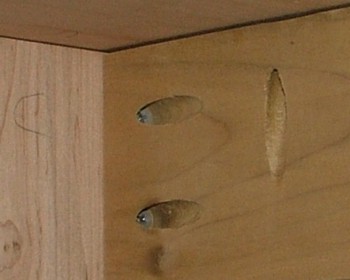
Close-up of pocket holes. PHOTO CREDIT: Tim Carter
I don’t feel you need a special pocket-hole drill. I just used my regular cordless drill. However, the pocket-hole drill bit is indeed a very special one. It’s actually two bits in one. At the tip of the bit is a small drill bit about three-eighths-inch long that drills a small pilot hole in the bottom of the pocket hole. This small hole guides the screw so it exits the wood at the precise angle. The main shaft of the bit is slightly larger in diameter than the head of the pocket-hole screw. This part of the bit also has special cutting edges at the sides of the bit that cut a smooth hole into the wood.
It’s really important to pay attention to the best side of the piece of lumber you’re using. Typically you want the best side to face outwards. This means the pocket holes should be drilled on the side of the wood that has any imperfections. Keep in mind the pocket holes are intended to be hidden on the underside of furniture or inside a drawer. It’s best to drill your first hole or two in scrap wood so you can see how the wood looks after it leaves the pocket-hole jig.
It’s mission critical that the pocket-hole jig that the bit passes through is securely clamped to the piece of wood that’s being drilled. This ensures the hole is the correct size and that the hole is at the correct angle. There is only a slight margin of error when drilling a pocket hole in wood that’s one-half-inch or three-quarter-inch in thickness.
I can’t say enough about clamping the wood together as you assemble it. Get squeeze clamps that allow you to lock the wood pieces together in the exact position you want them after the project is complete. Clamping the wood together ensures that the screws will enter the adjacent wood in the exact location. With fine furniture assembly you’re talking tolerances of one sixty-fourth of an inch or less!
Column 780

Tim built custom homes and did ultra-custom remodeling for 20+ years before launching his Ask the Builder media presence. He was selected as one of the Big 50 by Remodeling magazine in 1993. This award gave birth to Ask the Builder in October 1993. Tim also operates https://DrawPlumbingPlans.com. His @askthebuilder YouTube channel was the first home improvement channel on YouTube.