Brick Mortar
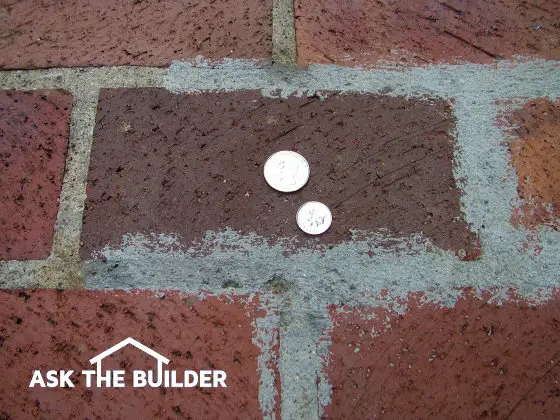
Brick mortar was smeared onto the brick. It’s been there for over two years to test the strength of the cement in the mortar. The climate is the Midwest USA with harsh winters with lots of freeze/thaw cycles. You can see the mortar is holding on like epoxy. That's a US quarter and a dime on the brick for scale. PHOTO CREDIT: Tim Carter
Brick and Mortar - The Perfect Marriage
DEAR TIM: Brick and mortar and I don’t get along. At my house, the brick & mortar are falling apart. It’s happening on the walls and in a brick patio in my rear yard. I desperately need a brick mortar how-to course so I don’t end up with a huge mess.
What are some of the important steps in brick mortar repair? Are there special tools that make the job go faster and look more professional? Steve T., Morris Chapel, TN
DEAR STEVE: Bricklaying mortar is a fantastic product when you stop and think about it. For all intents and purposes, it’s just glue. You use it to stick two or more things together into one object. You may not believe it, but there’s an enormous amount of science that’s involved in mortar for brick. I can’t begin to scratch the surface in this column.
What is Brick and Mortar?
Bricks are solid rectangular blocks made from fired clay or cast concrete. Mortar is a mixture of sand, Portland cement, and hydrated lime if you're able to find it. The mortar has the consistency of apple sauce and it's used to bind the brick together as one solid unit.
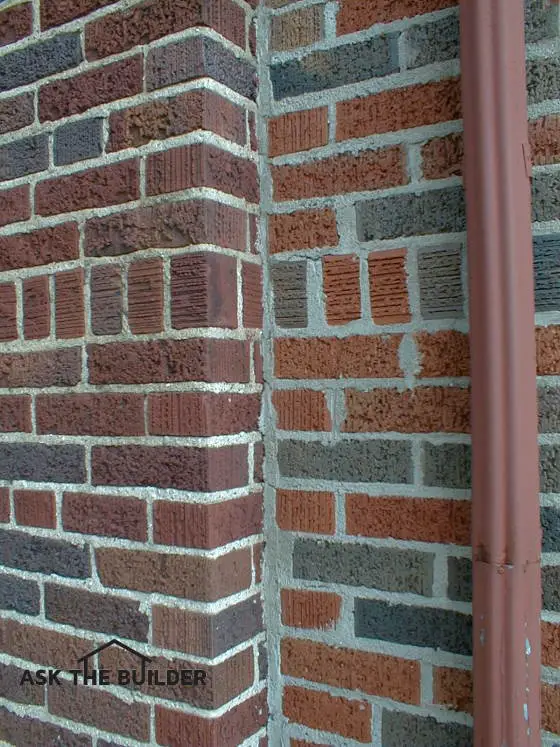
This is a typical installation of brick and mortar in the wall of a house or commercial building. The brick on the right was added years later and it's more orange in color than the brick on the left.
There are many different types of brick mortar, many with different strength properties. A standard mortar used with bricks in a wall often is a mixture of Portland cement, hydrated lime, and some form of clean, washed sand. Note that the sand can have a significant impact on both the strength and final color of the weathered mortar joints. Not all sand looks the same, because the small rock particles that make up the sand are different colors.
How does hydrated lime help mortar?
Many old masonry buildings were made with a mortar that had abundant quantities of hydrated lime or just lime and sand. Typically the more lime that’s in a mortar, the weaker the mortar is. You may think you want a strong mortar, but the lime in the mortar offers a unique self-healing property that may be of great interest to you. If tiny cracks develop in a mortar joint, the hydrated lime can actually grow crystals that seal the crack.
In my opinion, one of the most important steps is to match the mortar to the job. You don’t use the same mortar for your brick walls as you would to patch the mortar joints in your brick patio. The patio mortar needs to be far stronger than the wall mortar as the patio is subjected to more wear and tear, and if you get freezing weather, the mortar must be able to withstand countless freeze-thaw cycles.
David Kullander who hales from Libertyville, Illinois shared this heart-warming story about how he used hydrated lime as a young lad:
"As a 12-13-year-old lad, I labored for my bricklayer dad who belonged to the local mason's union. He made extra money for the family on regular weekend scab jobs for friends and neighbors building garages/fireplaces/additions. I soon was their go-to guy for mixing mortar in a mortar box-trough, using a big hoe with large holes in it. My instructions were 2 shovels of Portland cement, 1 shovel of hydrated lime, 10 shovels of sand, and the needed water to make it the consistency of apple sauce. My dad told me the lime was to make it easier to clean the brickwork when the work was all set and finished. According to him, the muriatic acid solution we brushed the bricks with wouldn't work to get off mortar smears unless the lime was in the mortar to react with the acid. This may be an old wives tale, but who knew- THEY WERE STRENGTHENING THE MORTAR!! Thanks for the article."
AUTHOR'S NOTE: The addition of the hydrated lime did little to aid in cleaning the smears off. Lime makes the mortar stickier, to be honest. It's always smart to add hydrated lime to the mortar mix.
How do you make a strong mortar?
To make a strong mortar for your brick patio, you just use pure Portland cement, sand and water. I would make the mixture very rich meaning that there is lots of cement in the mix. Try a mixture of two parts sand to one part cement.
Be sure you have all loose mortar out of the joint, and that it’s dust-free. Spritz the joint to be repaired with a little water and add the mortar. Make the mortar stand up a little higher than the brick. Wait until the mortar gets a little stiff and then scrape off the excess with a small pointed trowel. If the mortar smears onto the brick, you’re not waiting long enough.
When repairing mortar, check out the existing mortar joints
To repair the mortar in your brick walls, look very carefully at the existing mortar joints. Pay attention to the small colored grains of sand that are visible. When mortar is first installed and it dries, it’s a uniform gray color. This happens because all of the sand is coated with the mortar-cement paste. But over time, Mother Nature erodes the mortar-cement paste from the sand exposing the different pieces of small rock that make up the sand. You may see brown, red, gray, white, and even green pieces of sand!
You'd do well to read my repairing brick mortar column for additional information.
The trick is to visit a local sandpit and look at the different sands. Note that there can be a difference in both grain size and color. You want to match both as closely as possible. This will be well worth the effort if you intend to restore your brick walls so the repairs match the original work.
You can purchase bags of premixed brick mortar from a business that sells building supplies. Avoid the home centers as they usually will not have a selection of different mortars. You want to match the color of the mortar as well as the strength. The older your home remember that you want a mortar that is weaker.
Get FREE BIDS from local bricklayers to repair your brick and mortar.
Are special tools needed to work with mortar?
You don’t need too many special tools when working with brick mortar. I find that a medium pointed trowel, a small pointed trowel, a narrow pointing trowel that’s only as wide as the width of the mortar joint, and possibly a mortar grouting bag will commonly allow you to do most repairs. You may need a mortar chisel to help you remove crumbling mortar from between brick.
It’s really important to make sure the brick joints are clean, dust-free, and damp before you add the new mortar. The water that you spritz on the brick and old mortar helps make your new mortar that much stronger. Without the spritzed water, the dry brick and old mortar will suck out the water from the mortar too quickly. If this happens, the new mortar will never get as strong as it could be.
Take your time to avoid smearing the mortar on the brick face. If you do make mistakes, try to scrape off as much excess mortar as you can that day. Then wait 30 days before you attempt to clean the mortar paste from the brick. Use a solution of muriatic acid and water mixing one part acid to ten parts water. Dampen the brick to be cleaned with water and add the acid solution. Wear rubber gloves, goggles and old clothes. The acid is very toxic. Allow it to sit and fizzle on the mortar pastes, then scrub the area with a scrub brush after ten minutes. Rinse with plenty of water. Repeat if necessary until all mortar paste is removed from the brick.
This column was mentioned in my January 5, 2017 AsktheBuilder Newsletter.
Column 784

Tim built custom homes and did ultra-custom remodeling for 20+ years before launching his Ask the Builder media presence. He was selected as one of the Big 50 by Remodeling magazine in 1993. This award gave birth to Ask the Builder in October 1993. Tim also operates https://DrawPlumbingPlans.com. His @askthebuilder YouTube channel was the first home improvement channel on YouTube.
I have a newer home with mortor inbetweeen the block missing and it looks like honey cone but its a buildings product and some that have zero mortor . I was told weeping spots ?
Tim, I was reading the article on brick mortar, I am currently preparing a 400 sq. ft. area for a patio. I have some old red clay brick that i will use as pavers and I would like the brick to have a mortar joint, a white mortar joint. After reading your article I am convinced now to mix my own mortar, I found some white portland cement. Would you recommend mortar for this application? Also is it necessary to mix the mortar with water prior to application? If so how do i keep applying mortar without cleaning off the excess before it dries? I have used polymeric sand before so i am familiar with that process but i do not believe it comes in white, besides what you have proposed sounds better. I would appreciate your input. Thanks
You really need to do a phone consult with me.....
My builder laid the bricks with mortar between them thicker than on any house in the neighborhood. As a result as have less brick around the house. The identical house across the street has one more row of bricks than my house does. I there a strict bulders code governing the mortar thickness? Thanks
No, there is no strict code. If your house has but one less course of brick than the house across the street, that means the mortar joint is thicker by perhaps a little less than 1 / 40th of an inch. I doubt anyone could determine that. Count how many horizontal mortar joints you have. There are 3 joints every 8 inches. A one-story house has 9 feet of brick or 108 inches. 108 / 8 = 13.5 13.5 X 3 = 40.5
I have brick mortar in its original bag that was used when my house was built 20 years ago. I sifted through a piece of screen enough from the bag to almost fill a 5 gallon bucket. I had to sift it as there were clumps in the bag from moisture absorption. Is this bucket of sifted mortar any good(does unused mortar have an expiration date or shelf life)?
I have a 14 inch horizontal crack that needs to be repointed and I would like to use the mortar used to build me house if it will 'hold up'. Thanks in advance for your advice.
I would not use it. READ my past columns about what you have to do to MATCH MORTAR color. The sand you use is far more important than the mortar!
Tim could send me some info on how to do a slightly smeared mortar look for the exterior of my new home.. My mason is willing to do it but has never done it before and needs advice ... Thanks in advance
We are located in Oklahoma of weather etc.. Makes a difference
Hi, thanks for your great advice in your articles. I am building a retaining wall with reclaimed concrete and mortar. I am using a premix Portland mortar, 80lbs bags amid am wondering how long I need to wait between batches?
I just used Rapid Set Mortar Mix on some stone steps for repairs. I hope fthis will stand up to a harsh winer *moisture* with snow and ice, and many thaw/freeze cycles.
Is this a good mortar for these purposes?
No it's not. You made a classic mistake. You went and did the work, then started to research it. You should have made a mixture up like I talk about in this column. Next time STOP and come here and read up / watch videos, THEN go buy products.
Hi
We had our garde renovated last year the mortar that was used had crumbled in an area where we had new drainage & some Ivory Stone Natural Stone flags laid.
It was replaced with a different mortar which seemed better but over time has become discoloured & darkened around the edge of the flagstones.
Would placing new mortar over old mortar without removing it first cause this to happen!
the company that did the work originally came back when we were out to repair it so not sure if they removed old mortar first!
We have also had some marks appear on the flags that won't come out why is this!
Hope you can help!
Kind regards
Mr. Barnett
Hi, I have a builder who is building a 4mx4m porch (when he turns up) and so far it has taken him 12 weeks to lay the bricks up to roof height, approx 29 rows of bricks, which is ridiculous but he keeps disappearing for weeks on end and I dont want to lose my deposit that I have already paid him (£600) so am having to put up with the shoddy work. But now when I have inspected it I am having grave doubts about whether it is going to be sturdy enough, although it is only 8.5 bricks in depth and overall I think about 550-600 bricks have been used so it isnt a big porch. But on looking properly, the mortar in some rows between bricks is 3 inches wide and the same at the end of some of the rows that join the porch to my house, except here its maybe slightly wider at 4 inches. Will the mortar be strong enough to withstand being that large, surely bricks should have been cut to fit in at the end of rows. Also in the middle of the brick wall, in the middle o the rows there are bits of brick about 2 inches stuck in as if he has started at one end and then from the other and realised theres a gap and had to shove a bit of brick in. Also the mortar used does not match, it is different colours, there are 4 different coloured mortars , so I am getting very worried now. I can email pictures if anyone would like to give me some advice as to what I should do so your help is greatly appreciated.
I would like to use a mineral paint by Roma Bio on the brick exterior of my home however I would like to fill my raked joints beforehand for a flush mortar look. Because I will be painting, I do not mind if it is not perfect looking or if it inconsistently adheres to the rough brick face. The current depth of my joints measure 3/8" up to 1/2" and they are all 1/2" wide. The bricks are rough.
My question: What ratio/mixture do you recommend? What method of application would be ideal?
Thank you
Nan
Why we use strong bricks and weak mortar in masonary buildings?
I could use some help on achieving a smeared look on the brick of my new home. My brick layer is not sure how to do it.
We had a brick patio recently installed with gray mortar joints. In one section the mortar joints turned white. Any idea what happened and how to correct it?
My mother has a brick walkway laid many years ago with cement and mortar joints. Much of the mortar has cracked and eroded away. Is she able to remove the existing mortar and use just sand in the joints instead of re-pointing the entire thing? The bricks seem solidly adhered in place, it's just the mortar that is eroding.
Thanks very much!
In your article - adding height to an existing cinder block wall; why was there no mention of rebar ? And how do you use it in the project. I live in Albuquerque, New Mexico
How long after bricks have been layed should one wait before driving nails on the opposite side of the wall to continue construction?
Hi, I bought a new build house 3 yrs ago, the dpc sits 3 courses above ground level but the mortar in the the 3 courses is falling out and is very soft,I can scrape it out with my finger, the bricks are always wet even in hot weather, when I have looked around my house I noticed that there are other soft areas in the mortar also different shades of mortar, the bricks are that wet below dpc there is constant efflorescence on them with moss.
Can you advise please