Urethane Grout
DEAR TIM: A bucket of premixed urethane grout got my attention at a tile store. The salesman was chanting all the benefits of this new product, but I’m a little skeptical. What’s the difference between urethane tile grout and traditional tile grout? Is this grout in a bucket just a fad? Do you think it’s as durable as traditional cement-based grout? Would you use it in your own home? Saundra P., Lexington, KY
DEAR SAUNDRA: A little over a month ago, I discovered this fascinating new urethane grout. I’m getting ready to test it on a small project so I don’t have any real testing data to give you. However, I can tell you that based upon my research so far, it appears to be a top-line product that I’ll use in my new home project that’s starting soon.
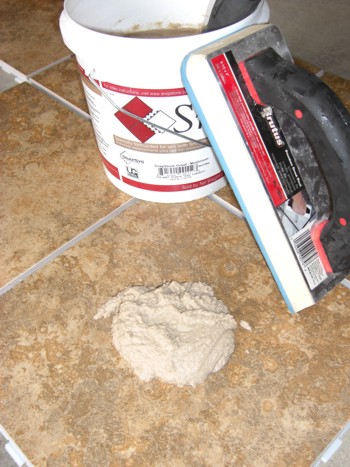
Yes, the urethane grout is premixed and comes in a bucket ready to go! PHOTO CREDIT: Tim Carter
I can understand being a skeptic with respect to home-improvement products. Failures can be expensive and time consuming as most things we install in our homes are meant to last. The last thing you want to be doing is chiseling out defective experimental grout from a tile floor.
The good news is that there have been hundreds, if not thousands, of innovative products over time that have quickly proven they have the mettle to withstand Mother Nature and the abuse we humans generate. I feel this urethane grout will be another one to add to the list.
Let’s talk about the differences between the urethane grout and cement-based grout. Because urethane grout is only available in a sanded version, we’ll limit the comparison to those two products.
Both products have a fine aggregate, usually fine silica (quartz) sand, as the foundation of the product. This sand is what really produces the strength and durability of grout. Silica has a hardness of seven on the Mohs scale, and not too many naturally occurring things are harder than quartz. When sanded grout is dry and you rub your finger across it, you can readily feel this sand.
Urethane grout is premixed. You open a bucket, stir it to fold in any of the urethane polymer that’s separated during shipment and immediately get to work. Cement grout is a powder you mix with water. If you add too much water, you can significantly reduce the final strength of the grout. Unequal amounts of water in different batches can lead to mottled coloration of the dried grout. Cement-based grouts are dusty when you pour and mix them.
The urethane grouts use polyurethane resins and polymers as the binder to hold together the sand particles. Traditional grout uses Portland Cement. Urethane is very sticky and bonds exceedingly well to just about anything.
The pigments in the urethane grout are a special coating that’s permanently bonded to each of the fine sand particles. The finished colors of the grout are solid, colors that are ultraviolet stable. They will not yellow nor fade when exposed to harsh sunlight that might stream through a patio door. Pigments in traditional grouts are powder additives that colorize the cement which then coats the silica sand. It can wear off over time. You’ll see this on older grout floors as the sand particles look white or a light color.
Because urethane grouts air dry, you have to wipe off any excess grout film quickly from the tile surface. It’s best to just work a small area of probably 10 square feet at a time. Always squeeze all the water from a sponge as you gently wipe and film from the surface of the tile. Excess water can weaken urethane grout.
The drying or curing time for these urethane grouts is about the same as cement-based grouts, however in very humid locations the curing time will be longer. They’ll not achieve a great hardness until the water in the emulsion has a chance to evaporate. Simply follow the instructions on the product label and you should be fine.
You’ll discover that the urethane grouts are more expensive than the cement-based products. However, factor in that the urethane grouts are more flexible than traditional grout. If there is slight future movement, a cement-based grout will usually develop a hair-line crack. The urethane grout may be able to withstand that stress without cracking.
If you’re a rookie and don’t know how to mix grout, the urethane grout takes away all that worry. You simply open up the bucket, mix and spread. If you have any leftover, you can save it if you follow the directions on the label. Once traditional cement-based grout is mixed with water, it will harden. You can save leftover dry cement-based grout, but you must tightly seal it so that humid air will not react with the cement powder.
Column 825

Tim built custom homes and did ultra-custom remodeling for 20+ years before launching his Ask the Builder media presence. He was selected as one of the Big 50 by Remodeling magazine in 1993. This award gave birth to Ask the Builder in October 1993. Tim also operates https://DrawPlumbingPlans.com. His @askthebuilder YouTube channel was the first home improvement channel on YouTube.
As I understand urethanes, they cure with moisture, (or a hardner a and b)
Is this not the case for grouts?? If then do they shrink?
Can you use urethane grout on any kind of tile? Snap Stone states you can only use it with their tile system.
What do the urethane grout manufacturers say?????? You always direct product-use questions to the people that MAKE the products. They know BEST what their product can / can't do.
I'm reading your Column 825 on urethane grout and can't tell what date the column is. Have you used the urethane grout yet? Any updates or changes to your advice? Thanks!
Can it be used on a glass block wall in a shower?
Out of interest, where did you source the grout from?
I am having problems finding urethane grout in the uk.