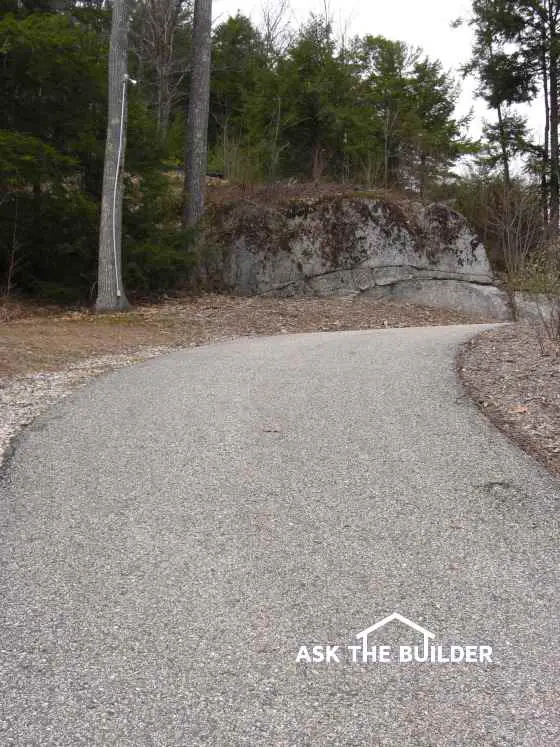
Asphalt Driveway
DEAR TIM: I grew up with an asphalt driveway, but my husband had a concrete drive. We’re debating what type to install as our current drive is in horrible shape. My contention is the asphalt driveway cost will be less than concrete. But my husband doesn’t want to mess with asphalt driveway sealer every year or so. What would you install at your home? What are the pros and cons of a new asphalt driveway? Lisa G., Burbank, CA
DEAR LISA: Let’s start by saying I’ve had both types of driveways at homes I’ve owned as well as a third possibility that you didn’t mention. I’ve had great success with all the driveways with respect to their ability to withstand heavy trucks, wear and tear, and virtually no maintenance. Yes, I said little maintenance with an asphalt driveway.
Asphalt is not too much different than concrete with respect to how it’s made. Both asphalt and concrete are made with stones and sand. But the binder that locks them together is completely different. Concrete uses Portland cement, while asphalt or blacktop uses asphalt cement. Asphalt is a very unique compound because at normal temperature ranges it can be flexible. This can be an advantage with paving.
When crude oil is low in price, the cost of an asphalt driveway is usually less than concrete. This is not always true as there are so many variables associated with each job. You simply have to get an asphalt driveway estimate along with one for concrete to make your decision, if it’s purely a cost issue.
But there are other things you should consider. Asphalt drives can contribute to staining of floors in your home if you’re not religious about taking off your shoes at the door. You can track in the oils from asphalt drives, as well as asphalt driveway sealer, if you leave your shoes on and walk around the house. My in-laws home had gorgeous white vinyl flooring in their kitchen that had yellow pathways created by the oils tracked in from the asphalt.
Sealing an asphalt driveway doesn’t have to happen as frequently as you might think. The current home I’m in has an asphalt driveway that’s eight-years old. It’s in nearly perfect condition, and has never been sealed. It’s absolutely true that sealers will help prevent water from seeping into tiny cracks in the surface, but I see none of those on my driveway.
Large asphalt roadways are not sealed, but they are sometimes coated with a rejuvenation product that helps extend the life of the asphalt cement that holds together the rocks and sand in your driveway. Ask your local asphalt contractors what they know about the rejuvenation coatings.
If you decide to go with an asphalt driveway, you need to understand where they derive their strength. Because the asphalt can actually move when it gets hot, the crushed gravel beneath the drive must be deep and well compacted. The soil under the gravel should be very strong, well drained and compacted. It’ not a bad idea to install a geo-textile fabric between the soil and the crushed gravel.
Asphalt driveway construction is a true science. I would install no less than 8 inches of crushed gravel under any asphalt drive I was installing. It should be installed 4 inches at a time and each layer well compacted. The gravel should extend at least 6 inches beyond the final edge of the finished asphalt if you want the edged of your drive to withstand heavy loads with no cracks.
If you’re considering asphalt driveway resurfacing, understand that you have several things that need to be thought out. Cracks in existing paving can telegraph through the new surface. If you want a perfectly smooth driveway for years, you may want to start over putting the new asphalt on freshly compacted gravel.
Adding one layer of asphalt on top of another can be problematic at sidewalks, garages, etc. The existing driveway may have great drainage away from these abutting surfaces, but the new driveway may create ponding issues. Be sure to discuss this possibility with your contractor. You want great drainage and no miniature ponds on your new drive.
Do NOT seal a new asphalt driveway for at least a year. You don’t need to seal it until it starts to turn gray or you see that the asphalt cement has worn off many of the small rocks.
You want a driveway that puts heads on a swivel? Go with a tar and chip driveway. It’s a hybrid asphalt driveway where liquid asphalt cement is squirted onto gravel and small colored stone chips are broadcast into the hot tar. Once it cools, you have a magnificent surface that wears like iron.
|
Still Need Help? Type Your Keywords Here:
Your Facebook friends would love to know how this column helped you solve your problem. Type a quick comment of what you discovered here at AsktheBuilder.com. Thanks! |
Comments:Welcome! I, Tim
Carter, don't answer questions
here. If you post a question here in the Comments Area,
perhaps another visitor will help you. You need to go to the Ask
Tim page if you want a question answered. Once there, look
closely at how many weeks behind we are. Please be patient as you use
this free service. If you have an emergency and need to talk to me,
there is an option there for you.
J 06 Apr 2010, 21:09
Tim,
What about concrete? You mention it in the first paragraph, but don't touch on it again. How does it stack up, what are its strengths and weaknesses, how do you maintain it, what's its life expectancy, etc.?
Joe Podolsky 16 Apr 2010, 05:39
Tim I am surprised you have left your driveway this long without sealing
it. Once the driveway shows the white stones it should be sealed. What
you have done by not sealing your driveway for eight years is you have left
the oils in the asphalt start to dry out by not sealing it soon enough. It
may look good, but when you have it sealed it will soak up the asphalt
sealer, AND WILL COST MORE TO SEAL IT, unless the contractor doesn't know
how long it has not been sealed.
The purpose of sealing asphalt is to keep water out and the UV rays from deteriorating the asphalt. It does not restors or replace the biinders and oils in the asphalt. Sealcoating should last longer than 3 years if it is not over diluted by adding too much water and a squeegee is not used to spread it on the pavement. If you use a squeegee to clean your windows, you know that a squeegee removes more than it applies, the same goes for asphalt sealer, it may spread it but it doesn't apply it with a thick coating, a broom or a spray wand applies it better and thicker. How thick should the asphalt sealer be applied? It needs to be applied at least 12 dry mils thick for a one coat on a driveway and two coats on a commercial parking lot at 12 dry mils thick. If anyone has more questions they can go to www.parkinglotworld.com and log on to ask any questions they have about asphalt sealer for their driveways or commercial parking lots.
Joe Podolsky 16 Apr 2010, 06:25
Correction: It needs to be applied at least 12 dry mils thick for a one
coat on a driveway and two coats on a commercial parking lot at 20 dry mils
thick. The mil thickness of sealer should be no less than 32 mils wet, 12
mils dry (first coat), 26 mils wet, 10 mils dry (second coat), drive lanes,
and turn areas Total coating dry mil thickness for 2 coats 20 to 22 dry
mils, and 3 coats 28 to 30 dry mils thick.
If anyone has more questions they can go to www.parkinglotworld.com and log on to ask any questions they have about asphalt sealer for their driveways or commercial parking lots.
A 23 Apr 2010, 11:01
While both asphalt and concrete drives, if built correctly and maintained
properly can last many years, concrete is much better for the environment.
That staining you mentioned reminds me of a report I recently read that
shows not only are you bringing stains onto your carpet with asphalt, but
you can be bringing other things into your home that are not good to be
exposed to. This is not the case with concrete. Asphalt sealcoats have
been shown by the EPA to put bad things in the water that runs off of them.
Joe Podolsky 23 Apr 2010, 11:57
While anyone can say anything on the web, it doesn't make it necessarily
true. It would help if people sighting something that someone or and
agency says if they would post the address of what ever was said. I am
from Missouri so you need to show me (the proof).
Joe Podolsky 23 Apr 2010, 12:31
Here is an article for those concerned about PAH's,
(http://www.forconstructionpros.com/print/Pavement/Features/Defending-Refin
ed-Coal-Tar-based-Sealer/3FCP15397). It tell how the study was or was not
done correctly. You can also look up PAH's in the dictionary to see what
other PAH's there are. Next time instead of posting your opinion please do
some checking on what ever it is that you have a concern about. Opinions
are like a**holes, everyone has one. It doesn't mean they are right wrong
or better than another.
Diana DiMaiuta 25 May 2010, 13:34
I have received 3 quotes with 3 different prices on having my driveway
repaved. The first one wants to remove all existing blacktop, regrade the
stone base then pave over the stone with 2" compacted asphalt base with 1
1/2" compacted ID2A wearing surface. The second quote is to remove
blacktop and dispose, grade stone base and compact with a vibratory roller.
Add additional stone and spread as needed to properly grade. Finish pave
with 2 1/2 ID2 blacktop compacted to 2". The same contracter if needed
will excavate drive and dispose of dirt and then stone drive with 6" 3M
stone and compact with vibratory roller and then finish pave with 2 1/2"
ID2 blacktop compacted to 2" which of course is more expensive and ony done
if needed. The last quote is removing existing pavement as needed for
tight flush finish at garage floor and walkways to assure proper drainage,
edge and move grass and clean and prep surface. Install tack coat adhesive
for proper adhesion to the surface. Install base coat of blacktop as
needed in order to provide a strong foundation and level surface. Blacktop
to be laid at 2" thick. He also uses blacktop machine installed and
vibatory compacted. I'm totally confused and not sure which to go with.
My townhouse is 30 years old and 13 years ago I had done what the third
quote wants to do and although it lasted we have had a lot of cracks in the
driveway. We did seal the driveway every 2-3 years. We don't park our car
on the driveway,most often it goes directly into the garage. What is your
recommendation?
My Driveway Dr. 04 Aug 2010, 09:58
Asphalt is cheaper than concrete which makes it a popular option. In
addition, there is also stamped asphalt. This is similar to stamped
concrete except with some advantages. This is a great option because it
makes aphalt look like real brick, stone, or slate. It is cheaper and also
less maintenance. Unlike regular asphalt which does need seal coating every
3-5 yrs; stamped asphalt has a polymer/cement coating ontop which does not
require resealing. The polymer/cement coating also gives it the flexibility
of asphalt, but with the strength of concrete. Also, unlike concrete you
can put salt on it during winter. Which you cannot do on concrete because
it can really damage it. It is a option worth looking into.
-My Driveway Dr.
Joe Podolsky 25 Sep 2010, 07:24
It sure is nice that we have so many people who are experts especally in
the field of concrete and asphalt, and the proper care and maintanance of
both. What it boils down to is how much people want to spend, the look of
it and the care and maintanance of their choice. You can put salt on
concrete to melt ice or snow, but if you read on the bags of salt it will
tell you not to leave it on the concrete once it has melted the ice or
snow. All concrete that is exposed to the elements needs to be sealed.
But not all concrete sealers are the same or do they have the same
protection. There are topical coatings and there are deep penatrating
concrete sealers. Topical concrete sealers need to be re-coated every few
years (3 to 5)depending on the ware. Deep penatrating concrete sealers
only need to be coated 1 time and last for the life of the concrete. Most
store sales people don't know which concrete sealers are the best to use
because there are so many concrete sealers on the market. You need to do
your homework before choosing a concrete sealer, because if you pick the
wrong one it can cause you more problems than you can imagine. If you want
to learn anout concrete sealers, or asphalt sealers you can go to
(www.parkinglotworld.com) and do a search or register and ask your
question/s. You can ask the pros on the web site, or e-mail them your
question.
pml 09 Nov 2010, 09:38
I am repaving (not sure which material yet) my driveway that hits right up
against my foundation. What is the best way to design drainage? Would it
be to but the paving up against the house and then just slant it away from
the house slightly? I do have drainage issues on that side of the house
already. What do you think of two trips down the drive with a center strip
of gravel for drainage?
View all comments |


