How to Stain a Deck
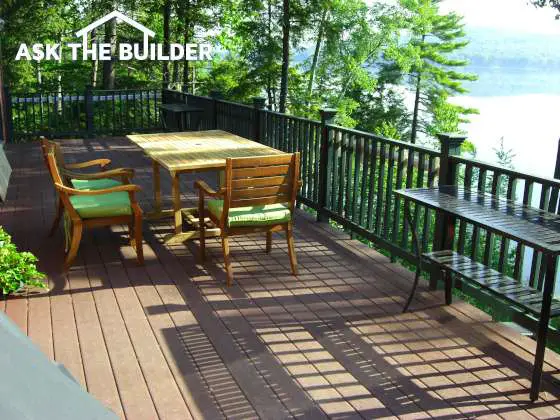
One of your decisions when staining a deck is to choose whether you want a colored or clear finish. PHOTO CREDIT: Tim Carter
How to Stain a Deck
DEAR TIM: I just bought my first home, and I have to discover how to stain a deck. I have so many questions. For example, how do you clean a deck before you start? Is there a difference between deck stains? Should I just paint my deck instead? Are there decks that don’t have to be stained? Jamie F., Nederland, CO
DEAR JAMIE: Let me start by saying that it’s impossible to completely cover this topic in the small amount of space I’m allotted. There are books written about all your questions and the one’s you failed to ask. But I can tell you that I’ll give you a crash course on cleaning and sealing a deck that will yield you great results over time.
Let’s start with selecting a stain. You can get at least two types of deck stain or sealer. One type is a penetrating finish that is designed to soak into dry wood. Other deck stains are formulated to perform much like varnishes or urethane. These products soak into the wood, but they also form a film on the surface much like a sheet of plastic wrap.
The problem with these film-forming deck stains is that they almost always peel when they eventually fail. The peeling is unsightly, and when you go to re-stain the deck, you must completely remove or strip off the old film. As you might imagine, this can be a tough job.
I prefer the penetrating deck stains and sealers that don’t peel when they fail. It’s easy to prepare a previously stained deck for re-coating if you have a penetrating finish on the deck.
You’ll next need to decide if you want your deck to be a color or do you want to have a clear finish. I happen to prefer colored stains that are a medium color of brown. Some people love a clear look that shows the natural color of the wood from the mill, while others happen to adore the gray look you see on weathered boardwalks or fishing piers.
The pigments used to color a deck stain perform a very important job. They help to absorb the ultraviolet (UV) light from the sun that bleaches out the natural color of wood causing it to turn gray. Some clear deck stains contain ingredients that also act as a sun screen much as the sun-screen lotions we put on our own bodies.
I tested the latest clear technology deck sealer last year and it failed miserably. The cedar wood I applied it to looked great for a month, then it started to turn gray. Within four months, my cedar wood looked like it was a neglected fishing pier it was so gray.
I complained to the sealer manufacturer and they sent me three different ones to test. I applied the products about a month ago, and I’ll know more by the end of the summer. I shot a video (see below) that’s also on my AsktheBuilder YouTube channel that shows me applying these deck stains.
You need to clean all wood surfaces before you apply and deck stain or sealer. This cleaning process is meant to get rid of all dirt, weathered sealers or stains, and any damaged wood fibers that may be barely hanging on at the surface.
Many people promote the use of pressure washers when cleaning a wood deck. If you use too much pressure, the wrong tip on the cleaning wand, and/or hold the tool too close to the wood, you can cause serious damage to the wood. The enormous pressure easily erodes the soft spring wood that’s in between the darker bands of summer wood. To get the wood smooth again, you have to sand the deck. That’s a tremendous amount of work.

I’ve found that cleaning the deck with oxygen bleach is a less-aggressive method that works well. Don’t confuse oxygen bleach with household chlorine bleach you might have in a white plastic jug in your home. Chlorine bleach takes the natural color out of wood, it’s highly toxic to all vegetation and trees around your deck, and it can accelerate the corrosion of any metal fasteners and structural connectors.
Oxygen bleach has none of these bad characteristics. It’s a powder you add to warm water. The oxygen ions that are then released in the solution are powerful cleaners that deep clean the wood. It’s best to apply the oxygen bleach to dry wood so it soaks in deeply cleaning the wood.
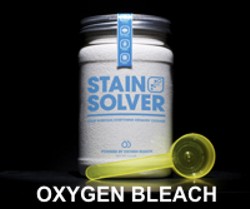
CLICK the bottle above to order Stain Solver Oxygen Bleach
I would never paint a wood deck. Just this past weekend I was on a friend’s wood deck that had been painted a few years ago. The paint was peeling off in many places, and as you might imagine, the deck looked horrible.
My friend asked what the best thing to do in this situation. Knowing that she didn’t have a lot of time or inclination to restore the deck to it’s original natural wood, I suggested she just clean the deck, let it dry, and then repaint it. I only said to do it this way because she then told me that in a few years they were removing the wood decking boards. My friend intends to replace the wood with synthetic wood decking that never needs to be stained or sealed.
Column 832

Tim built custom homes and did ultra-custom remodeling for 20+ years before launching his Ask the Builder media presence. He was selected as one of the Big 50 by Remodeling magazine in 1993. This award gave birth to Ask the Builder in October 1993. Tim also operates https://DrawPlumbingPlans.com. His @askthebuilder YouTube channel was the first home improvement channel on YouTube.
Is it better to use a water base stain on a deck or oil base.
The best, in my opinion, is a water-based product that is NOT a film former. Something that soaks into the wood.
These are becoming HARDER to find because in my opinion deck sealer companies WANT their products to peel and look bad so you have to buy more in a few years.