How to Paint
DEAR TIM: I’m embarrassed to say that I’ve never painted walls or woodwork. My dad always did it and I had no interest in helping. I now need to know how to paint as I just bought my first home. I tried painting the walls in my living room and made a huge mess. The paint looked good going on, but now looks transparent. Can you instruct me how to paint interior walls, ceilings and woodwork? How did you learn to paint? I’m so frustrated and am reluctant to call my dad. Angela P., Scranton, PA
DEAR ANGELA: I appreciate you asking me for advice, but your dad is the man who should be consulted. I say this assuming you’ve got a great relationship with him. He’ll be honored that you asked for his help and guidance. Being a dad, I can tell you that it should bring him great joy to hear his daughter ask for a demonstration of his skills and magic when it comes to painting. Do it. Make the call now.
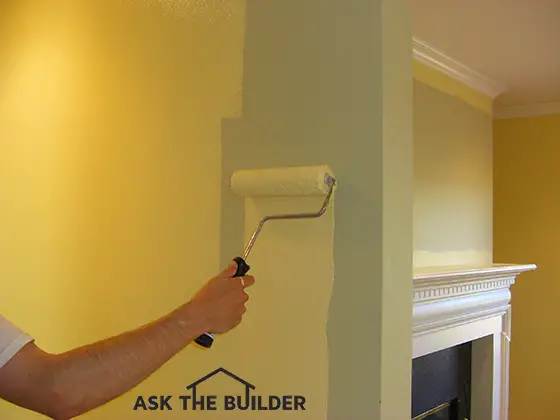
Painting with a roller looks easy. Believe it or not, it takes a considerable amount of hand-eye coordination to achieve professional results. ©2017 Tim Carter
In case he’s out and can’t pick up the phone, I’ll fill in. First, it’s absolutely impossible to share even a small percentage of what I know about painting in this tiny column. What’s more, instruction works best if you’re in the same room as the teacher. You need to see the actual techniques.
Let’s start with painting tools. Professional painters typically purchase the best brushes, roller frames, roller covers, etc. Why? Because these tools produce better results faster.
Make sure you match the brush with the paint. Polyester brushes are typically used with latex or water-based paints. I prefer using angled brushes for many tasks, but find they are a must for painting woodwork trim and cutting in paint where one color is up against another. I’m not a fan of the sponge brushes, but you may end up liking them.
Roller covers come in different thicknesses of the nap. I prefer to use one that has 3/8-inch nap for painting walls and ceilings with a flat finish paint. If you’re painting coarse masonry surfaces, you’ll want a 1/2-inch or thicker nap. If you’re painting a smooth surface with a high-gloss or semi-gloss paint, you may want a short-nap roller cover that has 1/8 or 1/4-inch nap. Smaller nap produces less texture in the dried paint.
Not all paint is created equal. You get what you pay for. Remember that paint is, for the most part, glue with color in it. There are special paints for different situations. For example, if you want to know how to paint drywall, especially new drywall, you’ll quickly discover that you need to use special primers that both prime and seal in one step. Some newer finish paints make the claim of not needing these primers, as they include the heavy pigments and porosity sealers in the finish paint product.
The problem with your poor coverage could be related to the quality of the paint, your painting technique or both. A considerable amount of the volume of many water-based paints evaporates from the surface you paint, leaving behind a very thin film of pigment and the chemical glue. If you spread the paint too thin as you work it, when the paint dries there simply is not enough pigment and adhesive to cover what was on the wall before you started.
Most paint cans have printed on the label the recommended coverage rate. For many years, a gallon of latex or water-based paint would cover about 300-400 square feet of surface area. When you do the math, you’ll discover that one gallon of paint should cover only the walls in a small 10-foot by 12-foot room that has 8-foot ceilings.
Be sure you read the label on the paint can before you start your next job. If you want the best results, follow the instructions. When they say to apply to a clean, dry, dust-free surface, they mean it. Remember, paint is glue and for it to stick well, the surface needs to be clean.
When painting ceilings, you’ll discover that adjustable fiberglass extension poles will save you time. Using this accessory, you can paint ceilings without making numerous trips up and down a ladder. The same is true for walls. I have numerous adjustable extension poles that screw into the base of the roller frame.
Clean up after the paint job is over is an art all itself. You can ruin a high-quality paint brush in no time if you clean it incorrectly. Never hold the brush up-side-down in a stream of water. This drives paint higher up into the bristles and fans them out. It’s better to dip the brush in a can of soapy warm water and shake it back and forth in the frothy mix. Do this with the rinse water as well until the water remains clear as you shake the brush.
If your house has a septic tank do NOT clean your brushes indoors. You don’t want latex paint residue entering the septic tank or leach field. Clean your painting equipment in a large bucket indoors if necessary and dispose of the cleaning water safely outdoors in a sand pile or other media that will capture the paint and not pollute the soil or ground water.
Column 833

Tim built custom homes and did ultra-custom remodeling for 20+ years before launching his Ask the Builder media presence. He was selected as one of the Big 50 by Remodeling magazine in 1993. This award gave birth to Ask the Builder in October 1993. Tim also operates https://DrawPlumbingPlans.com. His @askthebuilder YouTube channel was the first home improvement channel on YouTube.