Downspout Drainage Pipes – Use SDR-35
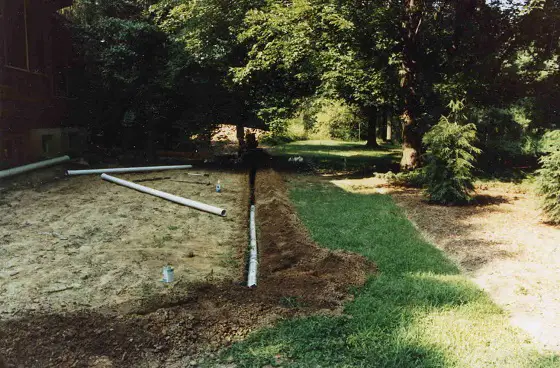
Downspout Drainage Pipes | You're looking at a 4-inch PVC SDR-35 sewer and drain pipe. The downspout drain line had to make a bend. In the lower part of the photo, the pipe you see connects to a 45-degree fitting. (C) Copyright 2021 Tim Carter
"Never direct roof water to a part of the lot where surface water would not normally drain."
Downspout Drainage Pipes - Use Solid SDR-35
Every year tens of thousands of homeowners suffer from water seepage into their homes caused by nonexistent or poorly constructed downspout drainage systems. Homeowners who are blessed with sandy, well-drained soils escape this problem.
I talk all about sandy soil and how it works at my New Hampshire home in this gutter downspout sizes column.
Does Clay Soil Cause Drainage Issues?
Clay soil causes drainage issues because water can't pass through it. Sandy soil is better
However, a majority of homeowners in the nation face problems with clay-rich soils. Certain clay soils are very resistant to water infiltration. In general the deeper you go in the soil the tougher it is for water to flow. Water builds up in the upper layers of these soils and looks for a place to go. Often that can be your basement, crawl space, or the lower level of your split-level house.
What is Soil?
Soil is made up of solid particles of tiny pieces of rock, organic matter, liquid water, and gas. The gas usually happens to be air. After a rain, this air oozes to the surface as it is replaced by heavier water.
The upper layers of soil usually have the highest air content. The greatest amount of water content and water movement usually takes place in the upper 2 feet or so of most clay soils.
Are Splash Blocks Acceptable?
Splash blocks are not an acceptable way to get rid of roof water. Roof water should be piped away from the house inside a solid 4-inch PVC SDR-35 pipe. This pipe should connect to an approved city stormwater drain system, a stormwater retention pond, or discharge on the ground at a low spot away from the house where the water would NATURALLY DRAIN to the next lot had the house not been built. Never direct roof water to a part of the lot where surface water would not normally drain.
Just before writing this bulletin, I received a book that shows how to make your own concrete splash blocks. These features are common on many homes here in Cincinnati and across the nation. Builders and remodelers have installed these simple 'energy absorbers' for decades. The splash blocks absorb the energy of the falling water. If you think they keep water from collecting around your foundation, well, I've got this bridge I'd like to sell you...
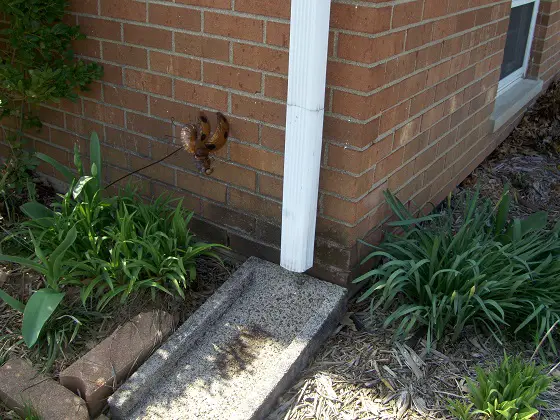
Splash blocks don't do much to channel water away from the foundation. © 2017 Roger Henthorn
How Much Water Falls on a Roof During a Storm?
The rainfall that falls on an average roof can be tremendous. I currently live in New Hampshire. The footprint of my house is 1,625 horizontal square feet. During a major storm where 2 inches of rain falls from the sky, my gutters will send 2,0215 gallons of water through my downspout drainage pipes! It's important to realize this is just one storm! Think how much water falls over an entire year.
A typical house in the Chicago area can have in excess of 50,000 gallons of water fall on the roof in just one year. The larger roof in my previous house in Cincinnati, Ohio will send about 145,000 gallons of water through the downspout drainage lines and then exit to French creek in French Park.
Is it a Mistake to Allow Roof Water to Empty Next to a Foundation?
Allowing your roof water to simply discharge next to your foundation and into the soil around your house is a big mistake. This water can seep into full basements or crawlspaces.
The solution is to pipe it away from your house. Some areas allow you to discharge this water onto the soil at the lowest part of your lot. Other cities may require you to hook up your downspout drains to a city stormwater system. Whatever the case may be, you want to get the water away from your house.
What are the Best Downspout Drainage Pipes?
The best downspout drainage pipes are PVC SDR-35 pipes. I prefer 4-inch diameter and it needs to be solid pipe with no holes. You can buy this pipe with fittings that glue on or ones with gaskets that slide together using liquid dish soap as a lubricant.
The worst downspout drainage pipes to use are:
- black corrugated pipe
- thin-wall 1500-lb.-crush-weight plastic pipe
I dislike these pipes because they crush easily and are tough to clean out should a clog develop and because roots can grow into their joints.
Instead, I choose to use pipes with smooth inner surfaces, thick crush-resistant walls, and tight-sealing joints.
Is Schedule 40 PVC Better Than SDR-35?
Schedule 40 PVC pipe is better than SDR-35. Schedule 40 has thicker walls and is more expensive. I feel it's overkill for exterior downspout drainage lines. You can use schedule-40 pipe if you want.
If you decide to use schedule 40 PVC, at least save some money going with the lighter cellular pipe.
There are two piping materials I'm aware of, both are made from PVC, that meet these criteria. The best material is Schedule 40 PVC. This is the pipe that you see used for indoor sanitary plumbing purposes. The pipe wall thickness is very substantial. The fittings are welded to one another with a special solvent. When dry, you can not separate the pipes. Roots can not penetrate.
The other pipe I like to use is called SDR 35. It is a lighter-weight PVC pipe that is used primarily for sewer pipework. I prefer to use the pipe that has special male and female ends. The female end has two durable rubber gaskets that seal the male connection. This pipe does not leak! You simply coat the rubber with liquid dishwashing soap and push the male end into the hub of the female fitting. BINGO, a solid leakproof connection. The fittings work the same way.
Do You Always Use 4-Inch Diameter Pipe?
I always use a 4-inch diameter pipe for downspout lines. This size can handle vast quantities of water. It is also easy to clean out should a clog develop. If you have a big house and are collecting the 4-inch pipes into one outflow pipe, at some point you may have to upsize to 6-inch pipe. I develop plumbing plans like this and do phone consultations if you need help.
How to Install Downspout Drain Pipe
Buried pipes should always be placed in a bed of sand. There should be no voids under the pipe before it's backfilled.
Pipes should never act as beams. A pipe becomes a beam if the entire bottom of the pipe is NOT resting on compacted sand or rounded pea gravel. The weight of the fill over the top of the pipe will cause it to bend or break.
The pipe should be completely covered with 4 inches of sand before adding any other fill on top of it. This is the best practice.
Sandy or loamy soil can be substituted for sand so long as it's dry and flows like dry sand.
Never stand on a pipe as you fill it.
Never cover a pipe with clay clods or fill that contains sharp rocks. Once you have a protective layer of sand or loamy soil about 6 inches thick over the top of the pipe, then you can put in crap fill if you so desire.
What Fittings Are Used to Change Directions?
You use three primary fittings in buried downspout drainage lines:
- sweep 90s
- wyes
- 1/8-bend or 45-degree fittings
A sweep 90 has a gentle bend and it's to be used just below the actual metal downspout. This fitting transitions the water from falling vertically from the roof to begin traveling horizontally under the ground.
NEVER make a bend in a buried drainage line using a 90-degree fitting. If you need to turn 90 degrees, use two 45-degree fittings and it's best to put about a 1-foot piece of pipe between the fittings. This allows a drain-cleaning snake to easily make it around the bend with the least amount of friction.
Wye fittings allow you to connect two downspout drain lines together from two different downspouts. The wye has a gentle 45-degree connection into the main drain line. NEVER use a tee fitting to connect two horizontal buried drain lines.
Tim, Are You a Master Plumber?
I am a licensed master plumber. I was taught years ago that it is a bad practice to install right-angle fittings below ground. Right-angle fittings are generally considered 90-degree elbows. These fittings slow down water flow and make it difficult to rod out or clean out a clogged pipe.

Tim Carter has been a master plumber since 1981. He knows all about plumbing fixture schedules.
If you need to make a 90-degree bend, simply use two 45-degree fittings separated by a small (1 foot) length of straight pipe. If you can put a longer piece in between the two 45's, all the better!
Ninety degree elbows can be used where the buried downspout drain line turns up to capture the actual downspout. In addition to this fitting, you may wish to add a tee or wye fitting just as the pipe exits the soil. This extra fitting can be used as a nifty cleanout. In the event of a clogged pipe, you do not have to remove the downspout from the hub. You simply insert the cleaning snake through the cleanout.
Column B112

Tim built custom homes and did ultra-custom remodeling for 20+ years before launching his Ask the Builder media presence. He was selected as one of the Big 50 by Remodeling magazine in 1993. This award gave birth to Ask the Builder in October 1993. Tim also operates https://DrawPlumbingPlans.com. His @askthebuilder YouTube channel was the first home improvement channel on YouTube.
Tim,
As a former Engineer (it has been more than a while), I am facing a home project exactly like what you are describing in this article. I am planning to use Schedule 40 PVC like you discuss. Do you have a good calculator that will show the best way to calculate the drain pipe sizing as we connect the multiple roof drains together into a common header for discharge?
Thanks.
The only calculator is the one in my head. I just switched to 6-inch pipe when I combined the front and rear of my house.
probably too late for this conversation, but for anyone in the future: this page has tables that show required pipe size for a given expected maximum rainfall (in inches per hour) and square footage of roof.
http://www.harvestingrainwater.com/rainwater-harvesting-inforesources/rainwater-harvesting-inforesourcesdownspout-gutter-sizing/
Are the fittings for SDR 35 labeled as such? The only fittings I seem to find are DWV. Are these ok to use with SDR 35?
Hi Tim,
We have never had a drainage issue, we have lived in our house 13 years and have experienced some terrible downpours. Last week we we had new gutters installed because we had some delayed in the corners and it was staying our cedar siding . Last night we had 2.5 inches of rain and our water started to collect in our window wells and pour into our basement. Our old downspouts were 2x3 and our new downspouts are 3x4 going into a 4in pvc pipe. There are 3 pipes go out to to our culvert. 1 pipe was was completely blocked but to be honest we never realized it was there. It had been grown over with grass. Another pipe was partially blocked due to the oak tree seeds they drop in the spring.
I want to know if we should increase the pvc pipe size because of the increased down spout or reinstall the 2x3 downspouts. Or just Jesse it alone and dig out the pipe deposit better - which had been done.
Planning on using this pipe and hoping for the best
Tim, my neighbor told me that according to the building code this pipe must me bedded in stone. I showed him this page and he said you were wrong and showed me page at charlote pipe that says it needs to have stone. I would like to tie into the town storm sewer system . Are these considered different than a commercial sewer pipe?