Foundation Drain Tile & Backfilling Tips
Foundation Waterproofing - You Might Not Have It!
Did you know that there is a big difference in exterior foundation waterproofing treatments? I'll bet that you think that your new home foundation has been waterproofed. Yes, you saw that black stuff sprayed on so you are in good shape. Isn't that right? WRONG! Fewer than one in 50 houses in the Greater Cincinnati housing market have waterproofed foundations. Most are damp proofed. What do you think is happening in your city?
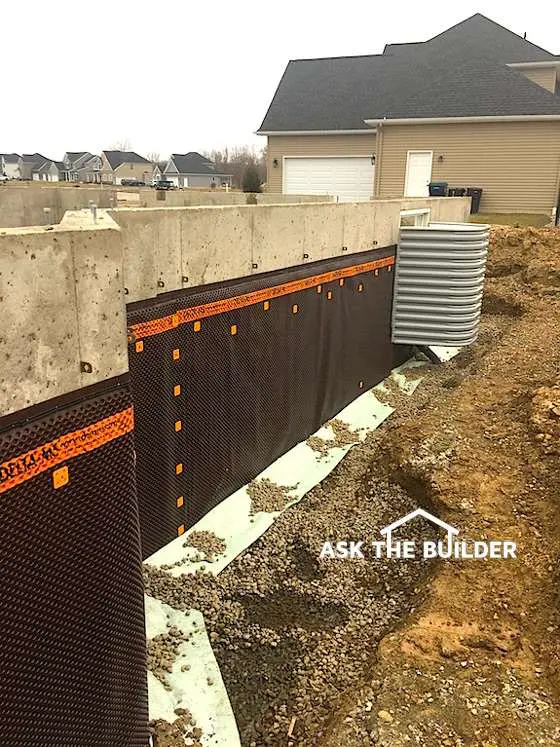
This system connects to the drain tile. It's a great waterproofing solution. I'd add more gravel and no matter what the MS Delta people say, I'd cover the gravel with a foot, or more, of straw. Copyright 2025 Tim Carter
What's the Difference?
Concrete soaks up water. If you place moist earth around an unprotected foundation, your basement will be damp. Surely, you have been in an older basement and smelled this moisture. Older homes rarely had any treatment on the concrete or stone.
Beginning in the 1950's, there was widespread use of asphalt on new foundations. This was hand-brushed or troweled onto a new foundation by laborers. The asphalt did a great job of minimizing water soaking into the foundations. However, it did not possess the ability to bridge or fill a crack that may develop in the foundation. You see, after a period of time, asphalt becomes somewhat brittle. When a foundation treated with asphalt cracks, the asphalts cracks too!
Approximately 25 years ago, Owens Corning modified standard asphalt by adding some rubberized compounds. The result was a compound that had a certain amount of flexibility. Other companies developed synthetic rubber compounds that have far greater elasticity than the modified asphalt. Even before either of these products were available, commercial builders used cardboard panels filled with bentonite for waterproofing. Bentonite is a special natural clay product that swells when wet. Water carries the clay into the crack, it swells and plugs the leak! The bottom line is that you can truly waterproof your foundation. It just takes a little homework on your part to select the right product for your particular building situation.
Drain tile - REALLY Important
If you decide to have your new foundation waterproofed, the company doing the work will most likely insist that they install or monitor the installation of your drain tile system. Very few builders that I'm aware of take the time or interest to adequately install drain tile.
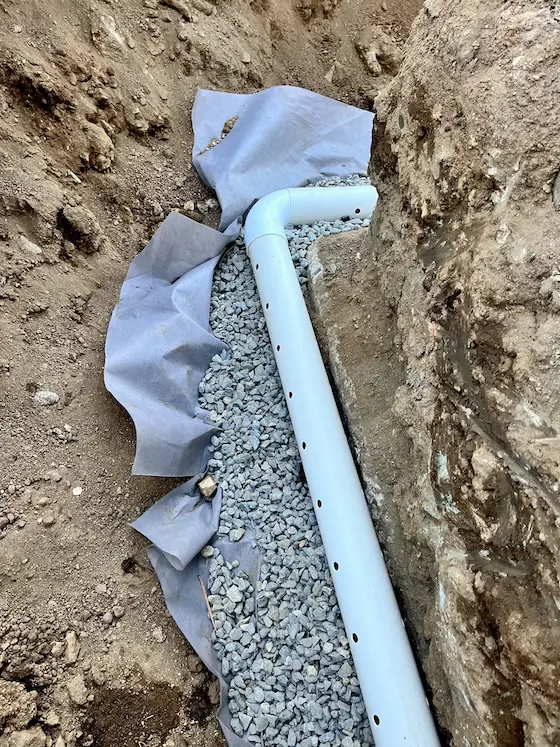
This is 4-inch-diameter perforated drainpipe. Everything about the installation, but one thing in this photo, is wrong. Copyright 2024 Tim Carter
Water naturally flows towards your foundation. This is especially true if you live on a hillside or even a slight slope (which, by the way, most of us do!). Much of the movement of water is horizontal through soil. Water occupies the void spaces between the particles of soil. The deeper you go into a soil, especially if it is clay, the less space there is for water.
To make matters worse, the soil that is used for backfill around your house is rarely compacted. When it is dumped around your house, it has huge amounts of air in it. This dirt was fluffed up and pumped full of air when it was dug from the ground. It can takes years and years for this ground to naturally compact. In some case, where overhangs protect the dirt, it may never truly compact. It can always have more air in it than soil only five or six feet away. This can spell BIG trouble for your foundation if it is not waterproofed AND if you have a bad drain tile installation.
From the above discussion, you can see why drain tile is important, I hope. The point is this: the backfill soil has the capacity (because of the large volume of air) to hold large quantities of water. You need to collect this water rapidly and get it away from your foundation. That is the job of the drain tile.
Another Quality Installation
That is a phrase I used to use to tease my coworkers after we would finish a task. It was an inside joke. However, the phrase applies to drain tile. You generally only have ONE chance to put it in. It gets buried deeply. It can clog up if not installed right. It's expensive to redo. For these and several other reasons, you need a quality installation.
I always like to install the drain tile on the side of the foundation footer. Many builders simply install it on top of the footer. Installing the drain tile on top of the footer means that your water table will be at the top of the footer. My method puts the water table about six inches below the top of the footer. You want the level of water as low as possible.
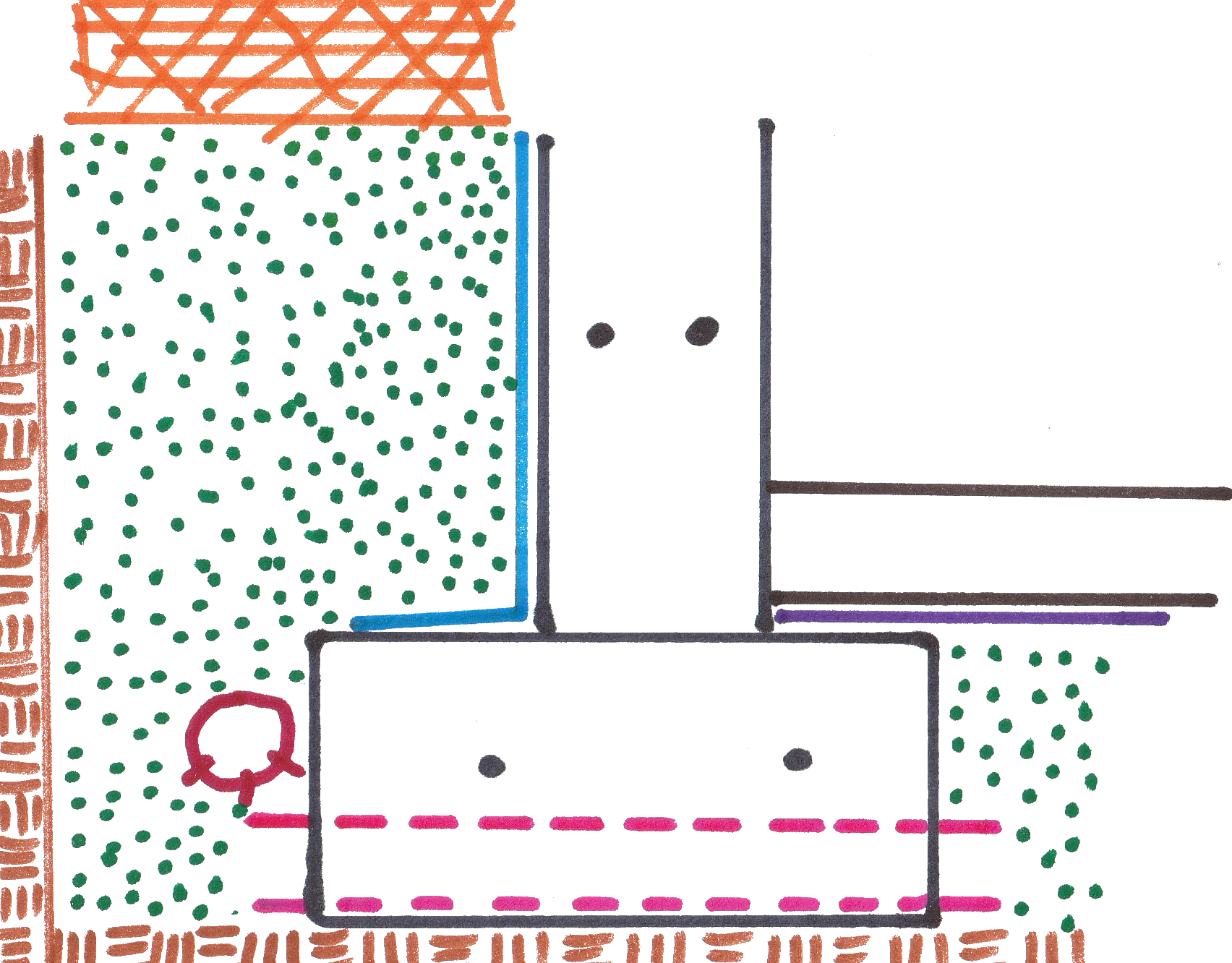
I recommend that the drain tile be installed the day after the footers are poured. I used to help strip the forms and then put a one to two inch layer of one inch gravel along side the outside of the footer. I would then install the drain tile continuously around the footer. Finally, we would cover the drain tile with one inch gravel flush with the top of the footer. This would complete phase one of the operation.
There are advantages to doing the job this way. First, the space between the side of the footer and the wall can fill with collapsed dirt and/or concrete overflow from pouring the foundation wall. This stuff is tough to dig out and remove once the basement walls are poured. Besides, it is tough to work in the narrow area left along the foundation after the walls are up and poured.
Once the foundation is waterproofed, you can continue the drain tile installation. I recommend that you install an additional two to three feet of one inch gravel cover above the footer. On top of this, install tar paper or a six inch thick layer of straw before installing any backfill dirt.
The elimination of the straw or tar paper is a huge mistake. The backfill dirt is fluffed up. When it gets wet, small silt particles will be carried into the gravel. This will clog the gravel. If your soil has enough fine particles, you may clog your drain tile! All of your work will have been for naught!
Seeking Daylight
So where does the drain tile water go? Good question! If you are lucky, it drains out somewhere on your lot. Here is what I mean. If you are building on a sloped lot, maybe you are lucky enough to have enough fall within your property line whereby the drain tile can daylight. There is no need for the pipe to have a slope. It can be laid virtually perfectly level from the footer until it daylights. The net result is that you are simply providing a resistance-free path for the water around your foundation to escape.
If you are unlucky, like me, you need to install a sump within your basement. The drain tile pipe gets to the sump either through or under your footer. I always install a six inch pipe under the footer right where I know I will install the sump. I actually install this pipe before the footer is poured. It's tough to tunnel!
An electrical pump pumps the water from the sump to either the outside of your house or into a storm water drainage system. Never allow the sump water discharge pipe to dump the water along side your foundation. This simply soaks the soil again!
Battery backup sump pumps are available to assist the regular pump in the event of primary pump failure or a storm-related electrical outage.
Backfilling Basics
Many a foundation crack is related to backfilling. Very few homeowners realize the risk of backfilling a foundation too quickly.
Don't forget that your foundation walls are simply beams or retaining walls. The walls act as a beam once the basement floor and the first floor subfloor are attached. Without these two elements, a foundation wall can tilt inwards, crack or even slide off the footer! Don't allow your builder to backfill until these floors are in place!
Also, did you know that it takes approximately 28 days (under ideal conditions!) for concrete to reach 75 percent of its design strength? I know of builders who backfill foundations within four days of being poured!! I have seen huge cracks develop from foundations that were backfilled prematurely. Don't let it happen to you!
Column B113

Tim built custom homes and did ultra-custom remodeling for 20+ years before launching his Ask the Builder media presence. He was selected as one of the Big 50 by Remodeling magazine in 1993. This award gave birth to Ask the Builder in October 1993. Tim also operates https://DrawPlumbingPlans.com. His @askthebuilder YouTube channel was the first home improvement channel on YouTube.
how do you install the drain tile under the footer before the pouring? any info of this would be greatly appreciated, thanks!
Hand dig a narrow trench.
I am on a slope and have a daylight drain from the drain tile. Is the proper installation for the daylight drain portion the same as the rest of the drain tile? I believe our builder simply connected perforated, corrugated pipe to our drain tile, ran it out to daylight, and back-filled the drain line portion with dirt. Could silt work it's way into the drain line and back into the drain tile?
Thanks,
Brian