R Value Guidelines

By
©1993-2012 Tim Carter

        
Summary: Using R value guidelines to upgrade your insulation is likely a smart move. R values, established by the U.S. Dept. of Energy for walls, ceilings, floors, and other areas of your home, are really minimum requirements. Check insulation R values recommended for your area on the map and table here. Increased insulation R value in your ceilings and wall insulation will bank extra energy dollars saved in no time!

Ceiling and Sidewall Insulation R-Factor Guidelines

Within the past few years, the Department of Energy has developed new insulation guidelines. These are minimum standards. There is absolutely nothing stopping you from installing more insulation. The only thing you need to consider is the long-term payback. For example, I built my home over ten years ago. At the time, the guidelines for ceiling insulation were an R-30 in my climate zone. I doubled that and installed an R-60 ceiling of blown-in fiberglass. Did I waste my money? I think not. My neighbors fuel bills for houses smaller than mine are nearly double! I save approximately $1,000 per heating season. I probably save an additional $400 during the cooling season. Some of these savings can be attributed to thicker sidewall insulation, an air infiltration barrier, and tight building practices. However, in your existing home, you might save $150 to $200 per year on average. If it costs you only $300 more to upgrade to an R-60 or more, do so! Within two to three years, you will be saving money.

The U.S. Department of Energy, Office of Energy Efficiency & Renewable Energy, has also published Technology Fact Sheets on basement insulation; crawlspace insulation; slab insulation; wall insulation; and ceilings & attics.

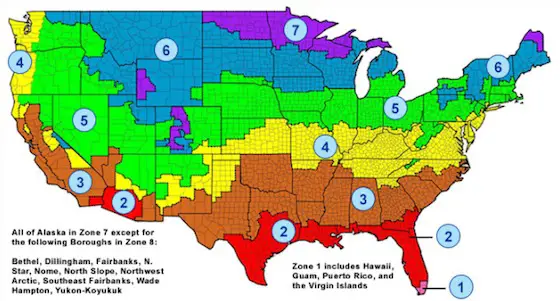
The map below is vastly different from the old guideline maps that showed only five climate zones. If your city is located on the borderline of one of the zones, always upgrade to the higher zone. It will not cost that much. Ask the manufacturers for installation guidelines. You need to learn how to do it right. Knowledge is power!


PHOTO CREDIT: US Department of Energy

All of Alaska in Zone 7, except for the following boroughs in Zone 8. Zone 1 includes
  • Bethel
  • Northwest Arctic
  • Dellingham
  • Southeast Fairbanks
  • Fairbanks N. Star
  • Wade Hampton
  • Nome
  • Yukon-Koyukuk
  • North Slope
  • Hawaii
  • Guam
  • Puerto Rice
  • Virgin Islands

* "These recommendations are cost-effective levels of insulation based on the best available information on local fuel and materials costs and weather conditions. Consequently, the levels may differ from current local building codes." ... US Dept. of Energy

How Much Insulation Does My Home Need?
For insulation recommendations tailored to your home, visit the DOE Zip Code Insulation Calculator at www.ornl.gov/~roofs/zip/ziphome.html.

Insulation Zone Map Guide

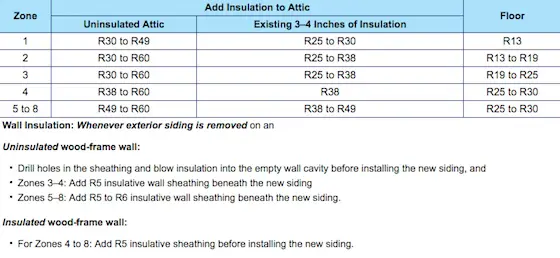
The following table shows the different R-Values that you need to achieve in ceilings, walls and floors with respect to the zone you live in. Study it for a few moments and it will make sense.

PHOTO CREDIT: US Department of Energy

NOTE: For more information, see:
DOE Insulation Fact Sheet (DOE/CE-0180)
U.S. Department of Energy
Technical Information Center
P.O. Box 62
Oak Ridge, TN 37830

or Energy Savers - Tips on Saving Energy & Money at Home from U.S. Department of Energy, Office of Energy Efficiency and Renewable Energy.

03/2009


Still Need Help? Type Your Keywords Here:
(examples: drywall repair, pilot light goes out, poor lot drainage, crown molding guide, etc.)

Comment on Facebook

Your Facebook friends would love to know how this column helped you solve your problem. Type a quick comment of what you discovered here at AsktheBuilder.com. Thanks!


Comments:

Welcome! I, Tim Carter, don't answer questions here. If you post a question here in the Comments Area, perhaps another visitor will help you. You need to go to the Ask Tim page if you want a question answered. Once there, look closely at how many weeks behind we are. Please be patient as you use this free service. If you have an emergency and need to talk to me, there is an option there for you.
Ryan
14 Apr 2008, 14:39
Tim,
I am currently building a home on an un-vented crawlspace in Central Arkansas. There is also an extra storage area utilized in the space with a garage door. I have installed a high performance vapor barrier that overlaps 6" with taped seems throughout the crawlspace. The vapor barrier also laps up onto the exterior walls of the crawlspace. The HVAC ductwork is on the interior of the home in furdowns, so there is no ductwork in the crawlspace. Would it be necessary to insulate the crawlspace walls (concrete block), and if so, what type of insulation would be sufficient for the job?
Mark Stewart
06 Jul 2008, 13:14
I want to know about R values when buying a fifth wheel travel trailer.
I want to stay the winter in Montana
And need to know what R factors would be required. Thanks
Mark
Gayle Austin
27 Sep 2008, 08:49
I would like to put an insulation board on the exterior of my home. the highest that we can locate is a 4 or a 5 for a 3/4" could you tell me if it is worth taking the siding off and replacing with either of the above R factors. What would be the difference between the 4 or 5 and would it be a financial savings. If not, what would you recommend to increase the R factor in the walls of our home. We live in the norther part of PA.
matt
29 Oct 2008, 07:55
I am trying to choose between wet sprayed cellulose and wet sprayed rock wool. This is new construction, so all walls and ceilings are open. Any thoughts on which might perform better? Which one has a higher r-factor?

Thanks.
ann
17 Feb 2009, 20:59
I reside in Zone 2. My house block built (1951) On a cement slab. Lots of windows mostly old things. Just put in a new 90% efficent propane furance. House also has a pellet stove that is supposed to be able to heat the entire house We have new, insulated exterior doors but will be adding storm doors as well.

I wanted geothermal heating but was told my house is too poorly insulated to make geothermal a viable option. ( I was told come back when the walls are R-18; and attic is R-40)

Getting mixed responses about the quality of my attic insulation. Some have said it is R-30 and others have said -- maybe R-20 to R-24 in places. VERY tight attic space but not impossible for workers to get into it. Roof is metal. (Base insulation is blown in cellulose with no apparent damage to it (no moisture, nor rodent activity, etc).) Heat ducts go through the attic and apparently are uncovered for the most part. Eve hang over where the cinder block comes into the roof, I have been told has NO insulation.

Would like an R-50 in the attic. What would be the best route to go? Thinking of a combination of insulation material (spray in foam and fiberglass??) . Would it be advisable to clear out the old material and put in new?

AREA TWO:

I don't believe my cinder block walls were insulated with anything. MAYBE there is a tiny moisture barrier wrap on the outside which was then covered by four in brick.

Some folks have told us--NOTHING you can do about the exterior walls for insulation; others suggested drilling holes into the cinder block and blowing in insulation; yet another suggested blowing it down from the attic (but it is tight up there).

I recently saw another farm house getting wrapped on the outside with something that looked like thick foil. I got the idea that insulated vinyl. We had the north side exterior wall insulated and covered with vinyl. WHAT an improvement. And we have replaced all the windows on the north side with energy efficient modern windows. But, I think at best we are at an R-11. I would really like an R-18.

Before I finish the other three sides of my house, is there a better way to increase the insulation level of these walls?

Is is possible to blow insulation into the walls?

AND FINALLY, I was just reading about insulating the base around slabs. I have never heard of this.

Can anyone tell me what this is? How is it done?

THANK you in advance to anyone and all who can help give me some guidance.

Steve
28 May 2009, 17:08
I have a log home here in eastern pennsylvania of approx. 1300sq ft. The roof consists of 2.25 inch thick rewood boards 6inches wide, tongue and groove assembly. above that is what I call composition board(compacted floor sweepings). Then felt paper and then shingles. I have a "leaky" roof in the winter and no problems in the spring or summer. I have been told that the problem is condensation and that the roof needs to be torn up and then insulted and a new roof put on. My question is two-fold. Does this sound accurate as far as the diagnosis? If so, what is the R-factor that I should be looking for? One of the quotes is to install Atlas Cross-vent system and that would give me a 6.5 R-factor. The roof that is on now is only six years old. I tried to save money by having "family" help put it on but.... Looking for some real answers, Steve
Terry Leja
28 Aug 2009, 09:35
Tim: Our client has an issue in a parking garage ceiling that constructed of double "T's" and concrete. The floor temperatures of the Offices above are very warm from the transfer of heat (we are Zone 2 Phoenix). THey would like to know if they insulate the floor with a R-7 or R-9 what would a 100 degree F floor temperature be reduced to? Same for 125 degree floor temp? Thank you!
tRAVIS
01 Sep 2009, 21:01
help with wall insulation
Ray Ivey
16 Sep 2009, 21:09
I'm building a new home and the living area will be a vaulted ceiling with a 12/12 pitch. It will be lined with tongue/groove wood (5 in). Is is best to insulate the top side of this ceiling with celulos or the underside of the roof with foam? Because of the high ceiling, R value for that area needs attention.Thanks, RI
Carole L
13 Oct 2009, 19:10
We are building a separate shop with a storage area up(Gambrel barn style). We are in area 6 (Hamilton, MT), what insulation do you suggest?
Thanks, CL

     View all comments
*Name:
Email:
Notify me about new comments on this page
Hide my email
*Text:
Security Image:

Visual CAPTCHA


Remember, Tim Carter doesn't answer questions here in the comments. You need to go to the Ask Tim page.
 
Have a Suggestion?
Do it right, not over!

Ask the Builder Comment Help

Thanks for stopping by! The Comments Section of my AsktheBuilder.com website is a place for you to share stories about how you've solved a similar problem at your home or carry on a conversation with other visitors. I tried, at the beginning, to be part of the conversation, but there were too many questions being asked and it was impossible for me to keep up and get my regular work finished each day.

If you want to ask me a direct question, you should go to the Ask Tim page of this website.

Helpful Comment Tips: If you need help with a problem, please try these things now before you type in a comment. You could discover your answer in just minutes.
Don't show this alert again.