Soil Drainage Solution: French Drain Systems
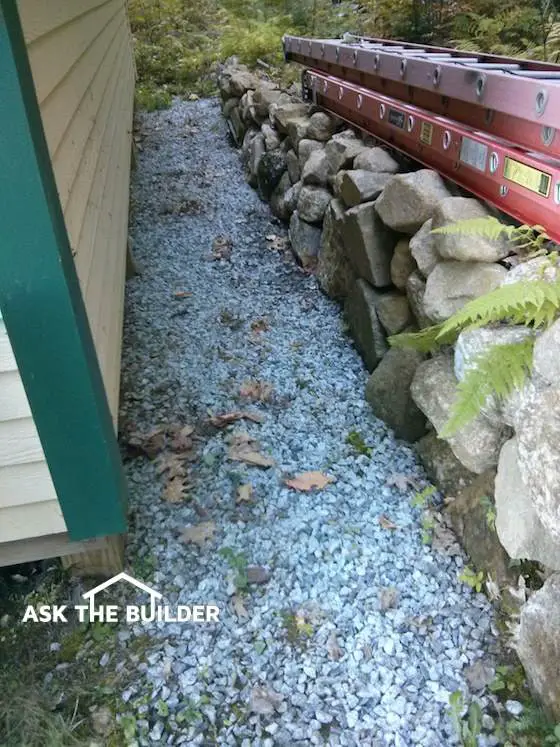
In the center of this gravel is a linear french drain. Some call them trench drains as I dug a trench and put in a perforated pipe. This area never has standing water in it now. Copyright 2017 Tim Carter ALL RIGHTS RESERVED
! ! ! See Author's Notes at Bottom of Column ! ! !
French Drain Systems In The Soil Work
Last year, I did some consulting work for one of my readers here in Cincinnati. She had a massive drainage problem in her rear yard. Half of the neighborhood's water was flowing through and over the soil into her backyard.
Her basement was leaking, the yard was soggy, and she had flooding in heavy rains.
I designed a simple linear French drain system to solve the problem. After seeing my design and asking some questions, I got the feeling she wasn't convinced as to its ability to solve the problem.
I assured her it would work. She indicated that it had better as she intended to hand dig the system. I gave her a handy tip on digging trenches and even let her borrow my duckbill shovel. This tool and a handy square point spade are the only shovels to use when digging trenches.
Why A French Drain Works:
- it captures water moving sideways through soil
- water prefers to move through the pipe in the trench rather than the soil
- surface tension SUCKS water from the soil into the trench drying out nearby soil
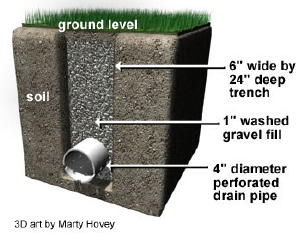
Cross-section of a Linear French Drain including the all-important perforated french drain pipe. Copyright 2017 Tim Carter ALL RIGHTS RESERVED - Do NOT COPY this graphic.
Related Links
How a French Drain Works Video
Step-By-Step French Drain Install DVD
My French Drain Stopped the Water
Eight weeks ago, I received the most wonderful Thank You note in the mail. We had a somewhat wet winter with several periods of heavy rain.
My french drain system captured and diverted all of the surface and sub-surface water. Her basement was dry and the yard allowed you to walk in it without leaving a shoe behind! She mentioned in the note that water rushed from the outlet portion of the linear French drain like a fire hose. Needless to say, she was satisfied and most grateful.
French Drain Construction Methods
The woman who I am speaking of built the entire system without any help. I visited the job site to inspect the trench after the pipe was installed. She dug over 165 linear feet of trench by hand (working part-time) in 2 months. It was hard work, but she accomplished the task.
You can often do much of the work with a trenching machine. These handy devices can be rented at a tool rental shop and towed behind any car.
Most tool rental places will even deliver it to you. However, even with a trenching machine you still must do some work by hand.
The trencher does a majority, that is for sure! If you decide to use one, purchase a sheet of 4 x 8 1/2 inch plywood.
Rip the plywood in half lengthwise to yield two pieces 2 x 8 feet. The trencher discharges dirt to one side of the trench while digging. Place the plywood on the ground so the dirt piles up on it, not the bare grass.
It's a breeze to shovel the dirt from the plywood instead of the grass. Remove all loose dirt from the trench and tamp the bottom of the trench to compact the soil at the bottom.
Layout
If your trenching system requires different bends and turns to go around houses, sheds trees, whatever, then your layout is critical. If you do not dig the trenches properly, the pipe will not fit into the fittings that go around the bends.
I always dry fit my pipe and fittings together and lay them on top of the ground exactly as they will be installed. I then use a can of bright orange spray paint to paint the grass right next to the pipe. Always paint on both sides to make sure that you clearly mark the center of the trench. This layout will save you hours of extra digging!
Location of the French Drain Piping
If you want to dry out a leaking basement or a crawl space, then you must locate the linear French drain in such a way as to capture all or most of the sub-surface water that is flowing towards your house. If you have periods of flooding where surface water flows over your lawn, then the drainage system must extend to the surface to capture this water.
Linear French drains that are intended to stop water from entering a house work best if they're located approximately 4 - 6 feet away from the foundation. It's not necessary or recommended that they be placed closer to the house.
You want the piping in soil that was not disturbed during the construction of the house. Placing the piping too close to the house also concentrates water flow at the foundation!
The Effective Depth
Linear French drains do not need to be excessively deep to be effective. Remember, water movement through soils happens where there are air voids. In many soils, air is most plentiful in the upper 24 inches.
You want to install the piping system so that the pipe is level or has a slight downward slope to the discharge point. Do not install the pipe at a consistent 24-inch depth if your lot goes up and down. Doing this will trap water in the low spots of the pipe.
If your lot is rolling in nature, then you will have to use a builder's level or laser to make sure your piping is level or flows downslope. Do not underestimate the importance of this!
Use the Right Pipe
The pipe used to collect water from the soil must be perforated. Once collected and in transit to the discharge point, you can switch over to solid pipe. Only use perforated pipe in the areas to be drained.
I happen to prefer the PVC pipe that has two rows of holes in it. These holes must point down.
Pointing them up is not right. Do you think the water flowing through the gravel aims for and enters the holes? Wrong! Some water may go in the holes but the majority goes past it and simply saturates the soil until the trench fills with water to the height of the holes.
Gravel Fill
Once you have placed the pipe in the trench, fill around the pipe with 1-inch washed gravel to within 1 or 2 inches of the surface. The best gravel is about the size and shape of a large grape.
Cover the gravel with a piece of sod. Do not place any dirt in the trench. Water traveling through the soil will find this gravel and immediately fall down to the pipe. The large voids around the 1-inch gravel will accommodate a rapid flow of water.
If you have to bring the trench system to the surface to capture surface water, dig out soil to make a path. Use colored gravel for the path placed around fieldstone or stepping stones. It will make a unique attraction and landscaping feature in your yard.
Author's Notes:
You may wonder if my advice is worth anything. Well, read what Jim Sanders wrote to me when he was at the end of his rope:
"Hi, I just wanted to write to give you the results of my "Trench Drain". I have had a wet crawlspace for 15 years. Water would fill the crawlspace at times, so we actually had to drill weep holes at the base so that it would enter the basement and eventually, the sump pump.
have tried everything. Several contractors said that the only thing we could do was to bring the water into the house via drainage tile and let it enter the sump pump. That would work, but because I live on a 6' elevation, there is no reason that I should have water problems. It became like clockwork...when it rained, we would rush home from the lake or wherever we were vacationing so that we could be prepared to start the backup generator, in case the power failed. We even had our alarm company put a sump alarm on our system, so they could notify us if we had a power failure. Battery backup was not an option, because sometimes we lose power for days and during any rain, our sump would run every 7 minutes...just like clockwork.
I found your site and read the article on the trench or French drain. At first, it sounded a bit like "holistic healing" to me. I failed to understand why a 2 ft. deep trench, 4 ft. away from the house would do any good. How could this simple thing correct an extreme water problem that has plagued me for years, cracked my foundation, settled my garage floor and ruined almost every vacation?
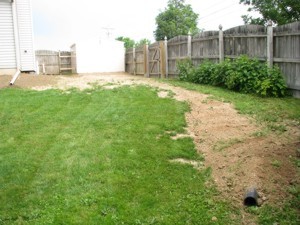
The Linear French Drain trench running from the house. PHOTO CREDIT: Jim Sanders
I decided "what the heck". I had to dig by hand using a trenching spade and a pick-ax, because the builder back-filled our property with brick and blacktop. It took quite a bit of time. Because the ground level varies so much on that side of the house, I was not able to achieve exactly 2 ft. deep. It varied from 18" to 30" in spots, but the slope was downhill. The trench is about 80 ft. long. At times, I thought about filling it all in, because I just didn’t believe that it would work.
I stoned it, put tile in, and filled it with #1 round stone. I socked the pipe just for safety measure and I also used geotextile fabric on top, so I could cover with dirt and grass. I also ordered some clay and pitched from the house to the drain.
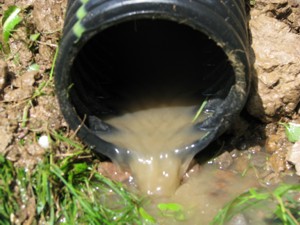
After a short rain, water is running away from the house. PHOTO CREDIT: Jim Sanders
Result? For the last month, we have had 7 or 8 torrential rains, the worst of which was last night. It rained so hard, that our lawn washed out in spots because of the high clay content. Our sump pump, that normally ran every 7 minutes during and after rain, has not turned on for 4 weeks. The silt at the bottom of the sump well is now dry and cracking. Our crawlspace has not shown a trace of water or even moisture.
Since I couldn’t see correcting the foundation cracks or the garage floor settling and tilting until I corrected the problem's source, I waited to see if the trench drain worked first.
This week, I had a company come in and perform sort of a "mud-jacking" technique on the garage floor, which worked perfectly. Also, during the past few weeks, I parged the cracks in the foundation.
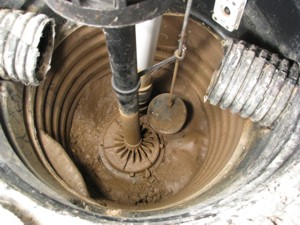
A dry sump pump. PHOTO CREDIT: Jim Sanders
I just wanted you to know how this worked. I stressed for many years over this issue and the solution was nowhere near as difficult as I thought it would be.
As a side note, I went to the end of the drain tile during a hard rain to see what was happening. Water was running out of the drain tile in about the same exact volume that it previously ran out of the weep holes in my crawlspace. This winter will be interesting, because last year, the ground next to the house was so saturated that during a thaw, my sump would run constantly. I'm guessing that the ground between the trench and the house will probably be drier now going into this winter."
- Jim Sanders, Upstate area - New York
CLICK HERE to get FREE & FAST BIDS from local drainage expert contractors.
Column B175

Tim built custom homes and did ultra-custom remodeling for 20+ years before launching his Ask the Builder media presence. He was selected as one of the Big 50 by Remodeling magazine in 1993. This award gave birth to Ask the Builder in October 1993. Tim also operates https://DrawPlumbingPlans.com. His @askthebuilder YouTube channel was the first home improvement channel on YouTube.
If 6-8 feet from my home lands me right where my new patio and my backyard grass will be going, am I amble to place a paver patio over the french drain? likewise am I able to place topsoil and grass seed over the gravel of the french drain? If not, I am not sure what to do because the french drain would be in the back yard right where the patio and grass would be going. Thank you for your time!!
Katie,
There's lots of moving parts to your questions. This is why I developed this product:
http://shop.askthebuilder.com/products/15-Minute-Phone-Conversation-with-Tim.html
Note the full money-back guarantee.