Heat Pump Operational Costs
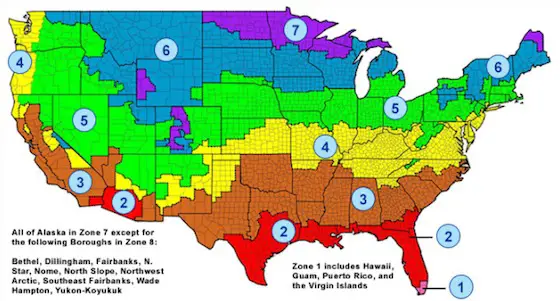
This is a very good map showing the different insulation zones in the USA. Your heat pump operational costs depend on what zone you're in!
Heat Pump Operational Costs
Different Geographic Regions
Does it make sense to buy the most efficient heat pump available? Well, it depends! Look at the table below. I selected some cities where friends of mine live. It is fairly well distributed across the USA and absolutely in different climates.
Pay attention to the cost of electricity in each city and compare it to your cost. Reference your electric bill. The calculations to arrive at the results below were done by a computer. Just about every heat pump distributor in every city in America has the capability to produce these numbers. They just need to know three things: the size of the system in tonnage, the local electric rate per kilowatt-hour, and the efficiency of the unit you are looking at.
The best thing to do is have a calculation run for three different efficiencies just as the table below shows. I extend my thanks to Jeff Urbanek who works very hard each day at Quality Crafted Systems - the local York distributor. Jeff was kind enough to take time from his busy schedule to run the numbers you see below. Thanks, Jeff!
The numbers below are based on some constants. The system Jeff and I selected is a 3-ton system. The calculations were done taking into consideration the design temperatures for heating and cooling for that city. The lifespan of the heat pump is 15 years. The total lifetime cost value in the last column is adjusted for inflation over the life of the unit.
If you’re interested in learning more about estimates for heat pump replacement I have an article here.
| City | SEER Efficiency |
Electric Cost per Kwt hour |
1st Year Cooling Cost |
1st Year Heating Cost |
1st Year Total Operating Cost |
Total Lifetime Operating Cost |
| Charlotte NC |
10 | $.076 | $359 | $602 | $961 | $16,619 |
| 12 | $.076 | $299 | $564 | $863 | $14,924 | |
| 14 | $.076 | $257 | $502 | $759 | $13,126 | |
| . |
||||||
| Cincinnati OH |
10 | $.070 | $258 | $668 | $926 | $16,014 |
| 12 | $.070 | $215 | $626 | $841 | $14,544 | |
| 14 | $.070 | $184 | $557 | $741 | $12,814 | |
| . |
||||||
| Orlando FL |
10 | $.060 | $694 | $191 | $885 | $15,305 |
| 12 | $.060 | $579 | $179 | $758 | $13,108 | |
| 14 | $.060 | $496 | $159 | $655 | $11,327 | |
| . |
||||||
| Seattle WA |
10 | $.040 | $31 | $578 | $609 | $10,532 |
| 12 | $.040 | $26 | $542 | $568 | $9,823 | |
| 14 | $.040 | $22 | $482 | $504 | $8,716 | |
| . |
||||||
| Toledo OH |
10 | $.11 | $319 | $1,386 | $1,705 | $29,485 |
| 12 | $.11 | $266 | $1,299 | $1,565 | $27,064 | |
| 14 | $.11 | $228 | $1,155 | $1,383 | $23,917 |
Column B294

Tim built custom homes and did ultra-custom remodeling for 20+ years before launching his Ask the Builder media presence. He was selected as one of the Big 50 by Remodeling magazine in 1993. This award gave birth to Ask the Builder in October 1993. Tim also operates https://DrawPlumbingPlans.com. His @askthebuilder YouTube channel was the first home improvement channel on YouTube.
According to the information in the published the more efficient heat pump is the preferred unit to purchase. I do not understand why you would say it depends. In each case, regardless of cost of electricity or geographic region it is cheaper to run a higher SEER unit 10 vs 14 for the examples shared. Can I assume it continues to 16 & 16.5 SEER units?