Avoiding Sewer Back Ups From Tree Roots
Nothing is more disgusting than 4 to 6 inches of raw sanitary sewage in a basement or crawl space. Often the cause of backup problems can be traced to tree roots that have invaded a sewer line. The tree roots are drawn to sewer lines as they constantly and randomly search for food and water resources. The roots enter very small cracks in the pipe joints and when they find the water and nutrients in sewage, they go crazy. In the process, they drive homeowners like you and me crazy as well.
Solving the Problem
There are all sorts of concoctions you can put into your plumbing system that claim to solve root problems. A few work, but many do little to solve the problem. Any product that is simply a liquid or a solution that is flushed down the toilet will often do little. Why? The roots often grow down from the top of the pipe. The chemicals may burn the tips of the roots or any portion that the solution touches as it passes by the roots. The better chemical products are those that create a foam that fills the pipe void and contacts all of the roots. But keep in mind that the tree continues to grow and makes every attempt possible to re-establish root growth in the pipe.
Stop Them Before the Pipe
I have always thought the best way to stop basement water leaks is to stop the water BEFORE it gets to the basement. I have solved hundreds of chronic basement leaks by installing simple linear french drains around the perimeter of houses. These devices capture sub-surface water and redirect it around a house instead of into the basement.
You can apply the same thinking to tree roots in sewer pipes. Why not stop the roots BEFORE they get to the pipe? To achieve this all you have to do is poison the soil above and around the sewer pipe. Even if you only are able to treat several inches of soil around a sewer pipe, this method will be highly effective. The problem is, it is nearly impossible to deliver chemicals with that degree of pinpoint accuracy, especially to a pipe that is buried under tons of soil.
Dr. Pryor's Class
I majored in geology while in college. One of my favorite subjects was soil science and hydrogeology. I learned that water moves through soils in two directions. It moves down, then it moves sideways. Dr. Pryor, you would be proud of me. I did pay attention in class!
If you combine this knowledge with a delivery system that gets you close to sewer pipes, you can effectively treat soil above and around a sewer pipe so that it becomes distasteful to tree roots.
First Hand Experience
The second house I owned had a tree root sewer infestation. With the help of a professional sewer cleaner, I was able to determine a fairly accurate distance from the house where the tree roots entered the sewer pipe. I also found out where my sewer line entered my property. When I combined these two pieces of data I was standing right beneath two maple trees in between the sidewalk and the street.
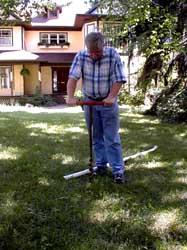
I borrowed an earth auger and drilled a hole 10 feet deep. I glued a female adapter onto the end of a 1.5 inch PVC pipe and inserted the other end into the hole. With minimal effort I was able to extend the pipe into the earth so that the threaded end of the fitting was flush with the grass. I then poured 4 pounds of copper sulfate crystals into the pipe. Five gallons of hot water was then poured down the pipe. To make a long story short, the sewer never again backed up. I had nailed the problem. The placement of the pipe was obviously perfect and I was undoubtedly lucky, but the bottom line is that the trees continued to thrive, they just got their water and nutrients from someplace other than my sewer pipe.
Multiple Pipe Casings
You may not be as lucky as I was. You may have to sink 4 or 5 pipes into the soil in a line directly above or very near where you think your sewer problem is. You must also be patient. The copper sulfate takes months to poison the soil. The roots didn't plug the pipe in just one day and you are not going to dissolve them that quickly. If you combine a professional sewer cleaner, PVC pipe casings and copper sulfate, you absolutely can solve your tree root problem. Remember, patience...
Column B326

Tim built custom homes and did ultra-custom remodeling for 20+ years before launching his Ask the Builder media presence. He was selected as one of the Big 50 by Remodeling magazine in 1993. This award gave birth to Ask the Builder in October 1993. Tim also operates https://DrawPlumbingPlans.com. His @askthebuilder YouTube channel was the first home improvement channel on YouTube.
Great idea - thanks for the tip Tim!
I’ve had to deal with roots in both my main line and the side line going to my laundry and kitchen. And of course the brilliant folks who lived here before me built a short deck over the line so that side line has been inaccessible. In 2020 I replaced the main line ( original was concrete, the chosen substance of the 50s) with a new PVC line that was not angled up hill, and had two 45 degree turns instead of one 90 one. 4 years later, it’s time to deal with the section that wasn’t replaced yet. Plumber jet cleanouts and foaming agents are no longer enough, the camera shows the roots are almost blocking the line entirely even after jetting. Pulled up the section of deck over the pipe, going to replace the connections as well as the line( with PVC). Installing two more cleanouts with trapdoor access in the deck. Anything else you would suggest ? Will it work to put the foaming agents in the external cleanouts on a regular basis? Anything you would say not to do? A bit more digging tomorrow so a little time before the pipe is replaced, and a bit more time before the deck goes back. I trust the plumber who is doing the work but want this to be as successful as possible and last as long as possible. Thanks!