PVC Pipe vs. Cast Iron Pipe
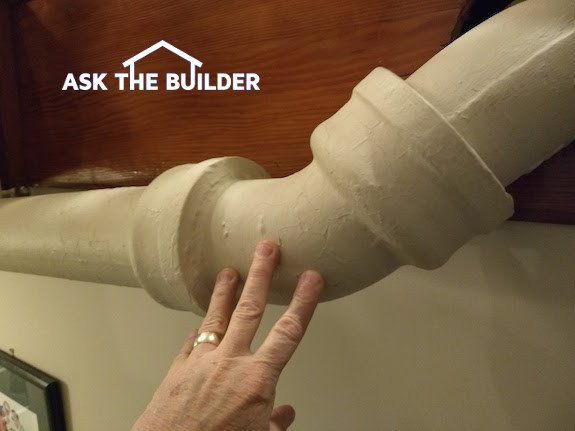
This is a cast iron pipe fitting. It's been painted countless times and is over 100 years old. It's above a staircase in one of the oldest buildings in downtown Southwest Harbor, Maine. The pipe is pitch black when new from the foundry. Copyright 2018 Tim Carter
PVC vs Cast Iron TIPS
- Cast iron is time-tested, durable and quiet.
- PVC pipe is easy to cut and noisy
- WATCH the PVC videos below
- Use cast iron for large drain stacks and PVC for vent pipes
- CLICK HERE to Get Tim's FREE & FUNNY Newsletter!
Cast Iron Pipe Is The Old Gold Standard
If you've not seen the guts of an old home, I'm talking about one built before 1920, you might not have ever seen cast iron drain pipes. It was the gold standard piping material used by plumbers for larger drain and vent lines for decades.
But the chemical industry explosion that happened in the 1960's changed the course of plumbing. Some may argue not for the better.
Related Links
Cast Iron Pipes are Easy To Install
Noisy PVC Pipe Complaints - Real Life!
Is Cast Iron Pipe Still Available?
Cast iron pipe is still made and it's better than ever. You purchase it at traditional plumbing supply houses, not big box retailers. New cast iron pipe uses rubber couplings and stainless-steel band clamps to make leak-proof connections. Watch this video to see how connections are made with ease:
Many homeowners associate cast iron piping with antiquated plumbing that's prone to developing leaks. Often people think that it clogs quite easily.
Conversely, many people think that modern plastic PVC plumbing piping is the miracle material. Well, both materials have advantages and disadvantages. Let's talk about both types of pipe and see what you think.
Free & Fast Bids
Is Cast Iron Pipe Durable?
Cast iron piping has been used successfully in plumbing systems for hundreds of years. In fact, in the year 1623 cast iron pipe was installed in the Fountains of Versailles in France.
That same piping is still functioning today. Thousands of miles of municipal water and sewer systems use cast iron pipe. The reason is long-term durability. Cast iron simply lasts.
Old cast iron pipe used to come in a regular wall thickness and an XH size. The XH meant Extra Heavy. It had thicker sidewalls and was much more durable. The XH lettering was cast into the side wall of the pipe and you can still see it if you look for it.
When Did PVC Pipe Start to Push Aside Cast Iron Pipe?
Virtually every residential home built prior to 1960 had some form of cast iron piping in its drainage system. The primary drainage stacks or pipes within the walls were constructed of cast iron.
The branches off of these stacks which connected to sinks, toilets, and tubs often used lead piping or galvanized-iron pipes.
Is Galvanized Iron Pipe Prone To Clogging?
Galvanized iron piping is especially prone to clogging. Within a decade or two of installation, the galvanized coating on the inside of the pipe wears aways or corrodes.
When this happens, the iron starts to rust and deposits start to form on the inside of the pipe causing the inner diameter of the pipe to constrict and get smaller and smaller. WATCH THIS SHORT VIDEO to show this exact problem with galvanized drain piping:
I've personally removed hundreds of these pipes which connected to kitchen or bathroom sinks. In virtually every instance, these pipes were clogged solid.
Do Cast Iron Stacks Clog Easily?
However, the cast iron vertical drain stacks only two to three feet away from the sinks were completely free of obstructions. Unfortunately, many homeowners and young plumbers don't realize this phenomenon falsely accuse the cast iron as a poorly performing product.
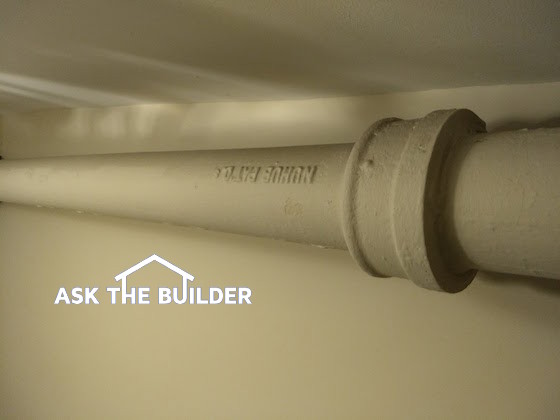
Here's a typical cast iron drain pipe. It's suspended from the ceiling in a stairwell in one of the oldest buildings in Southwest Harbor, Maine. You can see how the lettering is cast into the pipe. Copyright 2018 Tim Carter
Is It More Expensive To Install Cast Iron or PVC?
Years ago, residential construction labor costs were insignificant. Time was not always an issue with respect to how long a particular task took to complete.
For example, imagine how long it took to nail on those thin lath boards which allowed the plaster to be applied to the walls and ceilings of houses.
Think of the amount of time it took carpenters, using hand tools, to mortise hinges and locks into doors. The same is true for old style cast iron piping.
If you use modern cast iron pipe with no-hub rubber couplings, it takes just a few more minutes per joint to install than using PVC. One benefit of using cast iron is that you can make adjustments to the fitting angles after installation. You can't do that with PVC. Once you glue a PVC fitting onto a pipe, you only have seconds to get the adjustment perfect.
Do You Still Use Old Lead & Oakum?
You need to use lead and oakum if you're working with old cast iron. Old style cast iron piping was a chore to install. The plumbers had to pack oakum into each joint. Oakum was simply an oil-soaked rope that filled the 3/8-inch-wide gap where the male end of one cast-iron pipe mated up with the female hub of another piece of cast iron.
Once the oakum was taped tight into the joint and within a half-inch of the top of the hub, the plumbers would melt lead ingots and then pour this molten lead into the hub.
The lead solidified rapidly and the plumbers would use a flat tool to tamp and pack the lead in the hub so the joint became leak-free.
The job of installing cast iron was tough, time-consuming and dangerous.
Modern Cast Iron Pipe Is Easy To Install
The cast iron pipe available today looks somewhat similar to old cast iron. Old cast iron was indeed cast in molds. Modern cast iron is spun cast so the pipe wall thickness is much more consistent.
How Do You Connect Modern Cast Iron Pipe?
You connect modern cast iron using stainless-steel band clamps that squeeze full-sized rubber sleeves that surround the outer surface of the pipes.
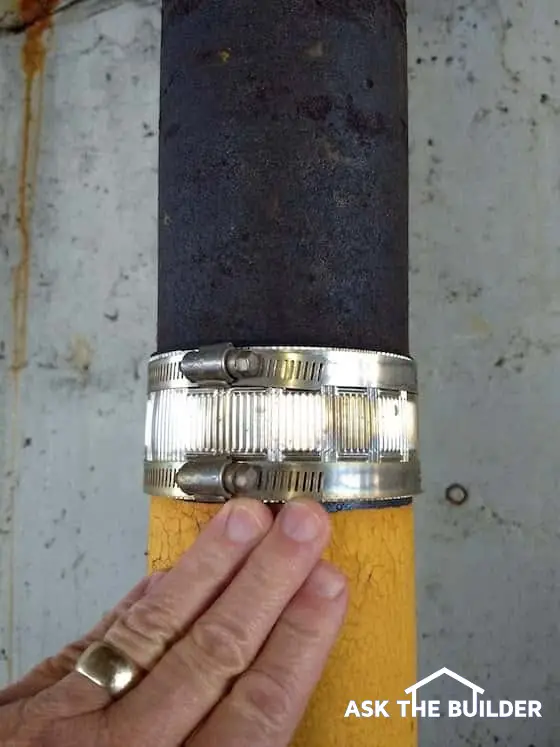
My hand is touching a modern cast iron band clamp that prevents leaks where two pieces of pipe connect to one another. Copyright 2018 Tim Carter
The methods of installing the material have changed drastically. Gone are the oakum and molten lead. In their place, you now find vulcanized rubber seals and stainless steel band clamps.
Cast iron piping systems can now be installed in a fraction of the time it took to install them fifty years ago. In fact, modern cast iron piping can be installed just as quickly as plastic PVC piping.
Can You Adjust Cast Iron Fittings After Installation?
One of the amazing aspects of the modern cast-iron pipe is the fact you can easily adjust the orientation of the fittings AFTER you install them. You can do this by just loosening the screws on the band clamps and then twisting the fitting.
It's IMPOSSIBLE to do this with PVC or old cast iron. Once you glue PVC together you have between five and two seconds, depending on the diameter of the pipe, to make any adjustments.
With old cast iron, once you poured in the molten lead, you're toast. You can't make any adjustments.
Cast Iron Is Super Quiet
Because cast iron is dense, it takes a lot to get it to vibrate. When water flows down a cast iron stack, you can only hear it if you put your ear up to it.
If you need to have a quiet home and don't want to hear a waterfall in your walls each time someone showers or flushes a toilet, then you want cast iron drain pipes.
PVC Pipes Are Acceptable But Noisy
I've been a master plumber since before I was thirty years old. I had the good fortune to work with both cast iron and modern PVC.
PVC pipe is lighter in weight than cast iron. It cuts faster with a regular saw you'd use to cut lumber. To cut cast iron, you need a cut-off saw with an abrasive blade that creates a shower of sparks.
To cut a 3-inch piece of PVC pipe, you might take three or four seconds. To make the same cut on cast iron with a cut-off saw, you'll spend at least 15 or 20 seconds.
PVC Pipe Videos
Watch this video to see how easy it is to glue PVC pipe together. Primer is mission critical!
Watch this video to see different PVC fittings you use with pipe.
PVC Is Noisy
PVC is not dense and water cascading down a vertical stack causes it to vibrate. This vibration creates lots of noise.
People who are not familiar with PVC pipe often think there's a leak inside a wall when they hear a toilet flushed for the first time. It's annoying in my opinion.
Column B380

Tim built custom homes and did ultra-custom remodeling for 20+ years before launching his Ask the Builder media presence. He was selected as one of the Big 50 by Remodeling magazine in 1993. This award gave birth to Ask the Builder in October 1993. Tim also operates https://DrawPlumbingPlans.com. His @askthebuilder YouTube channel was the first home improvement channel on YouTube.

I'm in the process of cutting out and replacing some rusty, leaky cast iron pipes that are clogged solid, so the assertion that they are somehow clog proof doesn't add up.
Well, perhaps they're full of grease or they were abused. The point I was trying to make is that cast iron has a rich history of not producing expanding scale on the inside of the pipe like galvanized iron.
I live in a 100 year old house. (built 1918) Our sewer pipes are cast iron and have never clogged in the 65 years my house has been in my family, and it does make a big difference in noise. We added a bathroom to the house and used PVC where we could, thinking about all of the points you have mentioned. The first flush was heard on the 2nd floor, 1st floor and in the basement. I'm old, the cast iron is old, my ears are old, but cast iron.. I like it!
in the content here where is the comparison between Cast Iron and PVC Pipe ??
Thanks for the info, but I feel the article was lacking. We're in the process of deciding to spend thousands of dollars redoing some plumbing and the obvious choice is PVC. Plumbers are certainly pushing for that. They say cast iron will last 40 years whereas PVC will last a lifetime. I have my suspicions about that, and like you feel that cast iron must have some pros.
A lot of times, I feel like a guy will try to sway you to go the route thats easiest for them to install (or do it how they always done it instead of trying a new way...which in this case would be old school), rather than doing it the way it will last the longest. Thats what we want to know about Tim. The details. Why does the title say Cast Iron vs. PVC and then contain zilch about PVC? Tell us about schedule 50 vs scheudle 80 PVC, and how 80 would stand the test of time? What are the negative aspects of PVC besides sound and no long term testing (hasnt been around as long as cast)? How do each resist tree root intrusion, and handle the cold elements in the midwest?
I've always enjoyed your articles and videos. Would highly appreciate if you could do an update and provide us with some more details. Especially since most modern plumbers will be looking at us like we're crazy if we suggest Cast Iron! Thanks
There's no need for an update. Cast iron has stood the test of time for hundreds of years. For me it's a sound issue. PVC is just too noisy. Cast iron costs more no doubt, but just use it for the stacks if necessary to cut down on noise. PVC can be used for branch arms and all venting.
I am going to renovate my bathroom . In my basement I have the black cast iron pipe for the main drain going outside to pvc pipe that goes into the city sewer system. I was told that the black cast iron drain pipe which is a 3-4 inch pipe has to be replaced by pic pipe. The cast iron pipe is leaking at one joint. Does anyone know the code about using the existing cast iron main drain pipe or do I have to replace it with pic piping
Great. It is good to know the pros and cons of cast iron. It is definitely not all bad. But currently, insurance companies are mostly concerning other drain pipe than PVC.
still waiting for my comment to be posted. . . .
Cast Iron Pros: Tough, resistant to being cut or impacted (unless you notch it and hit with a hammer). Can be abused with a drain snake without scraping off the pipe wall. Long lasting unless you put a lot of chemicals down it or run concentrated stuff like urine from a flushless toilet. Then it will corrode quickly. Quiet
PVC Pros: Low cost, light, fast and easy to install, smooth inside so it's not likely to get plugged up. Totally corrosion resistant unless you dump something like straight painters solvent down it. It's been around for sixty years and should give you a minimum of 50 years service.
Thanks for the article. We are redoing a house built in 1916. The cast iron was in perfect shape! We are only removing it because we felt it could be prone to cracking during the demolition process. However, I am concerned about the use of rubber gaskets vs the old lead. I can't image the rubber will last 100 years just as the current pipes did.
over 30 years ago I redid my bathroom, which is above our kitchen, and tied the new PVC drain into the existing cast iron stack with a rubber collar. 3 years ago we redid our kitchen. When we opened up the kitchen ceiling I wanted to see how my rookie plumbing held up. The rubber collar looked the same, and felt the same, as it did when I originally installed it. I think what helped it hold up was it was buried in the ceiling with no exposure to UV, or any kind of light, no exposure to fumes or physical abuse, other than what went down the drain and contacted it at the seam, a very small area.
I have to decide between PVC and metal by next week, the cast iron pipe in my house is last probaly 100 years, the plumbing keep telling me no one using cast iron anymore, I dont know the plastic pipe will hold till 100 years the cost is just about $1000 higher, I think I'll go with metal , it's for the sewer main pipe.
I have a pin hole leak in the iron pipe. A plumber friend of mine told me to wrap it with rubberized electrical tape and it should rust back into the pipe. Will give it a try .
Tommy. If you are really believing some guy telling you that PVC will last a life time then I would not use him ever. Because he clearly does not know what he is talking about. Cast-iron and copper is the only way to go. People use this pex piping because it's dirt cheap. I'm not even gonna sit here and argue about the skill involved to do it because there is none.but that's not the point. You have hundreds of years probably longer of copper proving itself. Water is some corrosive stuff we know that so the minerals that are in copper are in our bodies already now you tell me if any PVC minerals are in our body. how good can that be for you? I know in Europe where i Believe they started installing pex their first they are now ripping it out because of this issue. My house is over 100 years old and the cast is still in wonderful condition. PVC what Air does too it makes it so brittle where It just crumples. And if you're unlucky enough to have The ABS plastic pipe in your house that's 10 times worse that was their first attempt at trying composite material pipe. It's not even allowed in Philadelphia. Where I'm a master plumber.
NOTE FROM Tim Carter - Founder of AsktheBuilder.com: I'm also a master plumber since age 28. Aggressive water can eat away at copper tubing water lines. Talk to any plumber in the Phoenix, AZ area about that. As for *lifetime* expectancy of PVC, you need to define the length of the lifetime. The column above is not about water supply lines, it's about drainage lines. You'll not pick up and harmful chemicals in your body using PVC as a drain line. Mr. Hoge I think you're doing a disservice mixing up a person with water supply issues vs. drainage line materials.
Great article! The biggest problem I am having with cast iron for my remodel job is finding a plumber willing to do it. Here in mid-coast Maine, they think I am insane for wanting anything other than pvc. Any suggestions on finding one ?
Sure. Did you pass over the text links above that say, "CLICK HERE to get FREE & FAST BIDS from local plumbers."
Go back up, click it, fill out the form and wait for phone calls.
Hi. I have a question that I wish you can answer. When we made the drain in the house we used PVC pipes. This is written on the pipes (EN 1401 UD SN 8). Have I made a mistake using these tubes? Or is it okay?
I'm grateful for answers.
Wishing you a nice day.
Best regards! / Nick
You just want to make sure the tubes say on them SCH 40. This means Schedule 40. That number or higher is excellent.
"...stood the test of time..."? No. Just no. In fact, it has failed that test twice in my 100 year-old house, leaking not from the joint, but the rusted pipe itself!
I'll take the noise any day of any week.
Some of the old cast iron had quality control issues. The pipe walls were thin because of inconsistent molds.
New cast iron pipe is spun cast and has uniform wall thickness.
Let's hope your PVC pipe never catches fire. One or two breaths of that poisonous smoke and your toast. Firefighters all across the USA are contracting cancers and other illnesses traced to PVC smoke.
I can give you a link to some great earplugs if you need them. 😉
Our home was built in 1892. Would like to use cast iron pipe for the stacks and PVC for sewer and vent lines. Is the PVC connected to the cast iron with the same stainless clamps or by another means?
Hi Tim, My dad and I installed a lot of cast iron pipe over 60 years ago. At that time there was a lot of farmers that lived and farmed the home place. Most of the farmers didn't have indoor running water and certainly didn't have indoor bathrooms. Time consuming, yes, but when you see all the piping and the connections when your done it looked great.
I had only one issue with the cast iron pipe. This was not a job done by my father and me. My wife and I rented our first home and after living there a short time I kept finding water on the basement floor. I checked out all the water lines, no leaks. Finally one day when I was in the basement the stool flushed upstairs. Yep, that was our water leak. About a three foot section of the top of the cast iron drain line was completely rusted through. I could my whole hand inside the pipe. A plumber put a rubber patch with clamps over the top of the pipe. No more leaks while we lived there.
my new house was built with cast iron waste pipes. A while back I got a bad clog at the bottom of the stack, and my snake got bound up trying to get to it. Fortunately for me, the blockage was in an elbow secured by a rubber coupling, so it was easy to pull apart, physically remove the giant mass of hair, and reassemble. PVC? Would have had to hire a plumber for at least a couple hundred $.
it seems to me an advantage of pvc is that, since it weighs a lot less, it is easier to install long pieces and in fact sometimes you only need a 2 person crew where the same length of cast iron would require a 3 person crew to install
Martin,
I've been a master plumber since age 29. I've installed both types. You don't need a crew of three to install cast iron. In fact, up to 3-inch pipe, I can handle a 10-foot piece of cast iron installed horizontally by myself.
It's just a matter of installing the hangers first and sliding the pipe through the hangers. You adjust the hangers once the pipe is in for the proper slope then you tighten up the band clamp.
Nothing to it.
Hello,
The vertical cast iron drain pipe in my garage has several pinhole leaks. Is there some sort of glue or tape I can use to patch the small leaks? Or do I have to replace the portion of the pipe that is leaking?
Thanks!
Louis,
You don't have to replace it. I'd try some of this magic epoxy - PC Woody. Wash the outside of the pipe well before you apply about a 1/8-inch thick coat. Click this link:
https://amzn.to/2DCUJvx
Hey Tim
How 'permanent' is the magic epoxy? I had a leak in a cast iron elbow which I emergency patched with this epoxy stuff. It's working fine, but is it permanent? I can't see how the modern cast connections can work on this elbow. I'm sure my plumber is going to push for PVC, I just want the elbow replaced.
It's VERY permanent! The key is getting the surface clean and roughed-up if possible.
If you MUST replace the fitting, you can cut in a no-hub elbow. I'm about to install ALL NEW cast iron in my daughter's home. I'm doing all the plumbing and using no-hub cast iron.
Is schedule 80 PVC sewer pipe as quiet as cast iron?
I'm willing to bet that it's not. It's all about density, not necessarily thickness. Sound is created by vibrations. It takes quite a bit of turbulence to get cast iron to vibrate.
Tim
How do you connect new cast iron to an existing hub? Is there a modern fernco-type clamp thing for that? My epoxy patched cast iron elbow connects to another hub (with a clean-out) before that one enters the stack.
You use special no-hub couplings.
https://www.pscia.com/ASSETS/DOCUMENTS/ITEMS/EN/no-hub-couplings-e83feb9c.pdf
Sorry, I've seen those but...
How do you connect new cast iron to an existing hub?
You used up all your free advice, Michael:
http://shop.askthebuilder.com/products/15-Minute-Phone-Conversation-with-Tim.html
Great article & video clip.
House I bought has PVC drains- and associated noise. I have often wondered if insulation could be of any help to lessen the noise factor? It would mean opening up a sealed wall space- and I know from your article that cast would be a better solution- but looking for something “DIY”.
Thanks for being there & all the experience you share.
I thoroughly enjoyed reading and watching about cast iron vs pvc. I believe your perspective from being a master plumber gives even more credence. The inclusion of galvanized pipe hit home with me,as it's one of those things I learned from experiencing i with an older home we moved from 20+ yrs ago. Since I have the Anti- Midas Touch when it comes to plumbing, I hired a professional to replace the galvanized water pipes with copper in our basement, feeding the upper floor. The inside of these galvanized pipes looked very similar to the one in the short video you included. I'm guessing galvanized steel pipe was used because it was cheaper than copper? And the original builder was long gone by the time we came around. When one experiences the short comings of dealing with something someone cheaped-out on, it causes one to think twice about paying more for quality up front rather than paying for it later.
I want to bury a pipe that discharges water from my sump pump before putting a new asphalt driveway. Should I use pvc schedule 80 or cast iron pipes? The pipes will be buried along my house walls. Therefore, they won’t be heavy traffic over them.
I'd go with Schedule 80. It's all about making sure the pipe has compacted fill under and around it and enough fill OVER it.
Good luck!
Hi Tim,
I live in a 70 year old home with cast iron and galvanized iron pipe. I have replaced most of the galvanized with PVC by using the rubber band clamps but can I use them the connect new cast to the old cast? (I want to move my stack to allow for a change in the wall that it is running in now.) Do I cut the hub off the old cast and use a compression band fitting? Seeing that it is just the vent stack and there is no water running through it, is it still to my advantage to stay with cast iron?
Thanks and I have loved the newsletter for years now!
Ted
Hi Tim we just had plumber and they did snake our cast iron pipe and used camera, in 36 feet and beyond that ,they have seen some tree roots, they think we need to replace. The whole pipe ,what do you think??
Sayeh,
Here's what I think. I think you should have typed "tree roots" into my search engine. 😉
Look what I discovered when I did that. You're about to save THOUSANDS of DOLLARS. You're welcome:
https://www.askthebuilder.com/sewer-lines-and-tree-roots/
Hi Tim, the main stacks in our basement are super noisy pvc. If I replaced just the vertical part of the pipe with cast iron but not the 90 elbow at the top or the clean out at the bottom do you think the sound reduction would be worth the effort? Thanks so much 🙂
The more PVC you replace with cast iron the BETTER the noise reduction will be. Keep in mind you still could have noise from any PVC that's above the cast iron you install. READ all of my Soundproofing columns here to understand the dynamics of how sound gets to your ears.
My house was built in 1951 I just replaced all the cast iron plumbing it was completely rusted and fell apart it is 2019 only the vent stacks was in good shape cast iron plumbing is probably good for about 50 years I live in Southwest Florida
Interesting information.
Any details the connection from the cast iron pipe to the toilet flange? This is new construction with 3 inch drain line in a second floor with 12 TJI floor joists. Total slope is 4" max. how about rough in condition for plumbing top out water test?