Hot Water Recirculating Loop – How to Install
Hot Water Recirculating Loop TIPS
- Gravity loops work well
- Insulate all but last 15-feet of loop
- Special pump needs no extra pipe
- Remove water heater flappers
- CLICK HERE to Get Tim's FREE & FUNNY Newsletter!
Gravity - It's Magic
When water is heated, it gets lighter. It wants to float to the top of cooler water.
Cool water is heavy and wants to fall. If you have a loop that projects upwards, the cool water wants to fall down the loop while the hot water goes up. Gravity fuels the motion.
Complete The Loop
It works in this fashion in your house. You already have half of a gravity loop in place. This is your hot water piping distribution system which begins at your water heater and ends at the farthest fixture which requires hot water.
If you were to install copper piping leading back from the farthest point and from other high points in the existing system, you'd have a loop. This return loop pipe connects into the bottom of the water heater.
You remove the drain valve and install a 3/4-inch nipple, a ball valve, a tee and a new boiler drain so you can drain the heater.
It's that simple.
CLICK HERE to get FREE & FAST BIDS from local plumbers who can install a hot water recirc system!
Slow Flow
The flow of water through the loop is very slow. It doesn't need to be fast.
The only thing that's important is hot water is near each fixture when you need hot water.
Without a loop there's no movement, so any movement is better than none!
Pumps for Slabs
If you live in a house on a slab or where a majority of the hot water lines drop below the water heater, you need to use a recirculating water pump. If you purchase a Grundfos recirculating pump like the one just below, you don't need to add any extra piping!
See that funny stubby U-shaped fitting under the pump? It connects between the hot and cold-water shut-off valves at the farthest sink away from the heater.
The pump uses the cold-water line to send water back to the water heater! Ingenious!
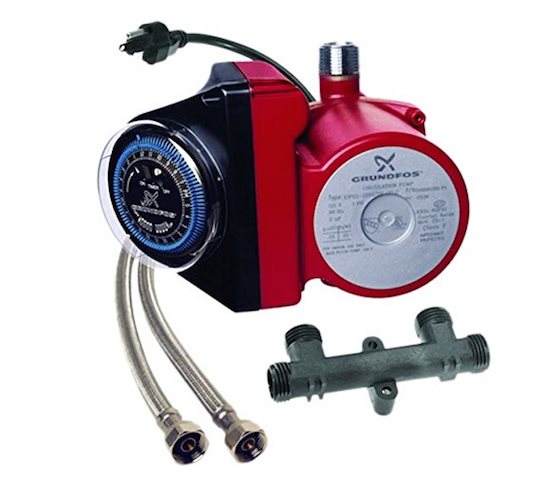
This is a reliable recirculating pump you can install on top of your water heater. The weird threaded fitting goes under the sink that's farthest away from the pump. CLICK THE IMAGE NOW TO ORDER THIS PUMP.
Pump Location
These pumps are often located near the water heater, however, they can be anywhere in the loop. The pumps circulate water at low pressure and low speeds.
Once again, there's no need to have lots of water moving through the loop. It is just important that the water is hot near the fixtures.
If you install one of these pumps, remember that you need to install unions on either side of the pump.
Unions are special threaded fittings that contain an inner flared surface or flat surfaces with special washers that allow you to break into the piping system and reconnect without soldering.
Water meters are always installed using unions. Look at yours and you'll see what I mean.
Insulation
Once you decide to install a gravity recirculating loop, you need to be concerned with energy loss. A gravity loop will work fantastically without insulation. In fact, it works best without it!
But, this can also cause your water heater to cycle on and off more often. Remember, you are bleeding heat from the heater when the loop contains hot water.
Type of Insulation
There are numerous ways to insulate the pipe. Many insulating materials are made exclusively for water piping. They fit snugly over different sizes of pipe.
Some insulation, like the foam types, must be installed as you install the pipe, not after the loop is constructed. The foam slides over the pipe sections.
When you select your insulation material, ask how and when it should be installed.
CLICK HERE to get FREE & FAST BIDS from local plumbers who can install a hot water recirc system!
Hold Off Framing
Piping installation methods must also be altered. Some people attach water piping to the sides of floor joists. You can't do this with an insulated loop system. The pipe must stand away from floor joists so that the insulation is not crushed. Special inexpensive pipe hangers allow you to do this easily.
Save Energy
All of the hot water lines that lead from the heater must be insulated. They need to be insulated up to where the return loop lines connect and slightly beyond.
The return loop also needs to be insulated except for a short distance before the loop connects to the bottom of the water heater. If you insulate the entire system too well, it may not work!
Remember, the water has to cool at some point for the loop to start its gentle movement. I suggest that you leave the final 15 feet of return loop uninsulated.
Water Heater Heat Traps
Modern water heaters have small rubber flapper check valves in the top of the heater. These need to be removed if you want a gravity loop to work. The check valves are mandated to preserve energy in non-insulated piping scenarios.
If you don't remove these flappers, the water can't move through the loop.
Cozy Up
Houses that don't have a recirculating loop system have hot water pipes that branch off a main line and stretch to each fixture. An ideal loop system would have the loop run as close as practical to each fixture.
The closer the loop is to the fixture, the faster you'll get hot water when you open a faucet.
Air Locks - BIG PROBLEMS!!
As you construct your loop system, you must be concerned with air traps. What are these?
Think about the drain traps under your sinks. Imagine if you did this upside down with a water line in a loop system.
Air naturally bubbles out of pressurized water. Normally it makes it to the top-most fixture in your plumbing system.
If you, or your plumber, inadvertently creates a trap, the water will not move through the loop.
Mystery Air
Air can get into a plumbing system in any number of ways:
- water main break
- repair process in your own home
- dissolved air within water
If you create a trap, the air will collect in the trap and BLOCK movement of water within the return loop. This happens because the air will not move down to the water heater.
Air is not a problem in the regular water piping system. The rapid movement of water through the pipes when you turn a faucet on pushes the air out of the way. Remember, water moves sloooowly through a gravity loop.
Check Valve
Just before the loop enters the bottom of the hot water heater you might need to install a simple check valve. These are one-way valves.
This valve will prohibit in-rushing cold water from the bottom of the hot water heater from flowing backwards through the loop when you open a hot water faucet somewhere within the system.
Check valves are not always necessary. Some systems need them because of friction loss and other obstructions that make it easier for the hot water to flow backwards through the loop rather than the correct direction - from the top of the heater!
Drill A Hole
These valves can be installed after the loop is completed. You can install this valve in the vertical - or horizontal - loop pipe just before it enters the water heater.
The valve should be within 5 feet of the water heater and it needs a 1/8-inch hole drilled in the flapper of the valve.
You might want to try installing the loop first without one and see what happens. If you begin to get cold water at a faucet when you should get hot, you know you need a check valve.
Final Connection
As the loop returns to the water heater it connects at the low point of the heater. This is always the location of the heater drain valve. This valve is simply screwed into the heater.
Attach a wrench to the valve and turn counterclockwise. It will come out.
Install an insulated nipple in place of the valve. This will minimize corrosion possibilities.
Then as soon as possible install a tee fitting with female threads at the tee. If you use the right one, the drain valve will screw right back into the tee. The other end of the fitting allows you to connect the loop to the heater.
Install a ball valve on the loop side of the tee so if you want to drain the water heater you can shut off the ball valve preventing all the water in the loop from coming out of the boiler drain
Shut-Off Valves
While on the subject of valves, let's talk about the shut off valves on top of water heaters. I've seen some aggressive homeowners install a shut off valve on both the hot and cold water line.
They thought this would help in the event they need to switch out the heater. Well it does help. It also creates a potential BOMB.
BOMB In Your Home
If some idiot turns off both valves (happens everyday somewhere), and the pressure relief valve malfunctions or was never installed, and the heater thermostat malfunctions, the heater will explode. It's happened more than once.
Only install a valve on the COLD water line, never on the hot line.
CLICK HERE to get FREE & FAST BIDS from local plumbers who can install a hot water recirc system!
Column B413

Tim built custom homes and did ultra-custom remodeling for 20+ years before launching his Ask the Builder media presence. He was selected as one of the Big 50 by Remodeling magazine in 1993. This award gave birth to Ask the Builder in October 1993. Tim also operates https://DrawPlumbingPlans.com. His @askthebuilder YouTube channel was the first home improvement channel on YouTube.
Is there a recommended pipe size for the return line ? My supply line starts at 3/4" copper but does reduce down to 1/2" at the faucets so I was planning on using 1/2". Then I started thinking of the 50" coils of 3/8" or even plastic. Does it work best with copper ? Thanks.
Kevin, your question require lots of typing and I have some questions for you. You should consider investing in a 15-Minute Consult with me. Look at my cart for that. Lot's to discuss. I just do short pithy answers here.
If there is a power failure using a hot water recirculator pump (gas water heater), will hot water still be available as if there were no pump? (or will the pump and valve prevent flow?)
Robert, Walter, this is what my 500-Second Consult is all about. Click the Shop icon at the top of the page!
I have a ranch with basement, insulated 3/4 inch copper tubing. Takes about 40 sec for hot water to arrive at bath. about a 20 ft run.
Would Pex work for the return of a gravity water circulation? I would assume copper to heater drain. Typical 40 Gal gas water heater. Is drain 1/2 in or 3/4 male? can see.
Thanks
Rog Swanson
Pex should work. I've not tried it. The key is the entire line except for the last feet returning to the heater MUST be insulated. Read ALL of my columns about hot water recirculating loops. There are several!
The water still flows though the pump when it's off or the pump is un-plugged. I had a pump for awhile and saw my electric bill shoot up $15 a month even with timer set. I just unplugged it since wasn't worth extra $150 a year keeping pipes hot. We just use a bucket and toss it on the plants out back warm up water. It doesn't block the water flow when shut off.
I hope someone can help. Our plumber did a recirculating system but attached the hot and cold pipes together throughout the house so when our hot water runs it gets cold first and the reverese for our cold water. Also our toilets always have hot water running from them. Our gas bill was so high the gas company thought we had a gas leak and it seems that our hot water heater is running alot causing the meter to spin. HELP
Hi my question is if the reciculating pump comes with a check valve in it . do i need to put another one in the cold water supply line?
Usually no.
I have a 75 gallon water heater that I just changed out last week. I also have a 1/2" gravity recirculation pipe that was installed by the builder. My question is that I am not getting hot water at the furthest fixtures for over a minute where I did before the new heater? There is a check just off the tank drain and a ball valve right above it. Not knowing how it was installed could it be air locked? If so will it correct itself at some point? Thanks
Your comment on shutoff valve above the water heater. If the criteria in you senario is the same except you do not put any shutoff valves above the water heater, won't you have the same explosion? If not, where is the pressure relieved?
Easy. The pressure is relieved at any of the faucets in the house. Believe me, they'll start to drip when the pressure gets high.
I have been looking for this, so thank you. I need this for 2 heaters, the gas hot water,because I am on tank water and for the combustion wood heater,which ideally I would like to use with a water jacket behind it as a floor heater to use less wood or even for a hot water supply. Can this be done?
Hi Tim, I liked your little explain on hot water systems. Gravity circulation designs are a simple pump free idea in use many years ago when hot water systems were open vented. On these designs the check valve of choice is a swing check valve installed horozontaly, a) stops water being pulled from the base of storage unit and b) importantly adds very little resistance to the convection flow of the water. Regards.
Hello,
We have a 75 gal gas hot water heater with a circulating pump that returns below the drain valve. So what do I do to drain the hot water tank to get the sediment out, without draining all the hot water out of the rest of the house through the loop return?
Thanks,
Peter
Hey Tim, my house was pre-plumbed for circulation; when I recently changed the heater (it was previously feeding both ends of the hot water loop), I decided to add a recirc pump. I placed the pump at the end of the loop, right before return to the drain tap of the heater. Works fine, BUT, the pump seems to be injecting air into the system. I have NO leaks; to isolate, I just turn pump off, bleed out all air. Is fine until I turn pump back on; a short time later I have air in the system. I have run this isolation step multiple times; air IS getting in when pump is on, no water is leaking from any joint. Have you seen this before?
so after 3 years I finally got around to installing a pump on my return line. added it to the bathroom central fan circuit (with a relay) so that it runs when the fan is turned on. Everything works awesome just one problem: the water runs yellow for the first 10 seconds. What could possibly cause this in the return line over 3 years?
I need some advice on how to correct a problem with a hot water recirculating line.We just had a new hot water heater just like the old one and we have had a hot water recirculating line for years with the old hot water heater which worked like a charm. It has a check valve installed but after some local plumber changed out the old hot water and installed the new one and reconnected the existing hot water recirculating line it will not work properly. I have had the plumbers back twice already and they purged air from the hot water recirculating line and it still will work like it did before. Do you think the line may still have air in it or could it be another problem?
Tim,
I feel complied to as why don't you show a 'diagram' to aid those thof us that can not visualize what you are providing. For some, such as myself, instructions provided are really helpful, BUT a diagram would add so much in understanding.
PS What happened to the 'FIRE PIT'? I truly enjoyed reading that.
Just fitted a circulating pump at my home. do i need a branch, with a regulator valve back to head tank,in return hot water line going to geyser?...to avoid any abrupt increase in pressure when circulating pump runs as it's a head tank fitted on the roof at about 15 feet above the geyser.
Hi Tim, Based on your gravity loop design listed in your Home Building guide that I used to build my new home in 2004, I had the plumber install the loop. It worked very well, but, did cause the hot water heater to heat more often.
I took the next step to install a recirculating pump that is NOT timer based, but, is an "On Demand" pump that I actuate via a cordless radio transmitter that comes with the pump.
Amazing results! I remotely actuate the pump when before I shower or run the dishwasher. I get hot water to both areas very quickly and do not waste water. I recommend you get a link to the http://www.gothotwater.com website for their "D'Mand" recirculating pumps.
All started with your idea for a plumbing loop. Also, I upgraded from a tank water heater to a tankless water heater, recirculating pump still works very well!
Yep, you bet the heater will work more often. You're constantly sending hot water through the gravity loop. But those who want the loop are willing to pay for this extra fuel to have hot water within a second or two at each faucet off the loop.
I don't know about your pump setup. More parts, more points of failure. And as for your tankless heater, wowza those things GULP energy..... and they gulp it every second that you're using hot water.
They may gulp energy at a rate 3 or 4X more than a typical storage heater.
To save water, I want to install a recirculating pump in our 30-year old house. I want to use the cold-water line for the return. The local home center pumps for this type of recirculating system all say to install the pump at the water heater. You point out that the pump should work anywhere in the loop. Is that true for a system when using the cold-water supply as the return line.
It should make no difference where the pump is so long as it's set up to draw hot water to the point where the bypass valve is. ALWAYS verify this with the engineers who work for the pump manufacturer. After all, they back up the warranty and performance claims, not me or any other opinion source on the Internet.
Do u still do consults? I changed out our tank w h for a tankless, and the 30 yr recirculating system is not acting right. Would like to craft simplest solution. Thc
Yes. I do lots of phone consults each week.
Here's the link to set up the call:
http://shop.askthebuilder.com/products/15-Minute-Phone-Conversation-with-Tim.html
I'm not totally understanding what to tie my circulating line into the cold or the hot. I cut in a T at the farthest fixture and ran a half inch line down to my tankless water heater with two shut off valves a check valve and a circ pump in between. I mainly do commercial plumbing and this is the only way I know what to tie it back into is the hot. But the manufacturer says cold water. My cirque pump has a timer I only plan on running it short times of the day when it's going to get used What should I do
Ryan,
You don't put a loop on a tankless heater for starters. If you want me to talk you through all that's going on with gravity loops, it's going to require a 15-minute phone call.
http://shop.askthebuilder.com/products/15-Minute-Phone-Conversation-with-Tim.html
These are the best installation instructions I have found for installing a closed loop system.
I have one question: should the ball valve be installed between the water heater and the Tee, or should it be installed between the Tee and the return loop pipe?
David,
I have no clue what tee you're talking about. To prevent a serious error, you should invest in one of my phone consults.
https://shop.askthebuilder.com/products/15-Minute-Phone-Conversation-with-Tim.html
Have you ever installed a pump under the kitchen sink? In theory it should work with the one way valve right after it over to the cold side? The reason is I want to control the pump only when I need it. Wire it into a wall switch. I had one before my home is 100% electric we only really need it for a few months a year I'm in Phoenix. I had one before shot my bill up $15 a month keeping pipes warm. My pipes are under the slab.
I have a Navien tankless heater and have been experiencing severe knocking in our pipes. It is especially noticeable at night (wakes us up). I set the heater to 'not recirculate'.... which seems to have stopped the knocking. So it is obviously in the recirc side of the system. any recommendations?
Possible causes:
1. Worn-out expansion tank - replace
2. Bad recirc pump - continue to test with no pump on.
GL as we say in Morse.
Thanks so much for this article. I did my own loop using your suggestions like using a check valve with a small hole, keeping the lines flat with no air locks, and insulation except for the end near the water heater.
I had 3/4 copper for the supply from the heater and I used 1/2 Pex for the return line.
After purging the air from the lines, it works amazingly! It has made such a difference for our convenience besides saving running water for 60 seconds at a time before to get hot water!
On a grundfos pump once the valve closes does the pump continue to run or should it shut off
Tim,
I have looked through your ideas on loops for instant hot water at the point of use. I have not found anything for tankless on-demand heater units as I have in my 62-year-old house. All of the plumbing is copper (Including all drain lines), and it takes about3-5 minutes to get hot water up to our second-floor master bath from the basement. The cost of water & sewer here in Columbus, OH keeps going up due to all the data centers being built here. Is there a way to hot water there sooner without using a point of use auxiliary heater? Thanks for all your tips. Miss you in the Dispatch newspaper!
I want you to really time how long it takes. Reply back here to my comment. It shouldn't take more than 1 minute. Normal water pressure in a house, about 50 PSI, creates a velocity of water at 8 feet per second through a 1/2-inch line. With a tankless heater, you should only have to wait about 45 seconds until the hot water pushes all the cold water out of the line. Test it by turning on the tub faucet as those usually deliver the most volume per second.