Drywall Primers vs. Drywall Sealers
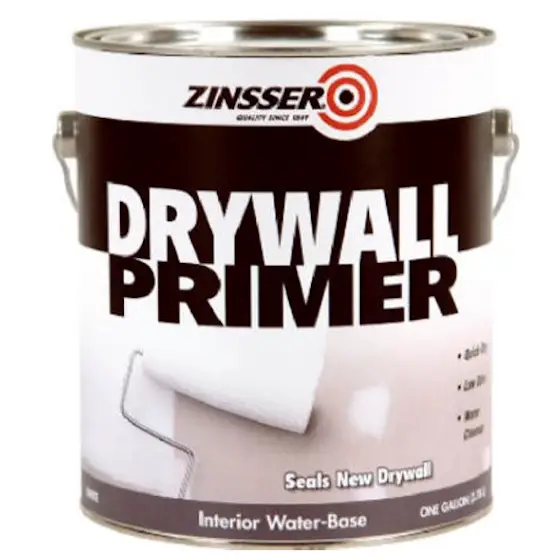
This is a special drywall primer that will make your new drywall look perfect. Don't skip this step. CLICK THE IMAGE to have this paint delivered to your home.
"Primers are specially formulated paints that are used to smooth out the surface you're painting. They have great filling capabilities."
Drywall Primer Checklist
- Unprimed drywall will look bad under artificial light
- Primer evens out texture and porosity
- Drywall primer is low cost and easy to apply
- Name-brand drywall primer makes new drywall look like real plaster
This column was the Mystery Link in the February 5, 2016 AsktheBuilder Weekend Warrior Update.
What Causes Drywall Imperfections?
Frequently, the cause may be poor or unskilled workmanship. Often the imperfections can be traced to lumber shrinkage. High humidity and large temperature swings during installation and finishing can cause problems.
Poor carpentry techniques also can be to blame. However, did you ever think that a problem could arise in the paint that you use?
Related Links
Secret Drywall Paper Repair Tips - DO NOT SHARE!
Special Gray Primers - Old Master Painter Trick
Free & Fast Bids
CLICK HERE to get FREE & FAST BIDS from local painters who can apply drywall primer.
What Ingredients are In Primer Paints?
Paints are a combination of ingredients. No two paints are exactly alike. Chemically speaking, paints are almost identical to adhesives. Paints primarily have three ingredients:
- resin (glue)
- vehicle (liquids that evaporate as the paint dries)
- pigment (finely ground colorants and powdered fillers)
What is Paint Primer Resin?
The resin in a paint is the glue that allows it to stick to a surface. The resins are usually clear and almost always encapsulate or surround each pigment particle.
What is Paint Vehicle?
The vehicle is the ingredient which allows paint to be a liquid in the can. I often refer to it as a temporary ingredient, for once you apply the paint to a surface, the vehicle evaporates into the air.
That is why you must ventilate a room when using a paint that contains hydrocarbons or flammable solvents. These liquids turn into a vapor and can either make you sick or, if ignited, explode.
What Are Paint Primer Pigments?
Pigments are the ingredients which impart color. They're solid particles comprised of many ingredients. The pigments adhere to the surface you paint because of the resin. Pigments will wash off an exterior wall surface if the sun damages the resin.
This happens with exterior paints that chalk. The resin which is exposed to the weather breaks down and releases the pigment particles. The pigment then washes down onto your brick, foundation or driveway.
CLICK HERE to get FREE & FAST BIDS from local painters who can apply drywall primer.
Are Drywall Primers Also Sealers?
Not all drywall primers are sealers. A primer has one job to do and a sealer has a different one to do on the new drywall surface.
Just about everyone who has painted something has heard of primers. Some of us have also heard of sealers. Did you know that there is a big difference? These two foundation paints have entirely different qualities.
What Is a Drywall Primer?
Primers are specially formulated paints that are used to smooth out the surface you are painting. They have great filling capabilities. Because they have a high solid (pigment) content, these solids can fill in any microscopic valleys, depressions, etc.
Primers are usually somewhat low in resin so that when they dry, the surface of the primer film is coarse. This coarse, or rough, surface provides the finish paint an excellent surface to grab onto.
What is a Drywall Sealer?
Drywall sealers, on the other hand, are exactly the opposite of primers. They have a high resin content and a low solid (pigment) content.
Sealers are formulated to even out the rate of absorption of the finish paint. This quality is achieved by the high resin content. The resin, when dry, creates a barrier. Finish paints cannot easily soak through sealers.
Why Do You Need a Sealer On New Drywall?
You need a sealer on new drywall because the white joint compound on the seams and in the corners absorbs paint faster than the paper surfaces of the drywall that don't have joint compound on them.
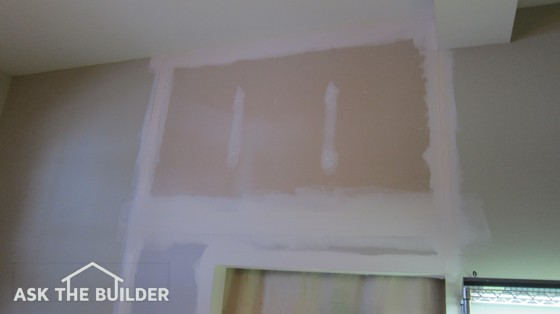
The white areas have joint compound on them. You can see the off-white area that's the drywall paper from the factory. A drywall primer/sealer will even out the texture and porosity in minutes once it dries. Copyright 2018 Tim Carter
Different materials absorb liquids at different rates. Materials such as these are said to have different porosities. Finish paint which is applied to a surface that has several different porosities will not dry at equal rates.
Those areas of the surface which absorb the paint quickly will pull the paint (and paint particles) deeper into the surface. The sheen of the paint will appear uneven, even though the surface which was painted is smooth!
CLICK HERE to get FREE & FAST BIDS from local painters who can apply drywall primer.
Column B49

Tim built custom homes and did ultra-custom remodeling for 20+ years before launching his Ask the Builder media presence. He was selected as one of the Big 50 by Remodeling magazine in 1993. This award gave birth to Ask the Builder in October 1993. Tim also operates https://DrawPlumbingPlans.com. His @askthebuilder YouTube channel was the first home improvement channel on YouTube.
so when to use which ????? !
It is nice to hear an accurate definition of the differences between sealer and primer. My interests are related to promoting education in this trade through Apprenticeships on going education and knowledgeable on site journeymen(journeyperson) sharing the needed correct information to those who want it to know. Good job Tim !.KEEP PAINTING A SKILLED TRADE
Rick M
I removed ceramic tile from above my bathroom vanity, In doing so the top layer of the wall board came off revealing the cellulose base cover. This is in a double wide mobile home. Is there a product to recover this and prepare it for applying new ceramic tile?