Foundation Grade Level – Don’t Go Too Low!
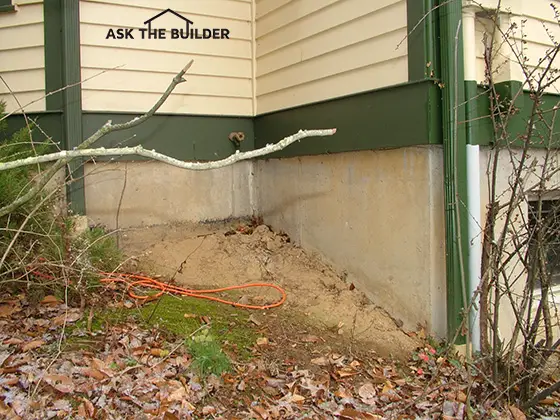
Foundation Grade Level | You can see that more than 6 inches of the foundation wall are exposed above the orange extension cord. On the right side of the photo, the foundation height is about 36 inches high. This allowed for traditional basement windows to be installed to allow air and light into my basement. I built this home in 1986. © 2017 Tim Carter
Foundation Soil Grade Checklist
- Most foundations too deep in the ground
- Top of foundation 18 inches above grade
- Use excavated dirt to create an illusion of a low slope
- 6 inches of exposed foundation minimum
- CLICK HERE to Get Tim's FREE & FUNNY Newsletter!
Your home may be one that was buried too deep into the ground.
The builder dug the hole too deep. Based on my forty years of looking at, and building, house foundations, I'd say it happens nine times out of ten. This mistake causes all sorts of drainage problems around a house.
I've traveled all across the USA looking at foundations on houses built after WW II. Just about everyone I see is too low. There's not enough slope around most homes to provide excellent drainage.
Builders from 140 years ago in many parts of the nation, knew how high to make foundations. More on that below.
New Construction
New homes and room additions are frequently the victims of poor planning with regard to grading. I can't tell you how many houses I have seen that were put too deeply into the ground.
This condition causes marshy ground, wet basements or flooded slabs. In virtually every case, a simple drawing or calculation would have solved the problem.
CLICK HERE to get FREE & FAST BIDS from local landscapers that can grade the soil around your home.
Make a Drawing
Many modern building codes have responded to this problem. They require that the top of foundations or slabs be at least 6 inches above the highest point of soil at any location around the house.
IMPORTANT TIP: This code requirement, as are ALL THINGS IN THE BUILDING CODE, is a MINIMUM requirement. This means you can increase the distance and give your home more protection.
Visit older neighborhoods in large cities east of the Mississippi River, and you'll frequently see the top of the stone foundations was about 36 inches above the grade or soil around the home!
Builders centuries ago knew that water would cause the wood frames and siding to rot, so they wanted the house up away from splashing rain.
Sloping Away
Furthermore, the ground must fall away from the foundation at least 6 inches within the first 10 feet around the perimeter of the house. Note that this is a minimum requirement. The more slope the better.
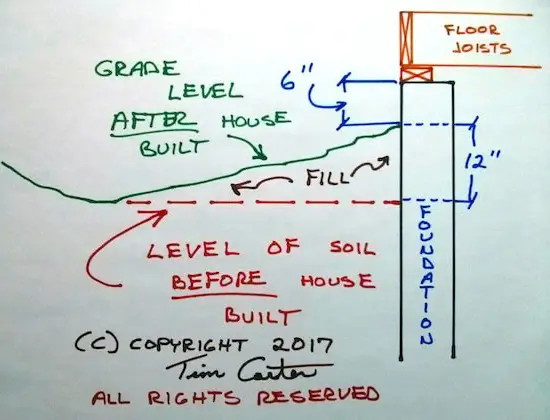
The top of your foundation should be 18 inches higher than nearby ground. Copyright 2018 Tim Carter
Using these calculations, this means that when laying out a new house, you need to pay attention to the existing grade before you dig.
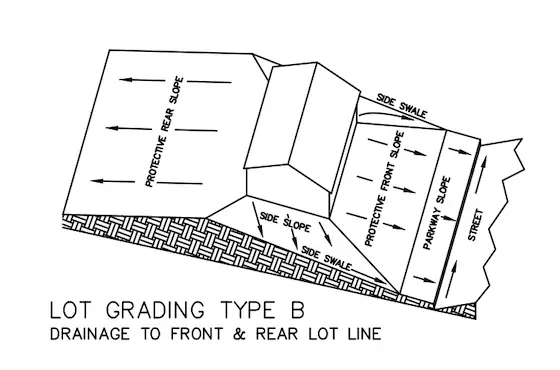
Note how the ground slopes away from the house on all sides.
In fact, you need to site the house and see just what the highest elevation of the ground is at any point within 10 feet of where the foundation will be. Knowing this, you can now begin to dig the foundation.
I always made a point to put the top of my foundations 18 inches above this highest point. You would be surprised how quickly the dirt from the hole disappears when spread out around the house. Although the foundation would look high prior to backfilling, the ground had a very gentle slope once all grading was completed.
In my opinion, you can never have too much slope away from your house. My guess is that anyone who has a wet basement or ground that slopes back towards their foundation will agree.
Existing Homes
Those of us with existing houses that have grade problems face different challenges. Landscaping, sidewalks and other improvements must be dealt with in trying to correct grade problems.
If you are lucky enough to have a sloped lot, your task of establishing grade can be accomplished. It may take a small piece of earth moving equipment like a Bobcat or skid-steer loader, but it will be worth it.
If you have a situation where ground is slopping towards your house (houses built on hillsides), the trick is to slope the ground gently by creating a swale. This swale, or ditch, allows you to do two things. It gets water away from the house and at the same time collects the water which runs downhill towards your house. You direct this swale around a corner of the house and continue until the natural slope of the ground is falling away from your structure.
CLICK HERE to get FREE & FAST BIDS from local landscapers that can grade the soil around your home.
Flat Lots
Those of you who live in houses on flat ground face a more serious challenge. Sometimes the ground is so flat that there is no way to easily create a swale or sloping condition.
See the above drawing I made to see a swale.
A swale is just a small valley in otherwise flat land.
Roof Water
In these cases, you need to pipe roof water as far away as possible. Downspouts that dump water onto the ground near the house can cause serious problems. You would be surprised at the volume of water a 1 inch rainfall can produce.
You can also consider surrounding your house with a hidden moat, something like the old castles used to have. This moat is simply a ditch that is dug around the problem areas of your house. I call it a linear French drain.
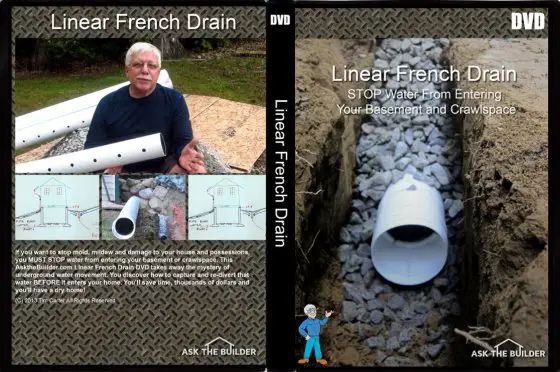
Do your own DIY install of a Linear French Drain with Tim Carter's time-tested methods and materials! CLICK IMAGE TO ORDER NOW!
This trench can be as narrow as 6 inches and work.
The depth of the trench depends on how much sub-surface water you want to collect and your local soil conditions.
In areas with heavy clay, the trench usually only needs to be 2-feet deep.
Once this trench is excavated, fill it to within 1 inch of the top with large 1 inch washed gravel. This trench acts as a collection area for surface water. As long as your soil can absorb water (even at a slow rate), you will have improved drainage conditions around your house.
Only in very wet seasons, when the water table rises around your house, will you experience problems.
CLICK HERE to get FREE & FAST BIDS from local landscapers that can grade the soil around your home.
Column B67

Tim built custom homes and did ultra-custom remodeling for 20+ years before launching his Ask the Builder media presence. He was selected as one of the Big 50 by Remodeling magazine in 1993. This award gave birth to Ask the Builder in October 1993. Tim also operates https://DrawPlumbingPlans.com. His @askthebuilder YouTube channel was the first home improvement channel on YouTube.
need to know what kind of soil to put around my house
Great topsoil.
What if the amount of water coming onto my property is so huge that it has( and will) continue to wash away my topsoil. I live in city limits and I feel that waste water is directed onto my property. I am told that since I live on lower grounds from my neighbors that I have to allow their water to come onto my property. I put french drains onto my property But the amount of water coming from theirs is flooding my yard and spreading into my second level home!!! Shouldn't my neighbors try to stop water coming upon their property like I did!!
You install a hardscape of larger rock in the area the water runs. Think of it as a stream bed. It's IMPOSSIBLE to stop water from running across your land or your neighbor's land. All water is trying to get back to the seven oceans. It is ILLEGAL to divert water from land in a way that it's now going a direction it wouldn't go PRIOR to the development of the land.
How do you grade the dirt under a bay window?
I do it with tools instead of my hands. Much faster. You want the ground to fall away from the house.
For soil around the foundation of an existing house - what's the appropriate soil composition (i.e. how much clay, gravel, etc. should be mixed together)? Thanks.
I would mix 63.457% sand and 36.543% clay. But that's just me.
I live at the bottom of a hill. When tropical storm Lee came through our area a few years ago, I ended up with 39 inches of water in my finished basement. (It's no longer finished). Since then I've noticed than when it rains I have water seepage in different parts of the basement. I had a plumber come by to give me an estimate for a sump pump, but he said until I fix the grading problem around around my house a sump pump wouldn't help as water ponds in my yard when there is a heavy rain. I don't understand. Could you possibly explain what the plumber might have meant?
Susan,
The plumber is trying to snooker you. You should consider a phone consult with me. Far too much to type here. Complete 100% Money Back Guarantee.
we are having a new house built and the construction crew is dumping all kinds of broken cement tile roofing , rocks and broken bricks, I asked them to remove the piles , I am afraid they will try to grade these items into our foundation, I think it will be harmful to our foundation, Am I correct ?
Yes. TAKE PHOTOS and document this and any other apparent error. Put your complaint in WRITING NOW to the builder. ALL complaints and issues MUST be presented to the builder in writing and produce written minutes of every meeting with the builder.
I need to coorect improper grading around my foundation. The existing dirt slopes inward towards the basement and water is getting in at the joint of the basement floor and basement walls. What kind of dirt do you recommend I get to fix this? Thank you.
I recommend you don't get any dirt. You need to get RID of dirt. You also need my Linear French Drain DVD.
We has an elevated yard, which causing the water to flow toward our house and the gate. The grass from middle of the yard to our house is pretty damage/muddy all the time. I contacted the builder and he replied 'the area is extremely shaded from being covered by the house and does not allow much sunshine. Unfortunately, there would not be anything that we could do to fix this.' Can't they put in a French drain by the house or something? Is there anything we can do? It's our first house and I feel cheated as the neighbor had they fixed before moving in.
You need to get my Linear French Drain DVD and follow the instructions. Wait till you see the first five minutes of the DVD explaining HOW it will solve your problem.
MOSS IT OUT!
In your situation, Hypnum moss would be the answer, I think.
Hypnum is tolerant of constant wetness, it's one of the most inexpensive mosses, and also one of the fastest spreading.
Because it's a Pleurocarp (one of the two types of mosses), it can be placed in patches all over the area.
DON'T do the milkshake thing. It doesn't work. It never worked. I think it was a prank someone pulled to get people to spray buttermilk everywhere.
You can order it online fairly cheaply. Or, and of course you can't do this because it's probably against regulations, just take a bag with you when you go to the park. I can almost promise you that just off the beaten path, there's Hypnum everywhere.
While you're (not) doing this, however, please don't take more than 25% of the patches you see. Moss holds moisture for the plants growing nearby and prevents invasion of competition. Don't take more than 25%, and don't take any if there isn't at least a square foot patch (there will be you just have to look).
You can take patches of moss-covered deadwood too, but it may be a different species so it might not be as tolerant of the conditions. Doesn't hurt to bring it to the area, though.
I used different mosses to solve a problem with topsoil erosion on the shady side of my house - which were rather pressing since I live on a terraced lot and there are three 4' staggered walls on the downslope as opposed to one 12' retaining wall. Worked like a charm and I've collected several species and am cultivating it on the uphill retaining wall and various pieces of decorative deadwood as well.
Not a moss expert, but not a novice - and that's my 2 cents.
Have a house one wall bricks sets foundation about 1inch inside move in put carpet down filled it but on north side of house when it rained real bad bedroom leaked on floor will that empty space fill with water.house bilt in1975
What's the mathematical way to figure out how much dirt will be coming out of hole for my house
And how do you change the elevation numbers to feet by having the undercuts
I have a new property where the driveway and frontof lot slopes toward new house spot. New house spot is now occupied by a 40x60 pole barn that will be relocated. I want to enlarge the exisisting barn earth pad to accomodate house foundation. Since part ofthe the spot has been compacted over decades from farm equipment what composition of fill is best to create a stable and well drained situation? Note my plan for drainage includes 2 swales i stalled uphill for redirect.
We have an older house with a crawl space under it. We have water coming in under the footing/foundation. We have checked for broken pipes and leaks. None found. We have been pumping the water out from under the house. Any thoughts as to what can be done with this problem?
Yes Debra. We should talk on the phone like I did with Declan. He lives in Sydney, Australia and I showed him in 15 minutes how to dry out his basement! CLICK HERE to order the phone call.
I got you. My kitchen is an add-on and has crawl space under it so I have a teeny bit of experience with this.
First step (inexpensive):
Ensure that rainwater from your roof isn't contributing to the problem. Make sure the gutter spouts are driving roof rainwater far enough away from your house, and in the right direction, that the rainwater isn't coming right back towards the foundation. If not, get some hoses or trays (trays can look nice if done properly). And I know it's no fun, but we have to clean those gutters twice a year.
Second step (inexpensive):
Ensure the water isn't gaining access the through the crawl space access hole. This is where my experience took place, because when I bought my house everything was fine but a year later there was an insane amount of humidity in the summer that my dehumidifier could not conquer.
Turns out the access hole to my add-on kitchen's footing, concealed by the backyard deck, had been covered with a very poor quality plywood which had warped and rotted and essentially let nature have free access to my basement. At least it was a few inches above ground level so there was no rainwater entering, but BATS SURE DID! (I mean... I love bats. They eat mosquitoes, and I grew up in the country with a barn so it's nostalgic to have them around at night - BUT NOT IN MY HOUSE!)
So... yeah - check the access holes. Make sure they're sealed properly.
Step three (inexpensive if you're patient):
Correct the grading around your home's footing. As far as I know, all of the same rules apply. If you're patient and wait for sales, or if you buy ripped bags (50% off at most box stores), you can buy silt, clay, and rocks fairly cheaply. Dig away the topsoil in sheets (as best you can), throw down the mix, tamp it so it slopes away (fairly sharply) from your home, replace the sheets of soil.
Or consider buying 4" perforated drainpipe and put it in under the ground near your house (after wrapping it with landscape fabric). It will essentially make an underground moat for your house and divert water flow to wherever it leads.
Nothing wrong with having a tiny hill next to your house. I have one on the East side of mine because the driveway is close by and no thank you I do not want an entire driveway's worth of rainwater getting shoved into my foundation.
So those are the first three steps. 1 and 2 might solve your problem. I hope they do because they're cheap and not too labor-intensive.
Step 4 (not all that expensive):
Crawl spaces need to be moisture controlled. The best way to do this is to prevent the water from ever getting in, but it will sometimes. I don't have much knowledge with this, but I believe the standard is to lay down a few inches of gravel, then cover with thick plastic sheeting SEALED to each other and to the walls a few inches up.
This is a fix for crawl spaces that don't see much traffic, because crawling around on plastic on top of gravel will damage the plastic, but there are tapes that will survive moisture.
--------------------------------
Even without plastic sheets, the ground under your house should be covered with gravel. Just the gravel alone prevents an insane amount of moisture from reaching your floor, because the moisture rising from the dirt beneath it is blocked or condenses back down.
It doesn't have to be official "gravel". Any small stone is fine. This is something you can usually find for free on Craigslist (if you haul it away) every now and then. If it's too much of a job to do all at once or you don't have a truck, get a sturdy rubber/plastic tote from Wal-Mart and get it filled occasionally with the free stuff. Or keep an eye out for those torn bags at home depot and get a $4 bag of pea pebbles / river gravel / heritage stones / pea gravel / paver gravel / etc for $2. (I bought 2 bags of pea gravel, 2 bags of pine bark nuggets, and a bag of heritage stones from the 50% off "torn bag" cart earlier today to cut into my potting mixes).
And because I have to get going - step 5+:
Waterproof / hire a professional. Full-on waterproofing (youtube vids for instruction) or hiring a pro. If you hire, get someone highly reviewed. If you're still nimble, watch a bunch of youtube vids and do it yourself. Get a good respirator, those surgeon mask things are crap.
Good luck!
P.S.
It's easy to be long-winded when you type 70 words per minute.
What about the opposite situation, too much grade? I'm looking at a house situated 14 feet from it's closest corner at a grade of 15%, to a culvert/stream bank that steeply drops from there in about 8 feet to the water which is about 8 feet down.
Even though it is in a no flood zone, my realtor recommends against buying it because of possible foundation damage as seasons alternate between wet and dry and the foundation gets stressed.
Any ideas would be much appreciated.
Tim Carter said, "I would mix 63.457% sand and 36.543% clay. But that's just me." Is this a serious answer or sarcasm?
Kim,
What do you think? You can always just do a 2:1 ratio if that's easier on the gray matter.......
Hey tim have a question i know my slope on my soil isnt good and i have standing water against the vinyl siding of my house should i have a minimum of 6 inches from the top of my foundation to any soil all around my house if so say my foundation is 4 inches thick would you just keep it at the bottom of the foundation? Thanks
How high can the ground be against a single brick home with no basement? I dug down towards the bottom of the last row of bricks and the gravel started to appear. There is still a row of bricks showing though. I am concerned about grading and bug control.
Can this be answered please?
I have backfilled against my foundation walls from footers to grade with gravel. I have drain rock from footing drain 7' deep wrapped in geotextile fabric and 5/8" chips to finish grade. I haven't seen this done and am wondering if there is a potential problems with this parfait. even if I sloped imported topsoil away from the foundation I am thinking due to the clay content of my native soil the runoff would still drain back to my footing drains anyway.
Am I missing some concept that could become a problem in the future? My architect says it's not a concern but I have run into other issues with their information.
One thought I had about final grade material is to use a a self binding gravel mix with fines and a pinch of clay in it. The idea being to cap the draining gravel with 6" of something that would shed water away more better. However I don't think this would do much to keep the water from finding it's way down to the footing drains.
For those of you planning to build in the future and to pretreat for termites, be sure to check with the termite treatment company before you make any decisions.
We live in the Piney Woods area of east Texas, so termites are a fact of life. We had our foundation pretreated and have maintained our protection contract, so we have had no problems getting warrantee work done. However, the new district manager stopped by during the last siege, and mentioned that the company no longer will maintain a new contract unless the top of the foundation is 10-12 inches above the landscape mulch (which termites consider a delicacy). Knowing that, you need to also anticipate just how high you need to make any foundation plantings for proper draining of your plants and how thick you will install any mulch.
We are grandfathered in our contract, and it is transferable, so you can bet that we will never let that thing run out. And if we ever decide to move, the height of the foundation and all necessary swales will be a priority.
I recently purchased 5 acres that I have plans to build on. A llittle over two acres for horses. This use to be a rice field. Would clay like soil be best to build the foundation up and then go over that with a 60/40 type soil. This property does hold some water but, with proper elavation it has a place to run off.
I have an older house and the soil has washed away over the years from the areas near the foundation, close to the house. My yard slopes downhill so I believe I just need to replace the soil.
What sort of soil do I use to build it back up so that it won't wash away when it rains?
All soil erodes. Resistance is futile. Look at photos of the Grand Canyon. That's solid ROCK.
Hey Tim, I have a house from the 70's that has a brick veneer. The soil line ok in some areas, but is 6 inches above the veneer in others. I have had problems with "wood destroying insects", along with some of the veneer caving towards the house in some of the higher soil areas. Would your linear French drain solution be an option in my case? Thank you
Will,
You need to regrade around your house as I show in this column. Period. The Linear French Drain is not the solution in this case.
Tim, If you have some lugustrom bushes that are 1-3 feet from your foundation wall and from their trunks it slopes toward the home, can you, instead of re-grading, too much vegetation besides these bushes would have to be taken out to grade away, can I places a series of catch basins there to catch any surface water that might go in there and the last catch basin can slope under the bushes to let out 10 feet away, I have gutters and 10 foot extensions up too on that side. It would be next to impossible to re-grade, really need your advice, at least I am trying to catch gutter water and some surface water, since the ground does slope down toward the stucco wall
Dana,
You probably need to schedule a phone consult call. Far too much to type here.
http://shop.askthebuilder.com/products/15-Minute-Phone-Conversation-with-Tim.html
Have my PVC drain pipes ready. Trench dug down to footer and contractors parged wall. My neighbors gutter twists around side of their home which my house is downhill and only few feet away. Has caused many problems. Lost free standing fireplace and now had blocks replaced. So I'm putting drain at bottom on footer. 4 inch stone, drain, 4inch stone, straw, ? then native clay like upstate NY soil. Then I'm repeating same drain closer to surface to catch their, which is now my surface water. I'm just dispursing this all the way out to the back of middle of my yard with a big pit of stone underneath the ground. Yard slopes away from home.
My big question is what do I put against the foundation. The native soil? Gravel? My thought is I wouldn't want soil material that attracts water against foundation. Like gravel will attract water since less dense than soil.
I only have 5feet between my wall and property line. So this is reason for drain at footer and one near top. Just don't know what should go against foundation. Is my layers of stone gravel and straw ok against it or should I have native 3 or 4 inches against parged wall.
Doing project next couple days in cold. Going broke because neighbor and town don't seem to care how you reroute your gutter downspout.
Thank you Have peaceful holiday
Interested in regrading around 1955 split level house foundation. Had existing stone pebble as landscaping around foundation and landscaper brought in black dirt and put over the rocks saying rocks were great for drainage. Also put dirt up to window sills in lower level of house which will rot the wood. I want dirt to slope away from house but he seems to have made horizontal beds saying I should put 4x4 treated wood as edging to keep soil from washing away. Does he know what he is doing. Should fill have been clay and landscape rocks removed before bringing in dirt? Thank you for any advice.
Charles,
My advice is to schedule one of my phone consult calls. There's FAR TOO MUCH to type here. The call is FREE if you're not satisfied.
https://shop.askthebuilder.com/products/15-Minute-Phone-Conversation-with-Tim.html
I'm making something similar to that French drain because our new house somebody built up the dirt from the front and all on the side of the house to the back of the house above the vynle siding dirt so I've leveled out all of the front side of the house
The dirt is now level with the foundation I have a tad bit more digging to do then put my cement in no drain piping
But really who in the right mind puts the dirt way above the foundation cement blocks and wood framing of the house so the dirt is resting on the vynle siding and rotting out the wood frame that's sitting on a block foundation because the dirt is to high
The shed is made just the same way they made the house well the left side of it is it's flat and the framing is wood on a slab floor so in time if it never gets dug out it to will rott out
Tim,
please help out. I have a 1930s house. The prior owner put a walkway on one side if the house that is directly against the foundation. There is clear water infiltration on heavy rain days on that side alone. Gutter are in good shape and drain far away. Is there any easier way to help the grade other than breaking up this concrete walkway that runs the length of the house?
This requires a phone call. FAR too much to type. Here's how to set up the call:
https://shop.askthebuilder.com/products/15-Minute-Phone-Conversation-with-Tim.html
Home has crawlspace with rain water seeping through foundation even though I've added dirt to slope 3ft. away from the home. The soil is clay and the land is basically flat. How would I utilize a french drain and how close to the foundation does it need to be located?
I answer all your questions in my linear french drain columns. If you need over-the-phone help, I can call you.
to build up soil around older home - i.e. ground slopes towards the home in some areas - trying to verify if any type of soil works for proper grading OR one really needs sand/clay mix? if so - not easy to find or buy at local home/hardware stores - mostly sell garden and lawn soils...
I agree with your observations about foundations being to low or deep, thanks for the article it covered alot of ground.
My quesiton is such. I plan to build a house under the ground. By cutting the side of a mountain off and only a glass front will be visible. So all that was written here is not applicable. But, because I'm not a builder... I have some ideas. first, pouring cement so that all sides of the box are integral with no cold joints. That seems like a real feat; for which I've not figured out yet using ICF foam blocks. But I would like to earthquake proof the house further. My idea is to take rubber tires (pellets). and fill in around the house say two feet of dirt; and 6 inches of rubber walls and then more dirt. This wall of rubber should do tow things. help remove moisture away from the house sides with drain pipes; and absorb any quake activity. What are you thoughts on such.