Tips on Sealing New and Old Blacktop Driveways
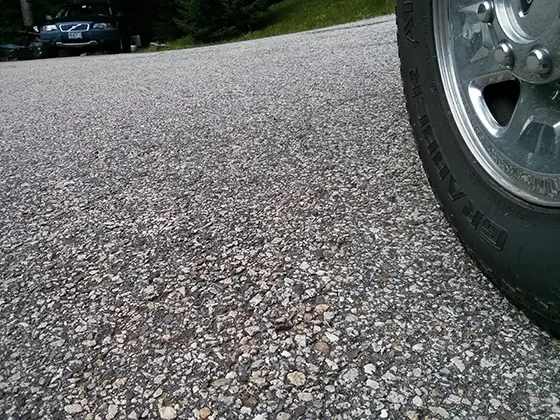
This blacktop driveway is twenty years old. It’s in very good condition. Photo credit: Tim Carter
Different Sealers
There are three basic types of blacktop or asphalt sealers: simple emulsified asphalt; refined coal tar sealers; and 100 percent man-made acrylic polymer sealers.
The simple asphalt emulsion sealers offer the lowest levels of protection. In essence, they simply contain the same asphalt that was used to bind the sand and gravel together in the first place. This asphalt coating will oxidize and get brittle just like the asphalt you are trying to protect!
The next best sealer to use is manufactured using refined coal tar. Refined coal tar offers two distinct advantages: it is not dissolved easily by gasoline; and oil and UV rays do not readily make it brittle.
Asphalt is easily dissolved by gasoline and oil drippings from your car. Because of this, you should consider using refined coal tar products.
There is a wide variety of refined coal tar products. Some of them have additional additives such as rubber and rubber-like polymers which make them more elastic. These sealers often contain fine sand and clays. The sand makes the sealers more durable. The clays make the sealers easier to apply.
The best and most expensive sealers you can buy are those that contain almost 100 percent man-made ingredients. These are the acrylic sealers. If you have ever played tennis on a blacktop court that has the distinctive green and red sealers, you have walked on these acrylic sealers.
The acrylics in these sealers are unaffected by sunlight and air. They stay flexible for many years. I know of a house only one mile from mine that has used the red colored sealer with great success. The driveway sealer they use often lasts for six to eight years before requiring another coat.
Yes, these acrylic sealers cost almost twice as much as refined coal tar sealers, however they may be a better value for you. I would check it out if I were you. Also, these acrylic sealers are available in black, so your driveway doesn't have to look like a tennis court!
Need help with sealing your driveway? CLICK or TAP HERE to get FREE QUOTES from local companies specializing in driveway sealing.
Tips on Sealing Old and New Blacktop Driveways
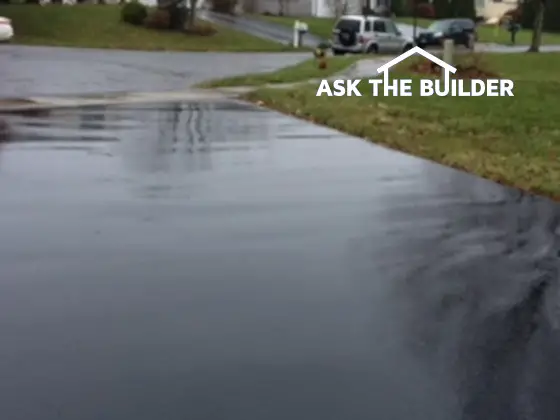
This is what blacktop looks like just after it's sealed. It looks like glossy black paint. Copyright 2018 Tim Carter
New Blacktop Driveways
New blacktop should usually be sealed within its first year. Depending upon the time of year it was installed, your climate, daytime temperatures, etc. the earliest you can seal your driveway is 90 days after installation. Your driveway should be exposed for at least 90 days where the daytime temperature is 70F or greater. This allows the lightest weight oils in the asphalt to evaporate, which in turn allows the blacktop to harden. This is very important!! If you do not let these oils evaporate, your blacktop may remain soft for a long time. Things such as bike kickstands, heavy metal objects, etc. will dent your new blacktop.
If you have anything that leaks oil, use cardboard to protect the new blacktop to keep it oil-free until such time as you can seal it.
When it is time to seal your new blacktop, follow the pointers in the following section.
Existing Driveways
Sealing a driveway is not much different than painting the walls or ceiling in your house. If you have ever painted a room correctly, you know that you must wash the surfaces to be painted, patch any holes in the plaster, caulk all cracks, and apply the paint in a uniform thickness (not too thin and not too thick). Driveways are just the same.
Important Tips for a First Class Sealing Job
- Remove all mud, vegetation, loose particles of sand and gravel, etc. WASH the entire surface to be sealed with water, brush dirty spots, rinse, and remove standing puddles of water.
- Patch any depressions with whatever patching compound is required. Deep holes will require cold blacktop patch. Shallow depressions (where the blacktop has slightly eroded) can be patched with various smooth asphalt patching compounds that often have the consistency of cake icing. Be sure to follow directions, as some of these compounds might need to dry for several days before they are sealed!
- Patch any cracks 1/8 inch or larger. Deep cracks should be filled with coarse sand to within 1/2 inch of the surface. Wide cracks up to 1 inch width may require special acrylic crack fillers that remain more flexible.
- Remove caked up oil drippings. Clean oil spots with special oil cleaners available from the sealer companies. Tough spots should have a special oil primer applied so the sealer sticks to the oil stained area.
- Just before (and during) sealing, fog the blacktop with enough water to dampen the surface.This water helps the sealer to bond to the older blacktop.
Only seal your driveway AFTER the old sealer has worn away. Even if you use just an emulsified asphalt sealer from a quality manufacturer, this coating should last two to three years. Applying sealer every year is a mistake. It is simply overkill and a waste of money. Good luck on your sealing project!

Tim built custom homes and did ultra-custom remodeling for 20+ years before launching his Ask the Builder media presence. He was selected as one of the Big 50 by Remodeling magazine in 1993. This award gave birth to Ask the Builder in October 1993. Tim also operates https://DrawPlumbingPlans.com. His @askthebuilder YouTube channel was the first home improvement channel on YouTube.
Our driveway was sealed with coal tar sealer 5 years ago. Can we apply acrylic sealer over the coal tar or must we continue resealing with a coal tar product. Thanks in advance.
Dan
I have just sealed my driveway a week ago a neighbor drove on it turned his wheels into the new seal left holes how can I repair them.
Sharon, when you called the company that sealed the driveway, what did they say? I believe I'd just put sealer down where it's messed up and I'd probably barricade the drive this time for a longer period of time.
I have an old driveway that is blacktop I assume it is its in a remote location and very little traffic but would like to keep what I have, I can blow it off but I have no way to pressure washer it as there is no water available at the location I really confused by all the products on the market and I have to experience in doing this, Any help would be appreciated, Thank you