Exhaust Fans for Kitchen and Bath
Kitchen & Bath Exhaust Fan TIPS
- Indoor air pollution needs to be exhausted out of a home
- Make-up air vents prevent dangerous backdrafting
- WATCH ventilation videos below!
- Remote fans are the best and they're quiet
- CLICK HERE to Get Tim's FREE & FUNNY Newsletter!
Man-Made Indoor Pollution
Indoor air pollution is real! All you have to do is stand in my kitchen on a Sunday morning when I cook breakfast for my family.
There's smoke everywhere. What's worse is in the smoke is vaporized grease that coats everything in the kitchen.
In fact, the EPA has instructed me to install scrubbers on my kitchen exhaust stack. Evidently the people in my neighborhood downwind from me are complaining.
Pesky Problem
Seriously, cooking, bathing and sanitation activities create airborne pollutants that should be exhausted to the exterior of your home. This is especially true if you live in a modern airtight home.
Vegetable Soup
I'm reminded of how things linger in the air every winter when my wife cooks my favorite vegetable soup. When I open the door and walk into the house after being gone all day, I'm hit with a wave of aroma.
The tasty vapors of vegetable goodness are suspended in the air of the house. The furnace, each time it operates, spreads all of the aroma molecules throughout the house.
The aroma lingers in the house for days.
That's OK for vegetable soup, but not so good for the greasy bacon smoke I produce on Sundays!
Minimum Standards
Certain rooms of your home require different ventilation expectations. Kitchens need more ventilation than any room in the house. Bathrooms need about half the ventilation that kitchens require.
It's all about replacing the air inside a room so many times an hour.
15 & 8
The Home Ventilating Institute recommends that the air in your kitchen should be replaced fifteen times per hour. That means every four minutes all the air in the room needs to be replaced by new air.
Bathrooms require a minimum of eight air changes per hour. Other rooms, such as laundry, family room and basements require a minimum of six air changes per hour.
Minimum Standards
Note these recommendations are minimum standards. If you want to ventilate more, feel free to do so. Commercial buildings have much more aggressive standards than a home if you want to really go nuts with new air.
Replacement Air
All too often people install exhaust fan systems without any thought as to replacement air. Replacement or makeup air is the air which must enter your house to replace the air you are exhausting.
If you didn't do this, your house might implode. Just kidding! However, problems can arise, especially if you live in a modern airtight house.
Path Of Least Resistance
If you don't provide for adequate makeup air, your fan will satisfy the pressure difference by sucking air from unwanted locations.
For example, you may turn on that new high-powered exhaust fan and draw furnace or hot water fumes right back down your chimney! This is called backdrafting.
IMPORTANT TIP: This backdrafting can be a serious issue and you should be sure you're not creating a problem at your home. If you draw furnace or water heater exhaust air back down a chimney, you could cause serious carbon monoxide poisoning in your home.
Thanksgiving Ash Storm
Many many years ago, I made a fool of myself one Thanksgiving at my sister's house demonstrating this phenomenon by mistake. For some reason, I decided to turn on her whole house fan.
These are powerful exhaust fans. Since it was cold outside and all the windows were closed, the fan decided to get its makeup air from the path of least resistance. That happened to be the fireplace chimney.
It just so happened that a fire was in progress. Smoke and ashes were sucked into the dining room! What an idiot I was!
Air Duct Hood
You can provide for makeup air in many ways. Some companies make nifty devices that you can install in a side wall to provide for this purpose.
Here's a great example of a simple and affordable fresh-air vent:
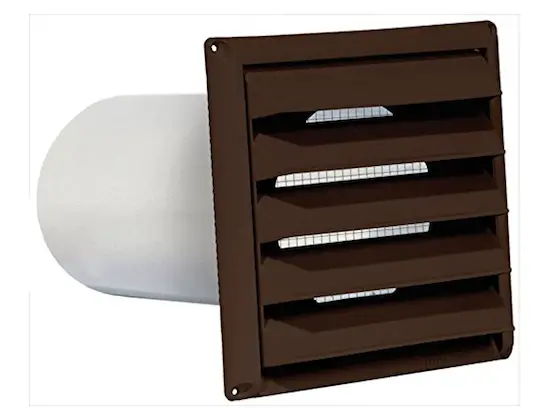
This fresh-air intake vent will do a great job. You may need several to get enough air indoors to satisfy all fuel-burning appliances. Pipe them with solid 4-inch metal pipe. CLICK THE IMAGE TO ORDER THIS VENT NOW.
You can also make your own like I did. I simply cut a slot in the side of my band board (floor rim joist on top of foundation) and covered it with a screened air register cover.
Fresh Air Vent Video
Watch this video to see a unique fresh-air supply vent.
Two Types of Systems
There are two basic types of ventilating systems: point of use and centralized or remote. Most people are familiar with the point-of-use fans. These fans ventilate a specific room or area.
Most kitchen range hoods or bath fans work this way. They have a motor in the fan housing (or it is sometimes in the wall or at the end of the duct run). This fan motor spins and exhausts that area.
Remote Fan
Other systems are available that work like my central vacuum cleaner. In these setups, there's a centralized exhaust motor and fan located in a remote location. When turned on, it sucks the air out of every room that's equipped with a suction duct.
Watch this video about a remote bathroom fan system I had in my last home:
I installed this type of bathroom exhaust fan in the last house I built for my family. One advantage with the remote fan is it's so much quieter.
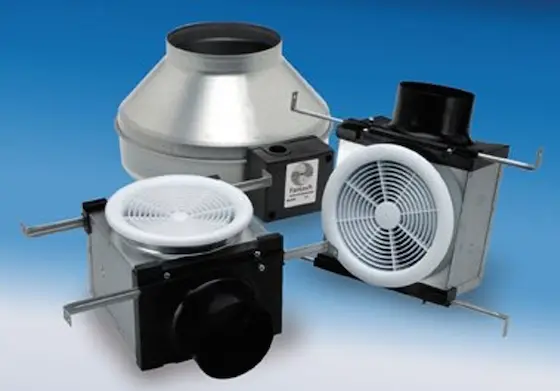
Here's a typical Fantech bath exhaust fan setup. The odd cone-shaped metal thing is the fan. The two boxes that have the round white covers are place up in the ceiling joists of the bathrooms. All you see are the sleek round white covers. They come with and without lights! I LOVED these in my last house. CLICK THE IMAGE TO BUY the SET NOW.
Exhaust Through Roof
I've found that it's often best to vent fans and dryers through the roof. The only places this doesn't make great sense are places where the snow buildup on roof could block the exhaust coming from the fan.
Roof Exhaust Flashing Video
Watch this video to see how to install a roof exhaust flashing and never have a leak.
Never In The Attic!
In many instances, the air from exhaust fans goes to the wrong place. I've seen both kitchen and bathroom exhaust fans that simply discharge the air into an attic space.
This is a huge mistake.
IMPORTANT TIP: In the case of a kitchen exhaust fan, this practice represents a major fire hazard. If you have a fire develop on your stove while the fan is on, the flames and fire are SUCKED UP into the attic BY THE FAN!
The moving air INCREASES THE INTENSITY of the fire. If the duct and the roof rafters, etc. are greasy the fire will spread quickly. The fan actually begins to operate like a blow torch.
Attic Mold & Mildew
Bathroom and kitchen exhaust fans also can transmit large volumes of moist humid air into the attic or other confined spaces. This can lead to wood rot, mold and mildew.
The trick is to simply exhaust this air from the fans directly to the exterior of your home. Every major fan manufacturer makes special termination "caps" that attach to the final piece of ductwork. These caps can be installed in a roof, sidewall or a soffit.
Correct Duct Size
The fan that you purchase has only so much power. It is often rated as so many cubic feet per minute (CFM) at a given static pressure. Static pressure is a concern.
Static pressure is a measurement of the power of the fan. In other words, if two fans are rated at the same CFM but list different static pressures, the fan with the higher static pressure rating will be more powerful.
Air Isn't Weightless
The concept of static pressure is really quite easy. Think of the fan and duct assembly just before the fan turns on.
Between the fan blades and the exterior of your home (end of the duct) lies a volume of air (the calm air in the exhaust duct). This duct may be short, long or have a number of bends.
The more air that is in this system, the greater the load (static pressure) on the fan. If there's too much air to push, the fan blade will simply sit there and spin.
Follow Instructions!
This is why you must follow the manufacturers instructions regarding duct size, total length of duct, number of bends in the duct pipe, etc.
If you decide to become an amateur mechanical engineer when installing your system and guess at how to install the duct piping, don't complain to me or the manufacturer if your fan doesn't seem to work.
Do It Right, Not Over!
Exhaust fans will help you to maintain a great indoor environment. You just need to select the proper sized fan, install it correctly and provide for some makeup air. Sounds too tough? Not really.
Column B98

Tim built custom homes and did ultra-custom remodeling for 20+ years before launching his Ask the Builder media presence. He was selected as one of the Big 50 by Remodeling magazine in 1993. This award gave birth to Ask the Builder in October 1993. Tim also operates https://DrawPlumbingPlans.com. His @askthebuilder YouTube channel was the first home improvement channel on YouTube.
What is the standard distance from a cooktop to the exhaust fan(hood)?
Off the top of my head I'm going to say 30 inches.
I was thinking of adding a second booster fan to the attic duct work for my micro wave/stove exhaust fan. My concern is first, is this a practical idea and secondly, should both fans be of equal cfm. I'm thinking that if the booster fan is more powerful it may cause a cavitation in the first fan and cause noise across the blades as well as a stalling (BLOCKAGE) of the air flow. If the more powerful fan is on the hood end I may have a reversal of this problem (if indeed there would be a problem).
Another option suggested by a builder I know was to vent the air down through the kitchen floor and out through the basement wall. I live in a raised bungalow. Any feed bac would be most appreciated.
Thank you.
BP