Drain Your Crawl Space

By Tim Carter
©1993-2008 Tim Carter

Summary: Natural springs can keep your lot wet. Drain the soggy land with the addition of French drains.

Related Articles: French drains, French drain illustration, dry out your lot

! ! ! See Author's Notes at Bottom of Column ! ! !

DEAR TIM: My husband and I are interested in buying a new home, but we found out that the lot the house was built on has two natural springs located on either side of the lot. The contractor had two French drains installed to divert the water from the springs as well as directing the down spouts from the roof into these drains. We decided to investigate the crawl space. The walls of the foundation were dry, but my husband found several spots of water in the crawl space on top of the plastic sheeting. However, there was not water under the plastic sheeting where he found the water. The amount of water was around a tablespoon. What, if any, problems might we experience if we decide to purchase this property? What suggestions do you have for us? We plan to go back to the property if and when a hard rain occurs. Betty R.

DEAR BETTY: You might have all sorts of problems and then again you may have none. The first thing to determine is whether or not there are surface water issues in addition to the subsurface water problems you already know about. Read my past column about Lots - Important Features to get a handle on the overall grade of the lot.

The liquid water on the vapor retarder concerns me as I wonder how it got there. Was it just condensation that had formed under the retarder and then flowed out on to the membrane at a nearby seam? Or, did water somehow enter the crawlspace and run over the membrane and this small amount of water was the last to evaporate?

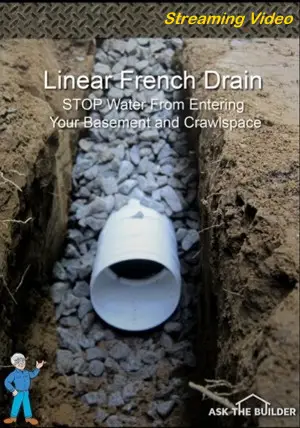
I would also ask exactly how the existing French drains were installed. It would be ideal if they were nearly identical to the method I have used for years. Read my past column about Linear French Drains to see a great 3D diagram of how they are constructed.

Author's Notes:

You may wonder if my advice is worth anything. Well, read what Jim Sanders wrote to me when he was at the end of his rope:

"Hi, I just wanted to write to give you the results of my "Trench Drain". I have had a wet crawlspace for 15 years. Water would fill the crawlspace at times, so we actually had to drill weepholes at the base so that it would enter the basement and eventually, the sump pump.

I have tried everything. Several contractors said that the only thing we could do was to bring the water into the house via drainage tile and let it enter the sump pump. That would work, but because I live on a 6' elevation, there is no reason that I should have water problems. It became like clockwork...when it rained, we would rush home from the lake or wherever we were vacationing so that we could be prepared to start the backup generator, in case the power failed. We even had our alarm company put a sump alarm on our system, so they could notify us if we had a power failure. Battery backup was not an option, because sometimes we loose power for days and during any rain, our sump would run every 7 minutes...just like clockwork.

I found your site and read the article on the trench or French drain. At first, it sounded a bit like "holistic healing" to me. I failed to understand why a 2 ft. deep trench, 4 ft. away from the house would do any good. How could this simple thing correct an extreme water problem that has plagued me for years, cracked my foundation, settled my garage floor and ruined almost every vacation?
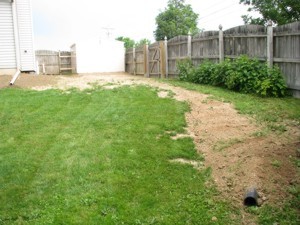
The Linear French Drain trench running from the house. PHOTO CREDIT: Jim Sanders
I decided "what the heck". I had to dig by hand using a trenching spade and a pick-axe, because the builder back-filled our property with brick and blacktop. It took quite a bit of time. Because the ground level varies so much on that side of the house, I was not able to achieve exactly 2 ft. deep. It varied from 18" to 30" in spots, but the slope was downhill. The trench is about 80 ft. long. At times, I thought about filling it all in, because I just didn’t believe that it would work.

I stoned it, put tile in, and filled it with #1 round stone. I socked the pipe just for safety measure and I also used geotext fabric on top, so I could cover with dirt and grass. I also ordered some clay and pitched from the house to the drain.
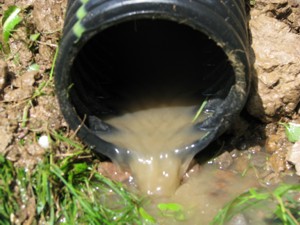
After a short rain, water is running away from the house. PHOTO CREDIT: Jim Sanders
Result? For the last month, we have had 7 or 8 torrential rains, the worst of which was last night. It rained so hard, that our lawn washed out in spots because of the high clay content. Our sump pump, that normally ran every 7 minutes during and after rain, has not turned on for 4 weeks. The silt at the bottom of the sump well is now dry and cracking. Our crawlspace has not shown a trace of water or even moisture.

Since I couldn’t see correcting the foundation cracks or the garage floor settling and tilting until I corrected the problem's source, I waited to see if the trench drain worked first.

This week, I had a company come in and perform sort of a "mud-jacking" technique on the garage floor, which worked perfectly. Also, during the past few weeks, I parged the cracks in the foundation.
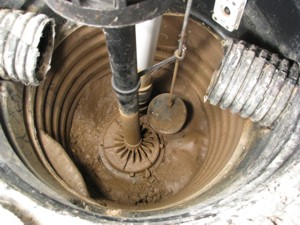
A dry sump pump. PHOTO CREDIT: Jim Sanders
I just wanted you to know how this worked. I stressed for many years over this issue and the solution was nowhere near as difficult as I thought it would be.

As a side note, I went to the end of the drain tile during a hard rain to see what was happening. Water was running out of the drain tile in about the same exact volume that it previously ran out of the weepholes in my crawlspace. This winter will be interesting, because last year, the ground next to the house was so saturated that during a thaw, my sump would run constantly. I'm guessing that the ground between the trench and the house will probably be drier now going into this winter."

- Jim Sanders, Upstate area - New York


Comments:

Jeff
04 Dec 2007, 23:40
Dear Tim,

We live in seattle. Our house is 20 years old. The crawl space has always been dusty dry (check often spring, fall, winter) However, we have had a lot of rain and snow recently (record rain fall) and I found about a foot of water in the crawl space.

water got in the vents in the crawl space. water went down after 24 hours and was nearly gone after 48.

Questions- what should be done about the water that was in the vents? (replace clean nothing)

best way to dry out the crawl space?
what is a cost effective way to prevent further/future damage (IE mold)?


thanks

Jeff
David
05 Dec 2007, 04:21
Tim:

Another Seattleite with the same problem... Water in the crawl space after heavy rains. Unlike Jeff, my water doesn't seem to be coming in from the vents, but rather coming up from the soil below the house itself. Is there a good way to figure out exactly where the water is coming from (I'm on a nearly level lot and there's a lot of standing water on the rear lawn too) and what the "right" solution is to keep it from happening in the future? I've read your columns about French Drains around the home's perimeter. Is that goind to stop water that seems to "bubble up" in heavy downpours?

On another - related - note, my vapor barrier (6mm plastic sheeting) is now floating in about 18" of water. When I re-install it after I have the crawlspace dried out, would it be a better option to attach the barrier directly to the bottom of the floor joists instead of lying it on the floor as it has been in the past? (This is not the first "flood" in the crawlspace.)

-David
AsktheBuilder
05 Dec 2007, 08:43
Jeff and Dave in Seattle:
Okay, for starters I need both of you to read *all* of the columns in my Drainage category. Then find the one about downspout drain lines to ensure yours are installed correctly.

An over sized linear french drain - one with a 6-inch diameter perforated pipe and placed in a 1-foot-wide trench that has the gravel extend all the way to the surface should kick butt the next time it rains like that.
Keith
07 Dec 2007, 18:49
I'm in the same boat as Jeff and David, and for the same reason. I'm not sure exactly where the water came in, just that it didn't flood in from above ground. I've read your articles but have found no advice on actually drying out the crawl space. I used a portable sump pump to drain away most of the water, but what should I do about the last inch? It doesn't seem to be going away by itself, either because it's now trapped on top of the plastic or for some other reason (water table still too high, lack of proper drainage channel from crawl space, etc.). I've been told I could rent fans, but will that rid me of the last of the standing water, or must I use something like a sponge and bucket first?
AsktheBuilder
07 Dec 2007, 19:18
Keith,
Yikes! You need to do whatever is necessary to get the water off the top of the vapor barrier. Any water below it will go away as the soil saturation level drops. You know what to do to prevent future infiltration.
Greg
18 Dec 2007, 13:56
Longtime fan, first time caller-
Yet another Seattlite who got hit by the Dec. 3rd rainstorm. I read all the drainage articles first, but still have a specific question: The combined storm-sewer (which my downspouts connect to) is my only storm water discharge option. In lieu of a pump, can I gravity feed a crawlspace sump into the sewer via a check valve? I understand a check is also a mechanical device that requires maintenance, but it still seems like a simpler solution than a pump.
AsktheBuilder
18 Dec 2007, 17:08
Greg,
You *possibly* can. I don't know your plumbing code up there. Most cities are moving away from combined sewers as a result of the Federal Clean Waters Act passed decades ago. Connect storm water to a sanitary sewer at your own peril......
Jennifer S.
13 Jan 2008, 18:26
Hi,

I have a little water in my crawl space, and someone recommended a sump pump, but I am wondering if it is really necessary.

I live near Portland, Oregon, but the amount of water is nowhere near the amount the people from Seattle are mentioning.

The soil is heavy clay, and when we have heavy and/or extended rains, we get maybe an inch at most, and only in small puddle-size spots where the ground is uneven. The worst spot is in a 12" diameter depression/hole around an insulated pipe going from the house into the ground, and even that is not too bad. Not much gets on top of the plastic, either. I have seen no signs of mold. I can't see installing a sump pump for what probably amounts to what looks like only a few gallons of water a year at most.

The previous owner extended the patio with pavers. They do not slope away from the house, and I doubt he installed a French drain, either. I have already corrected some other problems, and plan on changing the patio materials and installing a drain.

My questions are:

How much water in a crawl space warrants the expense of a sump pump? (Assuming the patio fixes don't correct the problem.)

Should I have the pipe that the water gathers around checked? Or does water probably only gather there because it's a low spot?

Thank you!

Jennifer


AsktheBuilder
14 Jan 2008, 08:37
Jennifer,
Forget about sump pumps! Go read all of the columns in my Drainage category and solve this problem outdoors with one of my Linear French Drains.
Richard Orton
16 Jan 2008, 23:14
Just saw your site on the internet and am now very interested in a "french" drain. Have read about all you have available and that really only leaves me with one question concerning putting one in some distance (about 20 feet from a north crawl space foundation. You advised one for a person for approximately 6 feet away.

My particular situation: East - west 76 x 32 x 4 foot crawl space with water coming into the space 'under' the NE corner (which is trenched to a sump pump and out the south side).

The ground 'gently' slopes away from the house to about 20 feet out where it meets the opposite slope of the hill coming down from the north of us. It's at this point where water collects (some 4 x 20 feet including in front of the garage apron) and, I suspect, continues from this point underground to up into the crawl space. This little valley runs the entire length of the house around both ends.

Would a french drain solve my problem this far away from the foundation? If such a drain is installed, can it be covered with sod on top of the gravel?

     View all comments
*Name:
Email:
Notify me about new comments on this page
Hide my email
*Text:
Security Image:

Visual CAPTCHA


Contact us to Advertise on this site.
Have a Suggestion?

Ask the Builder Comment Help

Helpful Comment Tips: If you need help with a problem, please try these things now before you type in a comment. You could discover your answer in just minutes.
  • Read ALL Comments Before Submitting One: If there are lots of comments that are already part of this column, there is a very good chance your question has already been answered by me or someone else.
  • Read Similar-Titled Columns First: The column above is almost always part of a two-or-three-part series. The answer to a question you may have is probably in a related column or in comments that are part of that column.
  • Read Columns in a Category: Take the time to read many columns in a category. The amount of information you will discover will amaze you.
  • SHARE a Story: Please share any tips or amusing tales of glory! Tell others what has worked for you. Maybe you have a disaster you want to discuss. Let's collaborate so we all learn together.
Don't show this alert again.