Light Bulbs Burning Out Fast
Light Bulbs Burning Out Fast TIPS
- Turn off circuit breaker to lights
- Remove bulb from socket
- Look at brass tab at base of socket - it will be flat or nearly flat
- Use needle-nose pliers to pull tab up carefully so it's at 30-degree angle CLICK HERE for BEST pliers.
- CLICK HERE to Get Tim's FREE & FUNNY Newsletter!
DEAR TIM: Four of the six bulbs in the recessed lighting in our kitchen ceiling keep burning out. I just replaced one and it burned out in an hour. I am using 65-watt bulbs. Our house is only three-years old. Are the bulbs the wrong size? Is there a problem with the wiring? Cory Dixson, El Dorado Hills, CA
DEAR CORY: The problem with the premature failure of the light bulbs has nothing to do with the wattage or the wiring. My first guess is that it can be traced to the person who has installed the light bulbs or previous owners of your home. I think they are twisting them into the socket too tightly.
The flickering of light bulbs in lamps and fixtures can also be caused by bulbs that have been installed too tightly into light fixtures.
Brass Tab
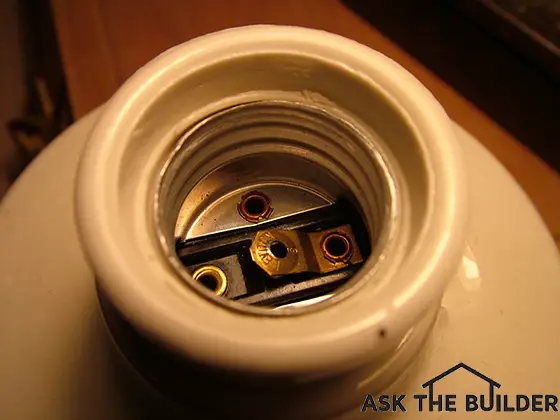
Look right in the center of the photo. You can clearly see the brass tab and if you look closely you can see it is raised up off the bottom of the socket. © 2017 Tim Carter
At the base of light fixture sockets you will find a brass tab. This tab is bent at an angle when the fixtures are new and will spring back and forth if depressed slightly. Do not ever stick your finger in the socket to test this, as you can get shocked if the power is on to the fixture.
Take several new light bulbs and inspect the base of each one. You will quickly notice that the bottom of most light bulbs has a small droplet of solder in the center of the base. More importantly the size of this drop of solder is not consistent from light bulb to light bulb. It is close in size, but not always the same size or height.
Free & Fast BIDS
Arcing Melts Bulb Bottom
If the brass tab at the base of the socket does not make firm contact with the bottom of the light bulb, a small electrical arc, or spark, can happen that starts to melt the solder. Over a period of time, the solder can deform and the gap between the solder and the brass tab gets larger.
In some cases, this arcing can create a hole in the base of the bulb causing air to enter the bulb. When this happens, the filament burns out rapidly.
When this happens, the electrical contact between the brass tab and the solder is broken and the light bulb acts as if it has been turned off when in fact the switch is on and the bulb is still in working condition.
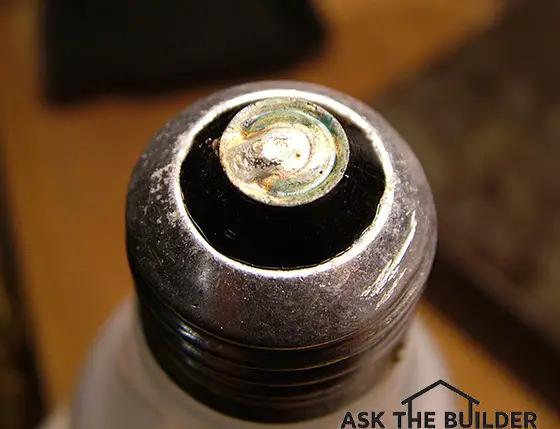
Pull Up The Tab
To prevent this arcing you must be sure the brass tab is always at about a 30-degree angle inside the bottom of the socket. People who twist bulbs in tightly will depress and flatten the tab so it does not spring back when a bulb is replaced.
Turn OFF Breaker
If you discover the tab is flattened, then you must turn off the power to the lights, and as an additional safety safety measure, turn off the circuit breaker to the lights.
Use a needle-nose pliers and carefully grasp the sides of the brass tab near the tip of the tab, not where it bends down into the underside of the socket. Slowly pull it up so the end of the tab is about one quarter inch off the base of the socket.
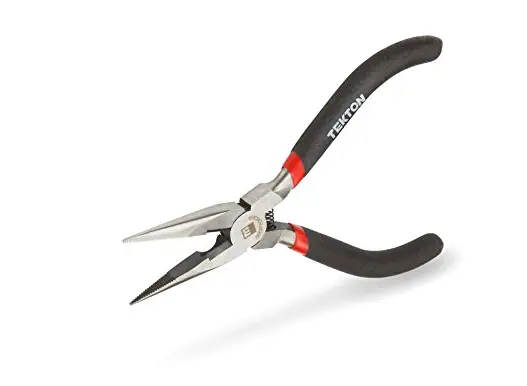
These needle-nose pliers will work great to pull back up the brass tab. CLICK THE IMAGE TO BUY THESE GREAT PLIERS.
When you install a bulb always do so with the power on and the light switch on. As soon as the bulb comes on, only continue to turn the bulb one-eighth of a turn. If you screw the bulb in too tightly, you will once again flatten the brass tab.
You need an excellent pair of needle-nose pliers for this repair. This is a great one. CLICK HERE to BUY it now.
Afraid of electric fires?
Column EM0017

Tim built custom homes and did ultra-custom remodeling for 20+ years before launching his Ask the Builder media presence. He was selected as one of the Big 50 by Remodeling magazine in 1993. This award gave birth to Ask the Builder in October 1993. Tim also operates https://DrawPlumbingPlans.com. His @askthebuilder YouTube channel was the first home improvement channel on YouTube.
I like this theory, unfortunately it is wrong at least in my case. With my bulbs (intermediate base 40 watt plugged into a ceiling fan) i can clearly see that the bulb is in fact blown, the wire between the terminals is broken and the glass is blackened on the bottom. My bulbs consistently last about a month which is just short enough to be super annoying. I was thinking about getting a base converter to either candelabra or the standard bulb size, that way at least i would have more bulb options and could possible get a more heavy duty bulb. Do you think this is a good idea?
Dallas, your question(s) require lots of typing and I have some questions for you. You should consider investing in a 15-Minute Consult with me. Look at my cart for that. Lot's to discuss. I just do short pithy answers here.
For future reference (as I am sure Dallas' problem has been solved by now), ceiling fans require bulbs label "rough duty" or "fan-rated" or "rough service". These types of bulbs have stronger filaments / filament supports. Another "trick" is to order 130VAC bulbs from a local electrical distributor. They will be slightly dimmer but their life spans will increase measurably. For example, a typical 60W 120 volt incandescent bulb is rated 1,000 hours / 555 lumens / 2700K color temperature (soft white). Now, replace it with the 130 volt version and it now outputs only 423 lumens but rated life jumps to over 2,800 hours! BTW, the rated wattage is reduced to 53W ... seem familiar? 😉
How helpful that was!!! After years of light bulb problems......no more! Thank you!
For Dallas, I would think that maybe when the solder melts it lets air get into the bulb and it promptly blows the filament. Just a thought. Bend the tab up as suggested and see if the problem goes away.
Incandescent bulbs have a heat-pinched glass seal separate from the metal socket.
Tim, thank you very much. I was having the same problem. I installed 12 can lights with no problem. I tried to "straighten" a bulb in one and broke the bulb. After that bulbs kept burning out fast. I think your theory is correct. If the contact is not good with that brass tab, then the arcing will generate a lot of heat, which quickly causes the bulb to fail. I had a suspicion it might be something like that, but it's great to find your confirmation by Google search. You saved me a lot of headaches trying to pull out the can light from a just finished living room 🙂
hi, i have my house running on 220v 50w down lights
but they keep on burning, i even tried energy saver 7w but
i keep on changing, kindly what could be problem?
/
I am having these same issues...and others with my electrical in my new house. Bulbs heat up to ungodly levels almost instantaneously. It is not limited to one or two areas. It has totally blown out the light kit in a fan. Many bulbs have gone out quickly including range light, flood light, fan lights, ceiling lights. It's all over the house. Plus now when I turn on my porchlight it immediately turns off but turns on and stays on after a couple of tries. Electrician has no clue what is going on. Very disturbing.
Sounds like a residential situation where either the 120V / 240V Main Panel ground / earth lead has come loose or the incoming utilities are not proper. Ask a professional electrician to take a look. The local utility may also have to check the pole / transformer for balance and voltage output. I've had both instances happen to me over the past 60 years. Hope this was cured quickly as these kinds of problems can also damage any electrical equipment from televisions to refrigerators.
It sounds to me like your porch light has a motion sensor on it. They will turn off shortly if no motion is detected but if you want them to stay on, you flip the switch off and on again.
Simpler terms, I just think bulbs are not made to better standards anymore. Maybe the quality is just bad. I have typically bought incandescent at places like home improvement stores. They typically have standard bulbs on sale. I bought several packs of 60's and put them in several places. They all began to burn out early. Strange yes, because previous those same sockets had bulbs that lasted years not months. I think its clear that bulb quality differs greatly, and that how much jarring in shipping and handling can also affect bulbs. Maybe the stock boy dropped a few boxes or mishandled them unloading or loading the truck that bought them. Not to mention our wonderful roads that those bulbs traveled to get to your store shelf. Many come from Mexico or farther. I agree, electrical issues can play a roll as well as socket problems. But common sense might prove that a bad bulb is just that.
Once incandescent bulbs were outlawed, so to speak, domestic production wound down fairly quickly. Several local manufacturing operations shed hundreds of jobs over this nonsense. So, bulbs are coming a lot further (most from China to put a name on it). Obviously this means cheaper in every sense of the word.
Another factor is Europe's rabid fear of lead resulting in the successful global ban of its use in solder. Millions of new problems in printed circuit boards lie in wait for us but it is quite possible that this also affected the reaction of the bulb's solder joints to minor arcs and such. Any research on that, Tim? I haven't seen any. Curious.
I've run into the problem that the light bulbs in my house numbers continue to burn out after a few weeks to a month. I have had the unit responsible for regulating the current to the fixtures replaced, the wiring inspected in the units and it still continues to happen. I'm not sure where to go from here. Any thoughts? Thank You
Yes. Just check what I say in my column.
Hi tim. My cousin has four sets of flood light on each corner of the house. And on two different switches. 2 to 4 bulbs will blow out every month. Made cause this and how can it be fixed.
Thank you for this very clear explanation. There I was thinking that my floor lamp had finally failed forever, with a series of bulb simply blinking out. Instead of using pliers, I simply carefully lifted the metal tab with a fingernail. The new bulb came right on.
Hi Tim.
When I replaced an inside oven light bulb and screwed in new one, it almost immediately blew out. This stove is 13 years old. It might be have some problem with this old worn out socket?
And I also can't find this appliances A15 light bulb in any nearby stores.
I'm wondering if I continue to use it without inside oven light bulb.
The oven lamp is wired to one of incoming legs. A stove is wired 220V; in other words, two 120V lines -- or legs as they say -- coming in with the burners wired across them to "see" 220V. If the neutral / return wire comes "loose", it can cause one leg to "see" a higher voltage than 120V which would shorten bulb life (and overheat burners) commensurately. Have a professional or certified electrician check voltages and tighten all screws from the stove to the Main Panel.
As to the bulbs ... unfortunately, the crowd that mandated replacement of incandescent lamps with alternate technologies failed to take into account that there are many, many applications where an incandescent bulb IS the best choice and in some cases IS required in order for things to work properly. My tree-hugger buddy is still trying to get his lava lamp to work with an LED bulb. LOL Your local electrical distributor should be able to order proper bulbs. They may balk if you're not a regular and you may have to deal with Amazon dot com (not that that is a bad thing). Also, expect to pay a premium price; of course.
In the mean time, leave a bulb in the socket so that the socket is protected when the oven is in use.
I have another issue: we have recessed can 2 sockets where the BR40 65w lights do not come one, but BR30 and a regular bulb - both 65w - do come one. I tried pulling up the tab but that did not help. All the solder ends on bulbs are the same condition, and the BR40s worked until about 3 months ago in one socket and the other socket started exhibiting this behavior today. Any ideas?
Sorry to see everyone having trouble but glad to know I'm not the only one. I've been in my house 11 years and every Fall I have to start replacing light bulbs and some of them only last a couple of days. It's different fixtures that blows so it's not a single outlet problem Thanks for some helpful ideas. I will research farther.
I believe my problem is due to the brass tab on the fixture being flattened, but I am unable to reach the fixture - it is in a chandelier about 25' up (in a church). I use an attachment on an extender pole to reach the fixture. Is there anything I can do to the bulb to get it to work? I have thought about adding extra solder to the tip of the bulb, but am not sure this is safe. Any ideas?
thank you for solving my problem! recessed kitchen lighting here as well. i used a ceramic knife to gently ease the brass tab away from its backing, then re-inserted the bulbs, only twisting a little after the light went on. all these years i thought the bulbs were burning out. i threw them away and bought new ones only to have the same thing happen. expensive bulbs too! about $12 a pop. the two i thought were blown are working great. so i wasted the bulb money but at least i didn't waste any more on an electrician. thank you again!
I used to blow bulbs weekly, don't know why but if I had to guess, it's because their cheap... I put led bulbs in and no more problems
This solution worked for me. The tab had flattened and a new bulb would burn out immediately when inserted into the fixture. Thanks so much.
I have a ceiling fan that has 3 lights. The ceiling fan has been in the house since we moved in over 12 years ago. I have been using energy efficient light bulbs and now the bulbs will alternate going "out" and coming back on. They never all go out at the same time. At most two will go out. Is the wiring bad or do is there another cause?
I had and energy audit and the person changed all my light bulbs to CFL bulbs. They too burn out rather quickly and they are in a basement that doesn't get much use. Is it possible they blow out because they are on a dimmer and are not meant for dimmer switches? They do dim though. This is also happening to one particular light in my dining room chandelier that is also on a dimmer.
We have a hanging candelabra-type light over our table, except the middle bulb faces downward and holds a regular based bulb. The candelabra lights work fine, but every time we put a regular bulb in the middle then turn the light on--the bulb explodes and blows all over the table. We haven't used that one in years, of course, but it would be nice to be able to use it. Any ideas what we can do?
I'm sure you'll discover there's a short circuit in the base of the socket. The bulb base is connecting the hot and neutral together with no resistance and you bet that will cause a bulb base to melt exploding the bulb. Should be a somewhat easy fix.
I live in a apt complex where the lights in the hall way of the bldg keeps burning out in a month. I was wondering what could be causing it and if it was dangerous maybe cause a fire or something is that possible or am I over thinking the problem they have had a couple of fires due to electrical shorts one of the fires was in the bldg I'm speaking about. I just want to know what to do and what to tell the mgr to look out for its a 3 story bldg and people can get hurt if a short is causing this problem I hope to hear back from you on this matter. Thank you
Do you want to know what to do? I would read the above column and pay close attention to what I say in it.
Hi Tim,
On my new EcoSmart brand LED floodlights from HD, the back is smooth, no slight raise/bump with solder. Can I assume arching will occur even though there is contact (bulb lights up, circuit completes)?
Thanks!
Susanna
I have pulled the center socket contact down using the plastic ring from a water bottle lid. Just reshape it by grabbing the ring with needle-nose pliers to flatten the about a 1/4". Use the pliers to grab the ring and put the flat part over the leaf spring contact to pull it down by about 1/8". I've found this to be necessary in replacing CFL bulbs with LEDs.
Hi,My problem is with helogen bulbs overheating and going out.Thanks