Concrete
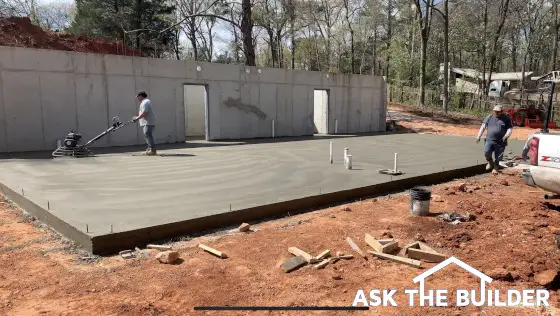
Concrete Tips | Here's a large concrete slab being finished. It's hard enough to stand on. The column below is so helpful I shared it in my free December 9, 2020 newsletter. 31,000 subscribers plus you will now know how to install concrete the right way.
Concrete Tips for Driveways, Sidewalks, and Slabs
Every week, I receive several emails from homeowners who complain about their new concrete driveways, sidewalks, and exterior patios. The surfaces of these improvements peel shortly after the first winter, random jagged cracks scar the surface, and puddles of water often form in the middle of a slab.
You may become a statistic as well as your new home is being built, unless of course you make sure your builder and concrete mason have a complete grasp and understanding of how to professionally install exterior concrete.
It's important for you to know as many concrete tips as possible so your concrete lasts for 50, or more, years.
CLICK or TAP HERE to get FREE BIDS from local concrete contractors.
Where are the Best Concrete Tips?
The best concrete tips can be found at the professional associations devoted to concrete.
Attempting to cover this subject in this small column does it a great injustice as many books and professional papers have been written about concrete. You can obtain vast amounts of superb concrete installation facts from:
- Portland Cement Association
- American Concrete Institute
- National Ready Mixed Concrete Association
There are a number of other state and local associations that also can provide you with reams of reading material.
Do Deicing Salts Harm Concrete?
CLICK or TAP HERE to discover the truth about deicing salts and concrete damage.
What is Concrete?
Concrete is an artificial man-made rock comprised in its most basic form of Portland cement, gravel, sand and water. It's not uncommon for concrete to also contain smaller amounts of fly ash, silica fume and even ground slag. The Portland cement powder ingredient is the basic glue that holds the sand, gravel and other components together.
What Makes Concrete Strong?
The stones, or rock, and Portland cement make concrete strong. You can test this with ease by comparing a mix of just sand and Portland cement and the regular mix of stones, sand, and Portland cement.
If you want strong concrete that will stand the test of time, you first need to make sure you have sufficient cement in the mix. The industry uses both strength measurements in pounds per square inch (psi) and volumetric measurements to communicate strength. For example, it is recommended that the minimum strength for exterior slabs be 4,000 psi or a six bag mix. Keep in mind that I said minimum. If you want to pour a 4,500 psi driveway, then do so.
Want perfect concrete work? Find a pro by using my Concrete Work (Sidewalks, Driveways, Patios & Steps) Checklist. I offer a 100% Money Back Guarantee.
Can Water Hurt Concrete?
Water is needed to activate the cement powder, but water is also concrete's worst enemy during the delivery phase and finishing phase of concrete installation. If you add water to concrete once it arrives at the jobsite, you can significantly alter the ratio of ingredients that make up the batch. Added water can dilute the amount of cement powder in the overall batch. This means the bond between ingredients is weaker. This same thing happens if the concrete finishers sprinkle lots of water on the surface of the concrete as they trowel it.
What Causes Concrete Spalling?
Concrete spalling is caused by a weak top layer on the concrete. When the top finished surface of concrete peels off, or spalls, revealing the coarse aggregate matrix below, it is typically a sign that a workmanship error occurred with respect to added water.
The mistake can even be traced to natural bleed water that appears on the surface during normal installation. As you can see, it is very important that all of the workers have proper training to understand what water can do to concrete.
WATCH these three videos to understand the dangers of concrete bleed water:
CLICK or TAP HERE to get FREE quotes from local companies who can pour your concrete driveway.
Proper curing of the finished concrete is also important. If the best concrete masons install concrete but fail to allow it to cure, the concrete can fail long before its time. The water used to mix the concrete must not be allowed to evaporate from the drying slab. Concrete finishers can cure concrete by keeping it wet for several days, spraying a liquid curing compound that seals the water into the slab or tightly covering the slab with high-quality plastic for several days. All of these things allow the water within the concrete to stay there to help fuel the chemical reaction that allows microscopic crystals to grow and bind all of the ingredients together. This hydration reaction goes on for weeks and even months.
Why Causes Concrete Cracks?
Concrete cracks are caused by shrinkage. Concrete shrinks as it cures and dries. This shrinkage creates tension within the slab that cause the concrete to tear itself apart.
Are Concrete Cracks Normal?
Cracks are normal. But with proper planning and tools, a concrete mason can control where the cracks will be.
Can You Control Where Concrete Cracks?
Yes, you can control and predict where concrete will crack.
This is often done by placing lines or control joints within the slab as it is being finished or immediately after the concrete is placed and can be walked on. The depth of these joints is critical. Be sure your concrete installer makes the depth of each control joint or saw cut line one fourth the total thickness of the slab. For example, a four inch thick concrete sidewalk should have one inch deep control joints.
What is the Best Weather to Pour Concrete?
Try to schedule concrete placement when the weather is cloudy and overcast. Concrete placement in weather extremes is very hard on the material. Concrete loves to be placed when the air temperature is in the mid 50sF. Placing it in blazing sunshine or snowy days is simply not a good idea.
Column NH005

Tim built custom homes and did ultra-custom remodeling for 20+ years before launching his Ask the Builder media presence. He was selected as one of the Big 50 by Remodeling magazine in 1993. This award gave birth to Ask the Builder in October 1993. Tim also operates https://DrawPlumbingPlans.com. His @askthebuilder YouTube channel was the first home improvement channel on YouTube.
I just had a concrete driveway put in a few days ago. I noticed that rain is puddling in a number of spots . Is this normal? What can I do about it to correct the problem?
Linda, it's normal when you have a bunch of losers put down the concrete. Sorry this happened to you.
Love these tips! The 3rd video says it's private though so it couldn't be viewed. What are your thoughts on the recent "dry pour" fad? Just a fad? Is there legitimacy to it?