Camphor Laurel Tops and Tables
I've made many a virtual friend over the years. Russell Morris is one from down under in Australia. He lives on the Gold Coast in S.E. Queensland.
Russell works with wood all the time and he wanted to share this project he's just completing.
I couldn't resist sharing it with you.
After you read Russell's comments, you might decide to contact him about making some tops or tables for you. Here's his contact information:
Russell Morris
geoflex AT SIGN hotmail.com
Tel. + 61-(0)7 5575-9572
Mob. + 61-(0)412-07-2234 (Gold Coast, Queensland Australia)
Here's Russell's commentary about what you see in the photos:
"Hi Tim,
Thought you might be interested in these photos. While I was recovering from my broken leg, I worked in the The Timber Slab Man's factory until I was OK for clambering around my sawmill.
I really enjoyed my time there. I learned a lot about finishing timber and making furniture etc.
One of the last jobs we did. (I did all the sanding, filling etc. in preparation for the final three spray coats.
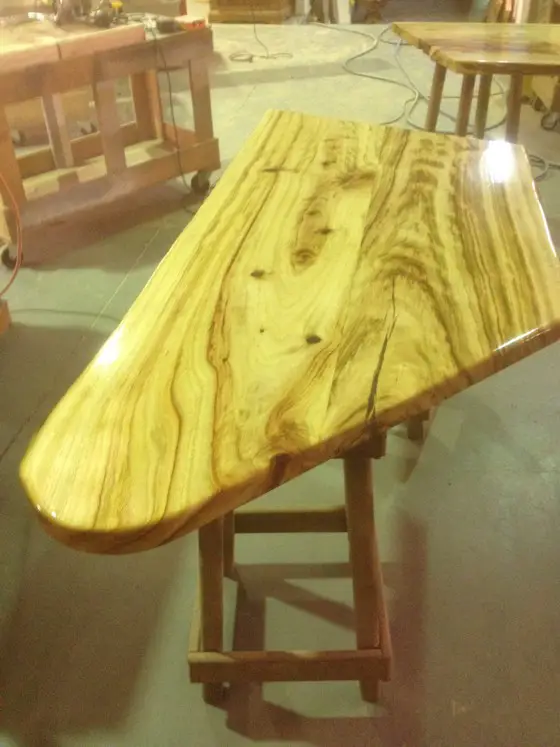
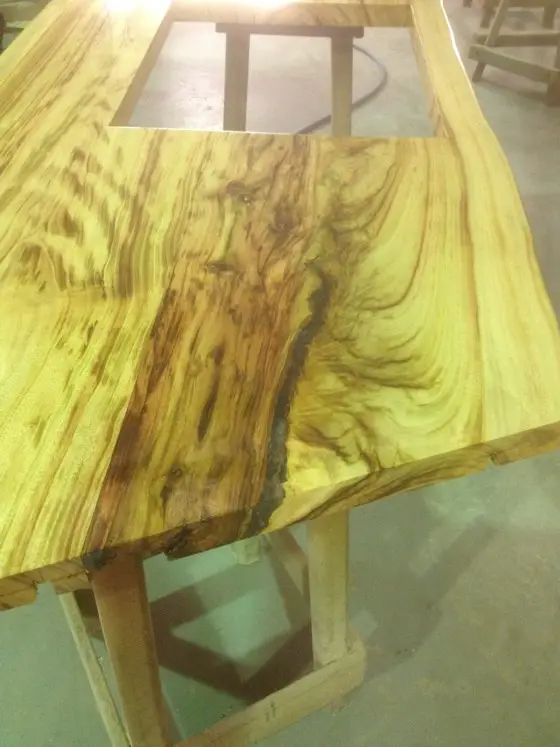
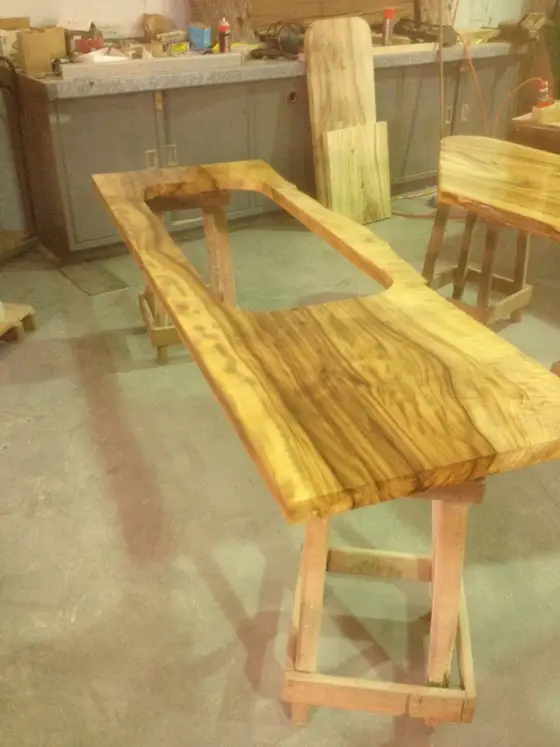
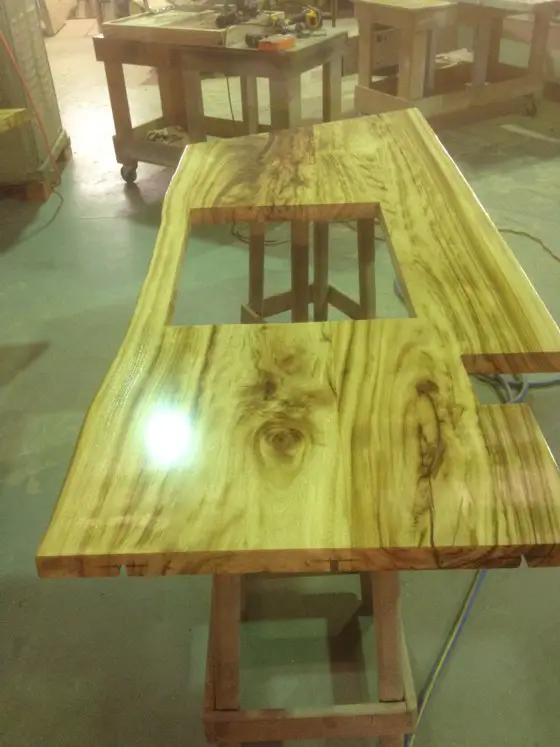
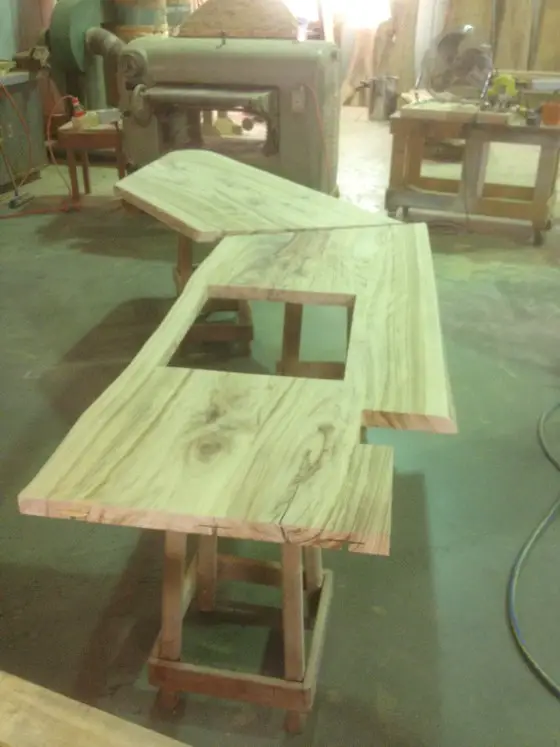
It's a three-piece-kitchen bench top with sink cutouts for a high-end kitchen.
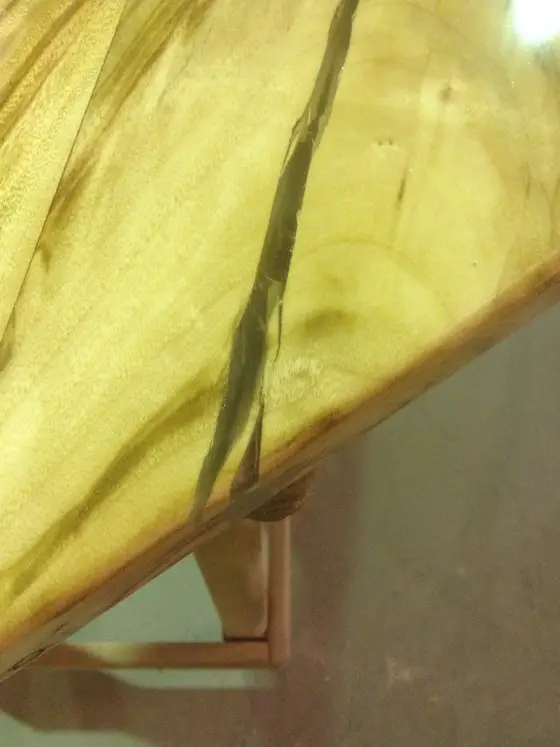
It's made out of a hardwood timber called Camphor Laurel. (Very lightweight for a hardwood though.) There were some big fissures and a big split in one end which we deliberately left as a rustic feature.
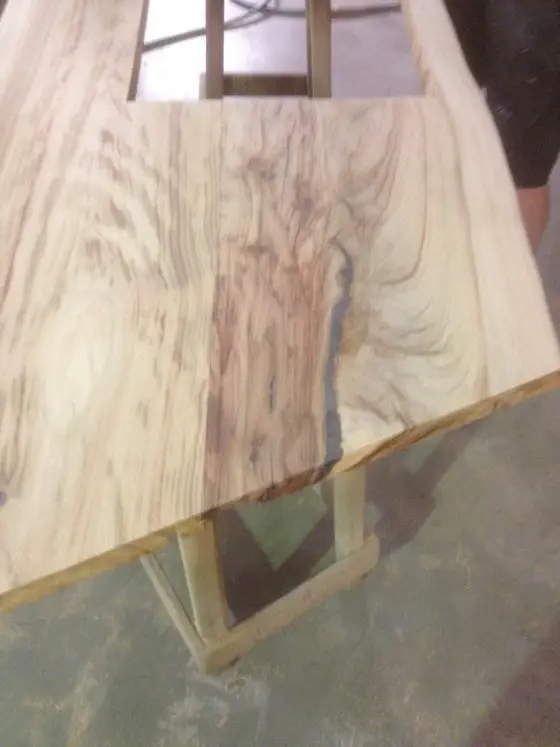
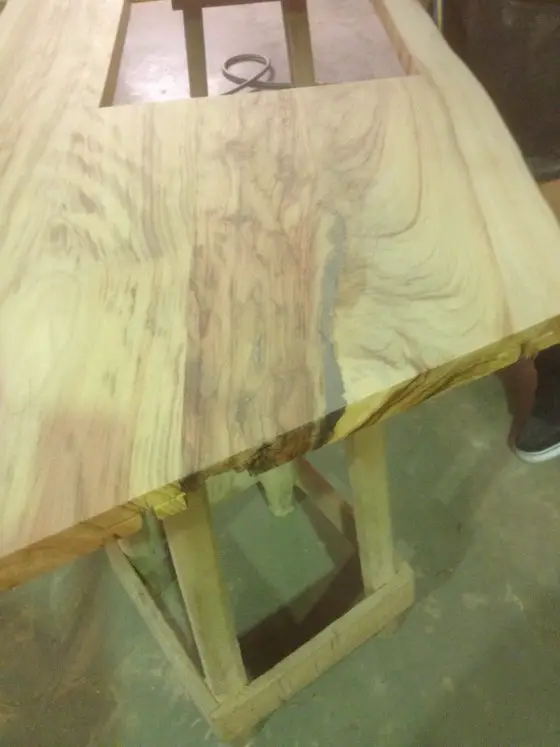
The owner wanted me to chisel out the splinters along the split, but I left them there as I thought it would look better leaving them there as a feature. The split goes right through, and we filled all the fissures up with clear casting resin before sanding them back. The resin is so clear that it looks like there is nothing in the crack. If you hold your hand under it, you can see right through it.
Everyone who saw it couldn't help but reach down to feel it, and was surprised that you could not feel the joint even though it looked as if there was a great big split in the wood. If you closed your eyes, you couldn't feel where the joint was.
All the edges not up against a wall are natural edges. The timber is about 2 inches thick."
Russell Morris
Below are his photos. Following the photos is a description of the process that was used for making these tables.
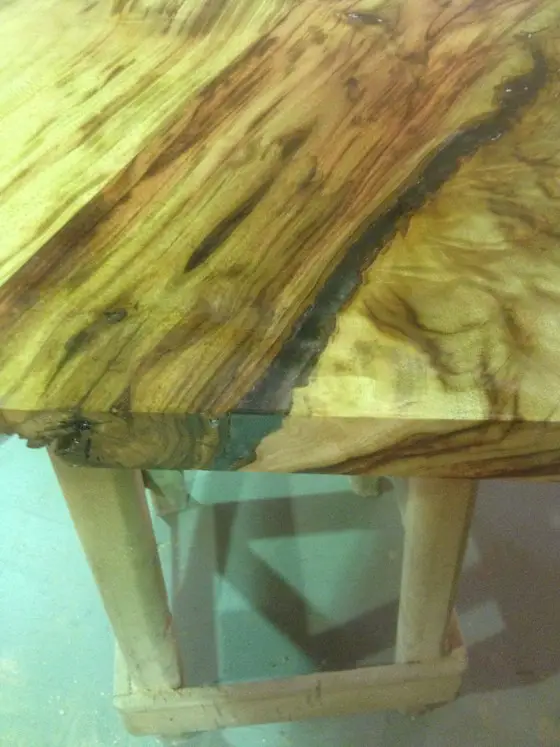
Russell's comments continue below.
"The way he normally designs the tables makes it a piece of cake to flat pack like something from Ikea.
The legs at each end are usually cut from bark to bark slabs the same as the top. Often cut from trees with a fork.
Then another slab is cut to go between the legs, and is through mortise and tenoned at each end. Wooden wedges tapped into each end hold the bottom three pieces together. Usually no metal fastenings at all are used. All you have to do is tap the wedges out to disassemble it, and tap them back together to reassemble it. It can only go one way, and only takes a minute or two.
The top is simply screwed on top with the aid of dinky little metal brackets. Again this takes about two minutes to remove the four screws. An absolute piece of cake. The tops are about the same weight as a similar thickness of laminated counter top material. About half the weight of most Aussie hardwoods.
Customers often get us to swap the tops around to get a top/bottom combination that they like. Since each piece is so different, it is a matter of taste as to which combination suits best.
Wrap the pieces up in bubble wrap, and you can pack up a whole container of them easily.
For simple book shelves etc., he usually simply uses recessed heavy duty batten screws concealed with bits of wooden dowel.
Raw Camphor Laurel slabs are the material of choice, but he uses all kinds of other timber as well. Mostly Aussie hardwoods.
Camphor Laurel is a tree that was introduced from East Asia as a street avenue tree back in the 1800's. They grow very large, and have beautiful canopies. The wood is extremely aromatic. ... To the point that if you turn it on a lathe, you need a fan to blow the fumes away or they can literally be overpowering.
The workshop has an amazing smell of Camphor, especially when we are thicknessing material. Even after many years of everyday use, a Camphor Laurel cutting board still smells of Camphor every time you cut it. It is a wonderful smell in small doses.
I came home every day smelling of Camphor. (I have almost no sense of smell, but Camphor is one smell even I notice when I am working with Camphor Laurel timber!!!! I lost most of my sense of smell when a Chlorine gas pipe broke in a public swimming pool chlorination plant.
Twenty-six kids were carted off to hospital, but I was the only stretcher case. It nearly killed me, but it did burn out most of my sense of smell unfortunately. If it was an indoor pool, a lot of people would have been killed, but fortunately it was outdoors. I just happened to be sitting on the steps of the pump shed, and all the fumes came out under the door I was sitting with my back against warming up in the sun after getting cold in the water. So I copped the worst dose.)
The Camphor in the wood gives it special characteristics. It is the best material on the planet for making cutting boards. That is what we make from the off-cuts. Bacteria do not grow in the knife cuts in the wood, so it is more hygienic than plastic cutting boards. The Camphor kills them.
Unfortunately the tree has escaped, and grows and multiplies like crazy in this sub tropical climate. Nothing eats its leaves or anything, but it is exceptionally fertile, and our native forests are being overcome by vast numbers of Camphor seedlings. You cannot easily kill it. If you cut the tree down, it just grows from the stump or roots.
The sugar mill down the road is powered by electricity generated by burning Camphor laurel that is hauled from surrounding areas. Vast areas of farmland are being taken over by the bloody stuff. It is very hard and expensive to control and remove. It is classified as a noxious weed, and you can be fined for not trying to control it on your property!!! It is an environmental disaster.
But it has wonderful wood to work with. Absolutely beautiful, and easy to work.
In Japan, where the cold winters prevent it from going to seed easily, it is usually grown around Temples and Shrines, and you often see magnificent specimens in parks. They call it Kuso no Ki in Japanese.
Anyway, glad you are impressed with the bench tops!!!"

What type of clear casting resin was used in this project? I have an old, solid wood end table where a knot has been picked out over the years. I really want to stain the table while keeping the hollowed out knot.
Contact Russell and ask him! His contact information is right there!
For small knot holes, cracks, insect holes, etc. we use Clear 5 minute Araldite. Make sure it is the clear stuff, and not the regular. You only get a few minutes to work with it before it goes off, but for small holes that is all you need. Just clean out or blow out any dirt or dust in the hole, and over fill the hole. After it is properly cured, just sand it back flush with the wood, then spray or brush your final finish.
For larger jobs, we use clear casting resin that we buy by the drum. This stuff takes much longer to set, and for large cracks and holes you have to build it up in layers. Keep adding more if the wood soaks it up. You may have to go back several times until all the fissures are over filled. Carefully tape the back of the slab first so that it doesn't run out the bottom. Once it is all filled and hardened, grind it back to nearly flush, then sand it down until it is flush with the wood, and there are no irregularities. When spray finished, you will be able to see all the inside of the hole.
If you don't want clear fill in the hole you can try to match the fill with the wood, or use a contrasting colour. To match it, collect all the dust from the floor after you have been sanding, and mix it with the resin or Araldite before filling the voids. For a contrasting black fill, grind up some charcoal to mix with the resin, or use coloured grout powder. Both work well.
When sanded back, the resin will still appear opaque or cloudy because of the minute scratches from the sandpaper. But when you spray it, and all those little scratches are filled with the final spraycoat, the resin will be almost crystal clear.
Hope that helps. Russell Morris. Gold Coast Australia.
Tim,
These tables are absolutely gorgeous!!! I have a good friend here in Baytown, TX that has a huge beautiful Camphor Tree growing in his back yard and it definitely smells like Camphor. The limbs on the tree even though it is huge are small in comparison. None of them over approximately 5 cm in diameter. Boy I wish I could have some of that wood for the dinner nook/ banquette I am currently seeking plans for to build. I just simply cant get over how beautiful this wood is. Sure would work great on the patio also....no big Texas mosquitos!!!
Have a fantastic day Tim and Merry Christmas if I dont shout back at you before then. Thank you for all these postings, I am loving each and everyone of them!!!
Camphor Laurel is a great timber to work. Easy to cut, sand, and glue. It is very light in weight for a hardwood. Each piece is unique, and the bold grain patterns on big slabs are amazing.
But it is not really suitable for permanent outdoor use. If it is kept under a veranda out of the worst of the elements, the 3 coat spray system we use will protect it for many years. Each table will become an heirloom. Very few of them will ever end up in landfill like the average laminex table or benchtop does after it wears out, or goes out of fashion after a few years.
As Kitchen Benchtops, they are very long lasting, with just a modicum of care. The coating system we use is very hard-wearing. And if it does ever get deeply worn or scratched, it is very easy to cover with a wax based product, or to re-spray it.
We can easily flat pack and export the tables, benches, vanities, and even custom kitchen benchtops. Especially if we had several orders that we could bundle together.
Tables made from our native hardwoods, (Usually from salvaged logs that are unsuitable for regular timber milling and would otherwise go to waste.) are MUCH heavier, (Many are too heavy to float!!) and extremely hard wearing. We have some of the densest and hardest timbers on the planet.
If you don't mind paying the freight, then I am sure you will find the prices very reasonable, and it is a quality product. Every unit we make is unique.
We are open to commercial inquiries for larger volumes too.
So let us know your dimensions, and maybe send a few photos of where it will go if it has to be fitted to your home, and we will see what we can do. As long as your measurements are accurate, there is unlikely to be any problem.
Best Regards, Russell Morris.
If you just wanted the wood for your own project, we can supply it no problem. You would just have to work out if the freight costs would be worth it. Let us know what you want, and we will check out export costs. It may still be worthwhile.
I am glad that camphor is an INVASIVE is not an endangerd species and a use has been found for it. Maybe we can build homes out of it. Is it termite proof? maybe this could be marketed as a new building material.
I would like to see Camphor used more widely than it is. Bulldozing it into heaps and burning it doesn't seem to be a very good end use!!
The growth habit of the tree doesn't usually lend itself to mass lumber production, and even if it did, you would probably not get the nice uniform strength characteristics that you need for a construction timber. The heavily branched growth habit of the tree is part of the reason for its irregular and bold grain pattern.
Northern Hemisphere softwoods are the kings of the construction lumber market!!
You also have to have the right place for it as furniture too. The very bold grain patterns, while very striking, sometimes don't really fit in with the clean minimalist lines of some modern interiors. ............. But for anyone with a taste for something a bit rustic, then it is absolutely fantastic!!!!! If you have a timber frame home, they would be great!!! It is also very good for accent pieces like staircases etc, although I would probably choose a harder timber for the treads.
Our Aussie hardwoods, are also fantastic too, .... In a different way. Many of our native hardwoods are naturally Termite resistant, (As distinct from termite proof!!!) Camphor laurel doesn't last long unprotected in the elements. It just isn't dense enough. Probably a fair bit more resistant than pine, but not nearly as resistant as our natives.
Hope that helps. Russell Morris.
Hi Russell,
I have a property in Fernvale NSW, and am about to remove 8 very large established Camphor Laurels, would you or anyone that you know be interested in using the timber? I am offering it for free, it will be cut down by experienced tree loppers
HI,
Please send me your contacts so I can see if we can do something about your unwanted camphor trees.
geoflex @ hotmail.com
Mobile. 0412 07 2234
Hi Peter,
I can't seem to find your contacts, Since Ask the Builder's site is still up, I thought I would try to get in touch again.
My phone number is 0412 07 2234 my e-mail address is [email protected]. (If the system will allow it to be sent.)
Maybe we can salvage some timber that will otherwise go to waste.
Best Regards,
Russell Morris.
Hi there,
Will camphor take stains well. I am on a guitar building process and came up with camphor top wood, want to do an oldmans tobacco burst over it with transtint.
Hello everyone.
I recently purchased a beautiful camphor wood coffee table for my living room. It came unfinished (I'm not sure if that's the right word but the seller basically said that they did not apply any form of finishing onto it) and I was instantly attracted to the "natural" look and camphor fragrance. It is now proudly displayed in the middle of my living room and guests have nothing but compliments for it.
However, I noticed that it seems to absorb any water spillage quite rapidly unlike most other wooden furniture I have. I am especially concerned of spilling any coffee or oily stuff onto the table, to the point that I'm afraid to even place glasses with chilled water onto the table (because condensation...).
I tried googling for information on the types of finishing I can use for camphor, and while I have found a few suggestions in here and on another forum, so far none have specifically mentioned that the finishing will still allow the wood to emit its fragrance.
Hence I would like to ask what finishing would be recommended if I would really like it to maintain its "natural" look and fragrance.
Thanks!
hi there, I have a beautiful 3m long slab of camphor that has been recently chopped down. Can I make a benchtop with it now if I epoxy resin top or does it have to dry? if so how long. thanks