How Much Soil Against a Brick House?
Quick Column Summary:
- Planter landscaping against foundation
- Water issues
- Keep brick dry, weep holes open
- Space around foundation allows for inspection
DEAR TIM: I just purchased a home where the landscaping bed is up against the brick front wall. The home is about twenty-five-years old. The planting bed extends about 3 feet from the house and is constructed with timbers that hold the dirt and mulch up against the brick. Is it bad to do this? What can happen? If you had built my house, how would it look and what would be done to ensure water isn't an issue? Debbie Beattie, Howell, MI
DEAR DEBBIE: Congrats on your new home! It's always exciting to get into a new abode and then get comfortable. Before the snow flies, you're going to have to deal with this landscaping bed. Based on your photo, the earth is too high up against the brick.
The fact that your house is but twenty-five years old tells me that it's brick veneer. Just behind the brick is undoubtedly wood framing. The proper flashings, weep holes, water barrier and everything that needs to be done to keep water away from the wood may or may not have been done. Since we don't have x-ray vision, we need to do everything possible to keep your brick dry.
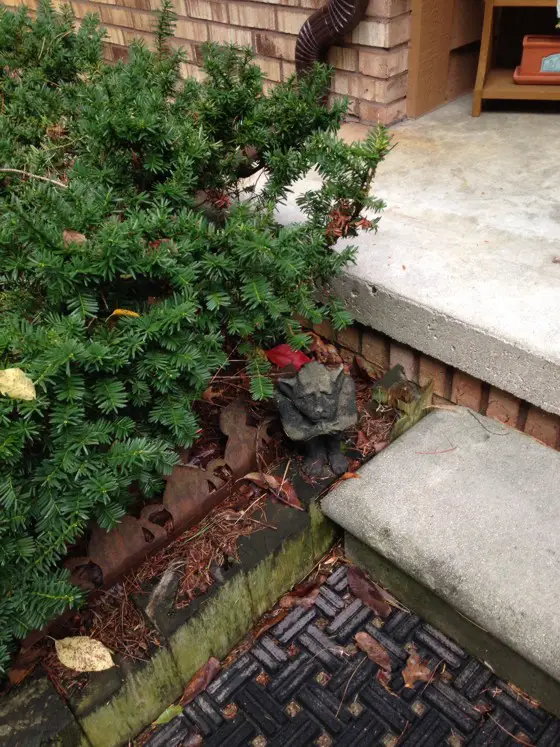
Soil, mulch and landscaping packed too tightly against a house is a recipe for disaster. Photo Credit: Debbie Beattie
The last thing we want to do is create a situation where water can enter the brick or water that flows down behind the brick from above can't exit the wall. Many people think that a brick house is waterproof, but that's the farthest thing from the truth. Water readily enters brick walls and this water must not be allowed to damage any wood that's part of the structure.
In old brick structures, the brick walls were two, three and sometimes four bricks wide. The inner invisible brick were almost always made from a softer more-absorbent brick. The outer brick that you would see was harder and more weather resistant. Water readily passes through the mortar between brick and especially the contact point where the mortar touches up against the brick.
In these old houses, the inner brick would absorb the water that was pushed into the brick from driving rainstorms. This water would be released naturally after the storm passed. The sun would come out and the breeze would pull the stored water from the brick in a jiffy.
Brick houses like yours don't have this extra brick that absorbs the water. Wind-driven rain gets into the brick and flows down the backside of the brick single brick veneer.
In well-built homes, this water is channeled to a flashing at the bottom of the brick. Holes in the vertical brick joints called weep holes allow this water to exit the wall. Your mulch, dirt and landscaping could be blocking this water flow.
If I had built your home, I would have worked hard to exceed any code requirements about the distance the top of the foundation must extend above the grade level outdoors. Your planting bed soil and mulch is considered the outdoor grade.
Different cities, towns and counties can modify the building code, but I clearly remember when the minimum distance from the exterior grade to the bottom of the first row of brick was 4 inches. For wood siding, it was 6 inches. I always felt these distances were too close to the outside soil.
I prefer to have at least one foot of foundation exposed so it's hard for water to back up over the top of a foundation. Here in my own neighborhood I got a call from a frantic resident early last spring. Water was pouring down the inside of his basement wall.
Once I saw the leak and then looked outside, I saw that melting snow from the roof had created a massive ice dam on the ground up against his home. Not only was the ground sloping towards his house in this area because of a raised planting bed, but there was also only 3 inches of space between the top of his foundation and the soil.
It's imperative that the soil against your home slope away from your house's foundation. Once again realize the building code is a set of minimum requirements. The code used to mandate that for the first 10 feet of horizontal distance away from a foundation, the soil had to have 6 inches of fall. Once again, I feel this is not enough.
I would have had at least 9 inches of fall in your grade had I built your home. You may feel this is excessive, but it's not. I would have also suggested that you don't put landscaping up against the house. I always coached my clients telling them the tips of branches from bushes and flowers and plants should be no closer than 2 feet from the house.
When you're out at the street, you can't tell a bush branch is 2 feet away from the house. You want air to be able to circulate around the base of your home and not be blocked by bushes or other landscaping.
This no-vegetation space next to the foundation also gives you plenty of room to walk around the house doing periodic inspections looking for insect issues, burrows from other tiny mammals or other problems with your home. When you have landscaping up against a house, you can't see anything. That's unacceptable in my book.
Column 1058

Tim built custom homes and did ultra-custom remodeling for 20+ years before launching his Ask the Builder media presence. He was selected as one of the Big 50 by Remodeling magazine in 1993. This award gave birth to Ask the Builder in October 1993. Tim also operates https://DrawPlumbingPlans.com. His @askthebuilder YouTube channel was the first home improvement channel on YouTube.
Thanks for this article Tim. So, this is my case as well, however not because of an existing issue; I am installing a patio of concrete pavers where the base (aggregate, sand) will have to be above the weep holes - there is no other way. What can I do to maintain the functionality of the weep holes?
I also have an issue similar to this - I have just purchased a cottage and the external ground is higher than the internal floor level, with water from the road directed to the front wall of the house. I am looking into a surveyor inspecting the site and issuing guidance on ground levels and solutions for drainage and your article has helped, thanks!
Hi there, Great tips by the way and thank you. I did have
a question though. I'm hoping you can answer it for me since
you seem to be pretty knowledgeable about gardening.
What kind of soil should I put in my raised garden beds?
If you had some insight I would greatly appreciate it.
ANSWER FROM TIM: I'd put in good soil. I'd also stop visiting websites leaving low-quality comments trying to get SEO juice.
I am planning on planting bulbs and annuals next to my house and want to know if the row of core Bricks at base of front with 3 core holes showing should remain above ground. I was digging to prep and found that row buried. I have a 3 foot crawl space as my house was built in 1953 so am wondering if they are for weeping and ventilating the crawl space . Thanks.
This is great information. Does this apply if my house is already on a slope? The builder built the foundation so that it steps down with the slope of the yard but my landscaper built up the soil 3-5" above the 1st layer of brick on the first step then installed a boulder retaining wall. Would this still not drain properly?
On the East side of my brick home, the dirt it right at the level of my brick and the concrete foundation slap. It's literally dirt to brick. Should I remove some of this dirt from this area? Leave more of the foundation exposed?