Solar Panels Return on Investment
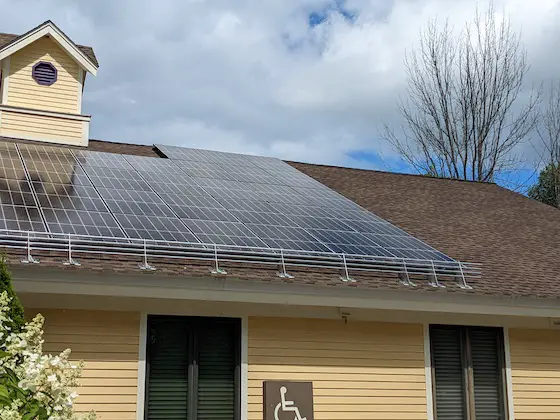
Have you thought about what has to happen to put a new shingle roof on this building? It might be a good idea to exercise your tiny gray cells.
Solar Panels Return on Investment - Moving Target
In August of 2022, Robert reached out to me after receiving last week's newsletter. Here's part of what he said:
"Along the line of conservation of resources, what are your thoughts on solar panels on one’s home? I live in North Richland Hills, Texas and have been thinking about it. As I am 81, I don’t expect to live to reap great financial benefits but think that it is something that might be worth pursuing."
It's very important to realize, I LOVE solar power. I love both active and passive solar heating. I love solar hot-water rooftop or parabolic-mirror heating systems.
All you have to do is stand outside in the sunlight on a calm day in central New Hampshire on an early January day at solar noon and you can FEEL the infrared rays warming you even through a winter jacket. Infrared as well as visible electromagnetic energy is such wonderful magic God created for us!
It's All About Money
Robert zeroed in immediately on how you should always assess energy-improvement decisions.
He realizes that the return on investment may take longer than the amount of time he hopes to be on this side of the grass. Good for him to display that amount of honesty.
You should also consider data from the National Association of Realtors. Back in 2016 while compiling data for my Roofing Ripoff expose' book, I reached out to them asking, "What is the average length of time a homeowner lives in their home?"
At that time, the answer was between eight and nine years. Yes, I know you have no intention of moving, but things come up. Health issues may force you into an assisted-living facility.
How will you square your ROI when you move out of your home?
That said, you may have so many acorns stored up that money is meaningless to you. You might be able to pay for your solar panel system with what you make in interest or dividends in several months so who cares what they cost? Installing them may make you feel warm and fuzzy. Unfortunately if this describes you, you're in a very tiny minority as most people don't have lots of acorns or the ones they have are small.
When Do You Start Saving Money After Installing your Solar Panels?
It's important to realize that you don't start to save even one penny until such time as you've repaid yourself in full, including interest or investment income, ALL OF THE MONEY you spent to install your solar panels, battery array, and transfer switch.
Do you understand that? Here's a very simple example.
Imagine after all tax credits, incentives, rebates, etc. that I'd still have to write a check to a solar-panel installation company for my new 10 kw solar system. Let's assume I have to finance the purchase as most people do. Based on an online calculator I used the cost in August of 2022 would be $19,181.
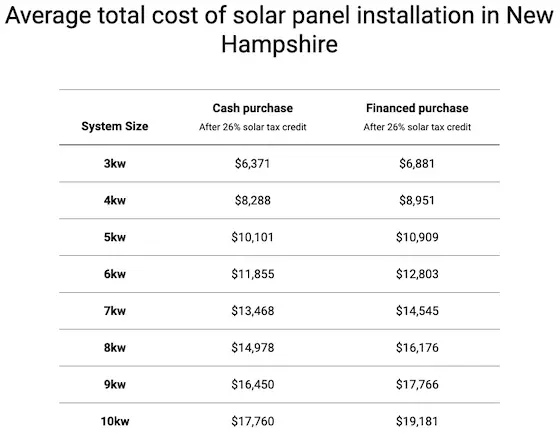
My average electric bill is now $260 per month. There are connection fees, taxes, etc. included. Let's assume that, on average, the amount of electricity I have to pay for each month is $230.00.
In one year I wouldn't have to give the NH Electric Coop (NHEC) $2,760.00.
Assuming all things stay the same, which they wouldn't, simple math shows that it would take 6.94 years just to break even. At that point the loan is now paid off. The money I had been sending to the bank can now be used to pay for other things that I want or need. Now the panels are truly saving me/you money. But not until the loan is paid off.
Keep in mind this is the most simple ROI analysis. It's far more complex in real life. Yes, the ROI period shortens as electric rates go up. But keep in mind your solar panels degrade and produce less and less power each year. See below.
The ROI analysis should also include what happens if you pay cash for the solar panel installation. Prior to writing the check to installer, your money was making money in the marketplace. Granted, you can't predict future results, but whatever money you were making each could have been allocated to pay your electric bill. Once your check is cashed, that income stream disappears.
But what happens in year nine or ten when all of a sudden I realize I need a new roof? See below.
What About Your Roof Structure?
Can your roof support the extra dead load of the panels? You might be surprised to discover that your local building department has a pre-solar-installation inspection. If you live in an area where heavy snow is possible, will a deep, wet snowfall that sticks to the panels and roof cause a collapse?
What About Your Roof's Warranty?
There's a very good chance that the installation of solar panels on your asphalt roof will immediately VOID the shingle warranty. Look at the language and you may see a reference to third-party foot traffic. That's exactly what solar-panel installers are - they're third-party people.
What About Your Home Insurance?
Did you know that some insurance companies won't cover houses with solar panels? A story in the Sun-Sentinel talked about homeowner Holly Strawbridge's modest 8 kW rooftop system. Edison Insurance Company was her carrier and sent out an inspector. Once the company heard back from the inspector, they cancelled Holly's entire policy. "I was shocked," Strawbridge said. "I've never filed an insurance claim and I've lived in this house since 2001."
You better check with your insurance company BEFORE you install your system. Find out if there's going to be a premium INCREASE to cover your system. If so, this needs to be factored into your return on investment.
Be aware that solar panels can cause fires. Amazon had a spate of solar-panel fires at their fulfillment centers that they kept private for as long as they could.
How Well Will the Panels Work?
Is your house oriented the correct way to get the most amount of electricity from the sun? My roof isn't. The long axis of my own home runs north/south. Putting solar panels on my roof means I only get great sunlight to the panels for part of the day.
What about trees? Does your lot have an issue with shade or partial shade? If you live in the Northern Hemisphere, the panels need to face south for maximum benefit.
Are you going to get solar panels that have a bypass diode that's connected to a string of solar cells connected in a series? If so, when just one panel is shaded and not producing power the entire string of cells stops creating electricity.
What about ambient air temperature? It's a known fact that solar panels produce less power in blistering-hot climates. They produce extraordinary amounts of power if the air temperature is cold. How will this affect your return on investment?
What about snow? How much electricity do the panels create when covered with snow? If your panels are beyond the reach of a typical snow rake, what is it going to cost you to have the snow removed? What are the chances the panels will get damaged during the snow removal? What will that cost to repair? How do all these costs eat into your electric savings?
What Happens When It's Time for a New Roof?
A vast majority of homes in the USA, possibly yours, are covered with asphalt shingles. In a rooftop installation, the solar panels are placed on top of your roof using brackets. How long will your asphalt shingles last? In my Roofing Ripoff book, I shared with you that asphalt shingles made today don't last as long as ones made decades ago.
What is the EXTRA COST you to have to pay the roofing contractor remove and reinstall your panels so he can install your new roof shingles? How many years of electric savings does this wipe out?
To help put this into perspective, one of my newsletter subscribers shared a tale. Greg lives in Ocoee, FL and sent to me, "When we retired two years ago we moved to a home with 34 solar panels on it. For my wife, this was a HUGE plus. Me? I already was thinking how when we would get a new roof 15 months into the future that there would be an added expense for removal and replacement. It was $5000 extra for that remove and replacement, so this is truly a factor that will come into play eventually for anyone with solar panels. Plus, our lowest possible bill used to be $13.13. Now Duke energy has added a "minimum bill adjustment" so now our lowest possible bill is $35.35. Just an arbitrary fee tacked on. Having the solar is still good, but your caveats are absolutely accurate."
What Happens as the Sun Destroys Your Solar Panels?
A small percentage of ultraviolet rays from the sun contain active photons. When these strike your solar panels at 186,000 miles per second they blast apart the molecular structure of the panels. It's a known fact that solar panels made today, in 2022, degrade and year after year produce less and less power because of this photon destruction.
What Happens When your Local Utility Company Changes the Monthly Connection Fee?
Have you thought about how the cost to maintain the electric infrastructure in your area is going to be paid for as time goes on? As more and more people install solar panels and not send the utility company money each month, the cost to maintain the wires on the poles goes up. Your system is connected to the grid. As the utility company revenue DROPS as more and more people install solar panels, your monthly connection fee will surely rise and rise logarithmically.
As you can see, it's not all unicorns and rainbows when it comes to solar panel return on investment. Don't allow your decision to purchase solar panels to be controlled solely by emotion.
I wish you the best of luck.
Column 1471

Tim built custom homes and did ultra-custom remodeling for 20+ years before launching his Ask the Builder media presence. He was selected as one of the Big 50 by Remodeling magazine in 1993. This award gave birth to Ask the Builder in October 1993. Tim also operates https://DrawPlumbingPlans.com. His @askthebuilder YouTube channel was the first home improvement channel on YouTube.
Thanks Tim. Excellent points.
B
Tim, great tips and rigor on the cost-benefit analysis. The insurance question was especially helpful, and although I knew the solar panel efficiency degraded over time, I never knew why. I've always wondered how the panels hold up against hail, as well as "How many roofs develop a leak after solar panel installation?"
thanks bud!! I almost fell for the fraud!!!!
Also look at the financing. If you pay cash then what is the "lost investment revenue" and can you get an equivalent yield in the market, and will it stay that way for the investment period of the array? As far as performance degradation it is 2.5% for the first year and generally 20% over the practical life (50 years). Payback period is more like 10 years. Homeowners policy cancelled? What is the name of the insurance company? Leak this to the green community and they will loose business, become the butt of many jokes. Asphalt shingles, replace them with metal roofing. Asphalt is soo last century You have a good point about the turnover rate of the average homeowner being in short term 9 years in a home I suspect this is an employment volatility problem and real estate speculation driven and eventually bring down the real estate industry to become a rental market.
Wow!!!
Thanks for all this info. Here in the Denver Metro solar companies are actually knocking on doors even if you have a No Soliciting sign. They hire young men that can't read.
Thanks again.
Some really good advice here. Seven years is a typical ROI for large projects here in Northern Ontario. Though we get little winter sun the cold to some "degree" makes the panels more efficient. We amalgamated with a still larger group in the South and put in an array of tracking panels in fields. Our volunteer group did however do an arena but ensured that the roof was good for 30 years before. It was a beautiful south facing, steep slope.
Cheers,
Bryan
Good issues. Here's some potential other issues:
- Solar credits. Some states give you solar credits. When I looked at this a decade or 2 ago in NJ, about 2/3 of the benefit of going solar then was these credits. But the cost of solar panels was much greater then. So that equation would change now. To qualify for these credits, they went up in the roof with a special instrument to determine the amount of sun you'll get year-round. I didn't qualify.
- Hail-I've never researched this but what's the chance of hail destroying your panels.
- Savings from using my generator less. When we lose power, I go through a lot of gas to keep us running.
Tim, thank you for the tutorial on rooftop solar panel installation and what we called the “Pitfalls”. As a retired Building Inspector, I can’t tell you the number of homeowners who didn’t even look at their roofs to check the conditions before signing up for solar installation. Our Building Dept. had to create a “Pre-Inspection” before the solar company was allowed to pull permits to install these costly dead weight items on people’s rooftops. The number of pre roof inspections that failed was incomprehensible as the industry continued to prey on the innocent. The most painful part about our inspection became the insults we would receive about how we were slowing down the industries opportunity to progress and make money. My response to these solar companies became second nature by thanking them for recognizing we were doing our job. If I may add another miss point in solar panels. These companies never provide homeowners any information on proper cleaning of panel fronts. It was to often I see a homeowner out watering in the dead of heat afternoon and then turn the hose on the solar panel while it was cooking in the afternoon sun. Failing panels were more often than changing a baby’s diaper.
Thanks for the article!
inspectormilton
1. Lease plans tend to stink - they save you far less than you'd expect. You don't know the quality of the cells, or how efficient they are.
2. There's another way to use solar - roof top panels that collect heat from the sun to help heat domestic hot water for heating your house or your hot water.
3. As I drive around near where I live, I see houses with solar cell panels where the light is substantially blocked by trees, some overgrown, some not. It's not just about where they are pointed, it's also about whether they get blocked for some or part of the year.
4. When they are covered by snow, they won't generate much, or perhaps any power. At night, nothing. Certain times per year, they may not get much light even in good weather.
5. They usually do NOTHING during a blackout. An exception MAY be if you have storage batteries to save power during the day.
Think you left off the need to clean the panels periodically. may be better mounted near the ground.
Great info, Tim! It’s difficult finding BALANCED info because sites say there’s no maintenance (they require cleaning you might need pros for); they are problem free for 15-20 years (they can have tech problems requiring a pro, and birds love nesting in the panels). Realtor sites claim increased value, but that’s true only to buyers unaware of problems or the difference between owned or leased! One home inspector said all homes he has seen developed problems if the panels were 5+ (!!) years old, which is not surprising since as you said, they have the sun beating on them. The long screws for install invite water leaks. Unless you buy the extra storage batteries, when the grid goes down (Hurricane Irma), your house will be as dark as everyone else’s. Before I looked into them I didn’t realize they are less efficient in hot climates. I believe I read the max efficiency temp is 77F! Solar panels (and roofs) are sadly also sometimes involved in that PACE Home Improvement Program that seems legit because they’ve affiliated themselves with chains like Sam’s Club. On another subject, what happened to Stain Solver? Is it still available? It just helped me with a carbon steel pan that had fish remnants stuck on it and it cleaned it right up.
It is no different than any other home improvement project. Do your homework. I had an install 11 years ago and it worked fine because I did all the brain-work as an exercise. and would catch problems early. Went as planned
I agree with the negative return on investment. Same goes for EV cars especially with negative temperatures. I see Honda has a big recall because northern states use salt and the frame are rusting apart.