A Beam From the Annie Hodges Schooner?
A Mystery Beam From the Annie Hodges Schooner?
Publisher Note: The following content was generated and contributed by Ms. Margaret Acquaurulo and her son.
The Writing in the Living Room
When the workers on a rowhouse renovation on E. Clement Street in Baltimore removed the ceiling, there was some cryptic writing on one of the old beams:
Knowles – Sch Hodges
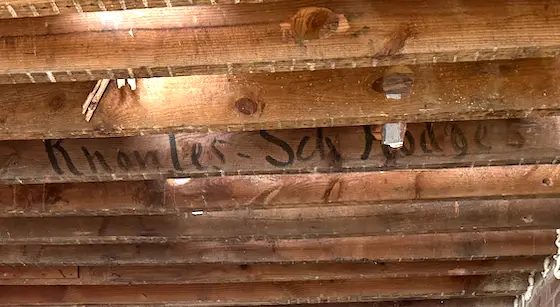
You can see the script on the floor joist. No normal carpenter would go to this trouble unless it were a special piece of timber.
After unsuccessfully searching for schools (Sch?) with the names Hodges or Knowles, an article in the Baltimore Sun provided a clue as to what this might mean. Ships coming into and departing from the port were routinely listed in the newspaper at the time the house was built in 1875. The abbreviation for a schooner was “Schr,” and there was in fact an oyster schooner called “Annie Hodges.”
Ship Building in Baltimore
Baltimore was a center for shipbuilding throughout the 1800s. The Inner Harbor was lined with shipbuilders and dry docks. Most of the streets in the area went directly to the water. Just a short walk from E. Clement Street there was a shipyard on the northeast side of Federal Hill where the Ritz Carlton and Harborview communities are today. The map below shows the area in 1890; the red arrow points to the street.
The Key Highway shipyard began when brothers Jeremiah and William Skinner Jr. -- boat builders -- came to Baltimore from Dorchester County, Maryland in the 1820s. In 1845, William sold his interest in the company to his brother and purchased his own yard on Cross Street. William’s boatyard became famous for its sailing ships and probably built Baltimore’s first clipper ship.
When William died, his brother and sons took over the business and renamed the company the Wm. Skinner and Sons Shipbuilding and Drydock Company, eventually growing it into a 35-acre complex. The company continued to prosper during the Civil War by meeting the greater demand for all types of sailing vessels.
There is no suggestion or evidence that the Skinner shipyard built the Annie Hodges; yet it is certainly possible. It was the closest shipyard to E. Clement Street, and the builder of the house may have sourced some of his materials from shipbuilders.
Key Highway shipyards 1968
The Annie Hodges
The schooner Annie Hodges was built in 1872 in Baltimore, three years before the house was built. A schooner is a sailing vessel with two or more masts; on a two-masted schooner, the shorter mast is forward. The Annie Hodges measured 61 feet in length, 21.8 feet across the beam, and 6.1 in depth. Its weight was 47.75 gross tons and 45.36 net tons.
The Annie Hodges’ initial home port was Baltimore until 1903. It was next based in Crisfield, Maryland on the Eastern Shore from 1904 to 1909, then it ended its life based in Bridgeton, N.J. from 1909 to 1913. After 1913 it is no longer listed in the Merchant Vessels of the United States annual publication. Regardless of where it was based, however, it was a merchant ship and would have spent most of its time sailing up and down the Chesapeake Bay.
Various news articles provide a look at the life and activities of the Annie Hodges:
- On September 22, 1876, Charles Wacker and R. N. Dobon, owners of the Annie Hodges, were issued a license to dredge for oysters. Two years prior, then captain John M. Grey had been fined $50 for oyster dredging on Cooks Point, Great Choptank River, without a license.
- In 1885, a news article listed the owner of the ship as C.D. Walker. From at least 1878 to 1899 its captain was R.N. Dolbow. Dolbow had an interest in at least one other vessel, the schooner Agnos, which he and C.W. Simpkins bought from P.C. Struven in 1881.
- Reuben N. Dolbow, who was born in New Jersey in 1843, drowned in the Patuxent River on January 10, 1890. One source claimed that the death occurred when the oyster schooner, Annie Hodges, sank off Cove Point, Maryland. Captain Dolbow was 47 and had lived in Baltimore for 25 years, leaving behind a wife and four children.
- On February 9, 1891, the new captain of the Annie Hodges, T.E. Dougherty, saw a large whale off the Thimble Light.
- Mike Krigger, a member of the Annie Hodges crew, accused the mate, Joseph E. Lawrence (or Laurence) of assault by hitting him in the face. Lawrence testified that Krigger was one of several crew members who cursed him and refused to go to work. Lawrence claimed that he merely shoved Krigger away; the case was dismissed on October 27, 1898.
- The Annie Hodges made national news on February 21, 1899 when some of its crew members were feared dead. After approximately 50 ships left Baltimore on January 23, they were hemmed in by ice in the Patuxent River. When a blizzard arose, fuel and provisions were low, and the captain, whose name was Watson, put the crew ashore to make their way to Annapolis. They were given shelter at the Annapolis station house, but four of the group had frozen to death on the way and were left in the snow. The owner of the ship was listed as Struven & Wacker.
- William T. Hooper of Hooper’s Island, Maryland was featured in an article in 1981 about his life as a waterman. He had signed on as the cook of the Annie Hodges – one of three crew members – in 1902 when he was 17. He noted that the ships traveled from Baltimore to Philadelphia carrying freight in the late summer and early fall and did most of their oyster dredging in the winter and spring.
- A lawsuit was heard on February 26, 1914, launched by then master and owner Sherman Hager. The Annie Hodges – described as a fishing and oyster vessel – had been damaged in a collision with the tug Prudence and barge Dorothy the night of June 18, 1912. Hager was trying to recover an amount for damage to his ship. This may have been the event that retired the Annie Hodges.
Origin of the Beam
The connection between Knowles and the house or the Annie Hodges is unknown. It was a fairly common name in the area at the time. Knowles may have been involved in the building of the house or of the ship. Two possibilities for how this beam came to be in the house are:
- It was a beam meant for the ship when it was built three years before the house but deemed not sturdy enough. The strength of the wooden beam of a ship was crucial for the ship's stability and ability to carry cargo. Beams were tested during the building of a ship through a visual inspection for cracks and by tapping or probing with a screwdriver to detect decay. If this wooden beam failed its test for the ship, it may still have been useful for a house. The 21.8-foot beam of the Annie Hodges was more than long enough to span the 12-foot width of the house.
- The beam was removed from the ship and repurposed after the ship suffered some damage. The Baltimore Sun reported on January 17, 1885 that the Annie Hodges incurred $250 in repairs from the loss of both masts in a strong wind while bound down the Chesapeake Bay on January 12. This, of course, was ten years after the house was built, but it raises the possibility that other damage could have occurred earlier.
1 The Baltimore Clipper was one variety of schooner with a raked mast. The clippers were very fast and used for trade around the coastline and to the Caribbean.
2 The ship is listed in the Department of Commerce and Labor, Bureau of Navigation, “Merchant Vessels of the United States,” under the category, Merchant Sailing Vessels.
3 It is possible that Dobon is a misspelling of Dolbow.
4 Dolbow is the most frequent spelling. Variations are Dollow, Doliow, Delbow and Dolbove.
5 The Baltimore Sun, April 22, 1881, p. 4.
6 The Baltimore Sun, February 10, 1891, p.4. The Thimble Shoal Light is in the Virginia portion of the Chesapeake Bay.
7 Struven & Wacker, Baltimore ship chandlers, was located on the corner of Alice Ann and Chester streets in Fells Point. A chandler dealt in equipment and supplies for boats.

Tim built custom homes and did ultra-custom remodeling for 20+ years before launching his Ask the Builder media presence. He was selected as one of the Big 50 by Remodeling magazine in 1993. This award gave birth to Ask the Builder in October 1993. Tim also operates https://DrawPlumbingPlans.com. His @askthebuilder YouTube channel was the first home improvement channel on YouTube.