Quick Column Summary:
- What causes concrete discoloration
- Were all slabs poured on same day
- What additives were used in the concrete
- Possible solutions for overall concrete color
Paula Butterworth, who had some concrete work done at her home in Kennewick, WA, is not happy with the color of the finished slab. Her story appeared in the September 28, 2014 Newsletter.
Here's what she told me:
"Based on the attached photos can you tell me what went wrong to cause the discoloration of my garage floor? The concrete finisher added 1 percent calcium - poured April 23, 2014, as well as two other slabs - all with 1 percent calcium and the other slabs look great. Temps were 48 - 53 degrees. Redi Mix plant is about 20 minutes away. Is it due to delay in troweling, too much water added? Thank you for any information you can provide."
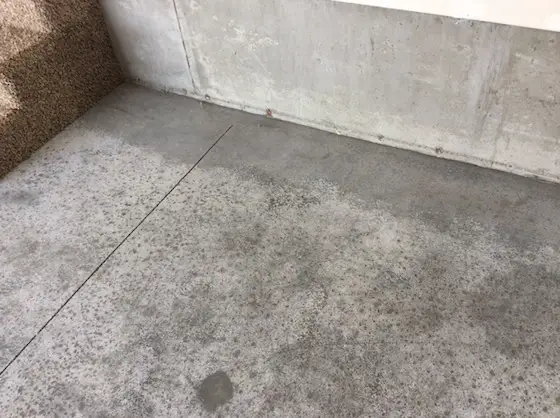
Here's the photo that Paula sent me. You can see the uneven coloration in the slab. Photo credit: Paula Butterworth
I asked some followup questions to Paula:
- Which slab was finished LAST?
- This one? Did it rain after they left or the next day?
Paula then responded:
"The job tickets confirm the other slab was poured two days before the spotted one! There were two loads on two different trucks with travel time to the job site averaging 25 minutes. However, the delivery tickets indicate 2 percent calcium chloride was added, not 1 percent as previously thought. It didn't rain at all that week."
Here's my advice to Paula:
Paula, adding calcium chloride to ready-mix concrete can cause all sorts of issues. It's an additive that's used to speed up the hydration chemical reaction in the concrete so the concrete transform from a plastic material to a solid faster in colder weather. Without the calcium chloride, the concrete can stay very wet and plastic for hours and hours delaying the finishing process.
If the calcium chloride is not mixed thoroughly in the concrete it can lead to discoloration. There are also other complicated chemical reactions that can happen with the Portland cement and other additives (fly ash, slag, etc.?) that *might* be in the concrete.
You can get trowel burns, which produces a darkening, when you use calcium chloride.
The addition of water to the concrete during the finishing process can create discoloration too. But if the weather was cool / cold so as to require the calcium chloride, I doubt the finishers would be sprinkling water on the slab. But you never know.
At the end of the day, if you want a monolithic coloration you may have a few choices.
One thing you can try in an out-of-the-way location that would be covered by a garbage can or ???? is to etch the slab with a solution of muriatic acid. This solution will dissolve the upper ultra-thin layer of cement paste uncovering some of the sand in the finish. It MAY even out the look of the slab. You would mix 1 part acid to 10 parts water. Just try it in an area about 1 foot by 1 foot. Let the solution work for about 20 minutes then LIGHTLY scrub. Rinse well and inspect it after it dries.
Take great before and after photos of this spot for comparison sake.
If this fails, then you can resort to one of the epoxy coatings for concrete. I don't like these too much because they turn a maintenance-free surface into one that requires periodic maintenance.
Tim built custom homes and did ultra-custom remodeling for 20+ years before launching his Ask the Builder media presence. He was selected as one of the Big 50 by Remodeling magazine in 1993. This award gave birth to Ask the Builder in October 1993. Tim also operates https://DrawPlumbingPlans.com. His @askthebuilder YouTube channel was the first home improvement channel on YouTube.

The slab looks freshly poured. Try just giving it some time to dry out. It appears to me it was power trowled based on the slight difference in color from the edges and the open area of the floor. That alone will cause color difference because the edges are hand troweled and will dry at a different rate. It takes many years for concrete to fully dry out. Another option could be to sandblast the floor and then seal it. Make sure if you try that to find someone that has done it before.
The slab is five months old at this point. The hydration reaction (what you call *drying out*) is all but finished. The curing process is a non-linear process and most of it happens quite rapidly in the first few months, not years as you suggest. The slab cures at the same rate - assuming a curing compound was sprayed on the slab evenly. Sandblasting is the last thing I'd do, but that's me.
Tim
A few more questions for Paula
1) Was the concrete placed on plastic or vapor barrier?
2) What kind of sealer or curing compound was used?
I can see that the calcium had been mixed thoroughly if in fact it was not it would be burnt black it looks more like trapped moisture
please check out the web site NRMCA.org and look up CIP 23 on discoloration also I myself have used 50% vinegar and 50% water to draw the moisture from the slab this seem to help but be very careful on using acids they can and will take the finish off or Home depot has a epoxy Garage floor coverings with glitter that looks great in new homes:)
Life is to short to worry about a spotted garage floor unless you're serving tea and scones or parking your Bentley in there. Besides, I rather like the Jackson Pollock look.
🙂 That's my philosophy about garage floors. They're a tapestry of past jobs, failures and accidents. Just recently I added a few paint spots that will remind me of the upcoming Color My Door contest!
If the garage floor were 5 years old then I would agree that's not a big deal. However, it's a high-end model home that I need to sell. My philosophy is the entire job should have a quality look. It represents me. I didn't have sod and trees installed that are discolored.
Paula, Now that I have the backstory, I understand your position. I'd do the acid wash test and I'll bet it solves the issue. I'd LOVE to see an AFTER photo if you do this. Send it directly to me. tim at ask the builder dot com.
Hi Tim, I moved into a house with nice wood floors. The problem is there's no insulation under it. I saw this by going into the basement and seeing the nails sticking out form the floor. I think I have a pretty good idea on adding insulation, but I'd also like your input on heated hardwood floors?
If there are heating ducts in the basement, you don't want to insulate the floor. The heat from the ductwork helps temper the basement and it radiates some heat to the underside of the floor.
Is it possible to stop a spot leak on a twin-wall polycarbonate roof? If it can be done please tell me the different ways it can be done i.e. the materials required etc. The contactors I have asked all claim that I need to change the roof because spot leaks on a twin-wall polycarbonate sheet cannot be repaired. Please help.
You always get the CORRECT answer in situations like this when you contact the manufacturer of the product. If there's a way to REPAIR the product, they know how to do it. Reach out to polycarbonate roofing manufacturer. Get back with their reply so all know how you made out.
Need help driveway looks terrible 60x18 one section has very dark spots you can stick a screwdriver straight through to the bottom. Chipping off and leaving big holes. It was a dry day concrete company saying they're not responsible. Other people are telling me it's either too much calcium or fly ash mixed in one spot causing this I can send pics
Also, I have a similar issue and curious if there is a moisture build up on the slab from time to time given the higher concentrate of calcium chloride in the mix?