Dimmer Switch Fire
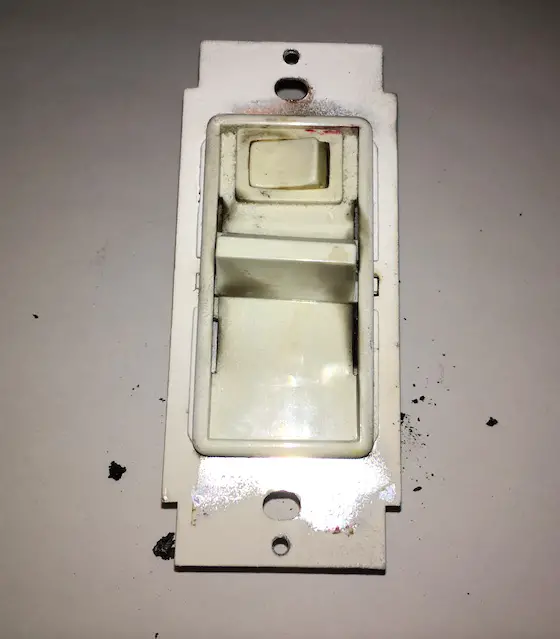
This switch looks somewhat normal, except for the soot around the edges. Wait until you see the back. ©2016 Tim Carter via anonymous friend contribution.
Dimmer Switch SAFETY TIPS
- Most dimmer switches rated for 600 watts
- Convert unused electricity to HEAT
- Electric heaters 1200 watts, or more!
- Wall switches could operate a full or half a wall outlet
- Use RED Sharpie pen to mark outlets
- CLICK HERE to subscribe to Tim's FREE & FUNNY Newsletter
Plugged in Space Heater
Several weeks ago a very good friend of mine and his wife almost became a grim statistic compiled monthly by the National Fire Protection Association (NFPA). He was trying to keep his wife warm in her home office and plugged a simple electric space heater into a wall outlet at her request.
Although it appeared to be a normal duplex wall outlet where you could plug in two cords, it was anything but normal. The outlet happened to be a split outlet. What's that? Keep reading as you probably have a few in your home.
My friend had a 50/50 chance of everything going just fine, but he chose poorly.
CLICK HERE to get FREE BIDS from electricians in your city or town to safely install a dimmer switch.
He plugged the heater into the one receptacle that happened to be controlled by a wall switch. The other half of the receptacle was wired directly to the circuit breaker and not controlled by a switch.
But it wasn't just any wall switch, it was a dimmer switch.
Switch on FIRE!
The instant current began to flow through the dimmer switch, it began to heat up.
Most common dimmer switches you install in a home have limited function. They can only handle about five amps or 600 watts.
The space heater my friend was using drew, at a minimum, 1200 watts!
CLICK HERE to get FREE BIDS from electricians in your city or town to inspect your wiring and switches now.
Heat From Unused Electric
Here's what you need to know about dimmer switches. If you turn the dimmer knob or use one with a slide control like the one you see above so the lights get dim, the current that was supposed to flow to the lights is kept in the dimmer and transformed into heat.
600 Watts Usually
But the heat sink in the dimmer can only handle so much current. Almost all dimmers come with a CAUTION warning on the back of the switch telling you that you should not have more than 600 watts flowing through the switch.
That only person who sees that warning is the electrician who installs the dimmer. Once the switch is in the electric box and the cover plate is on, regular people like you are oblivious to the danger.
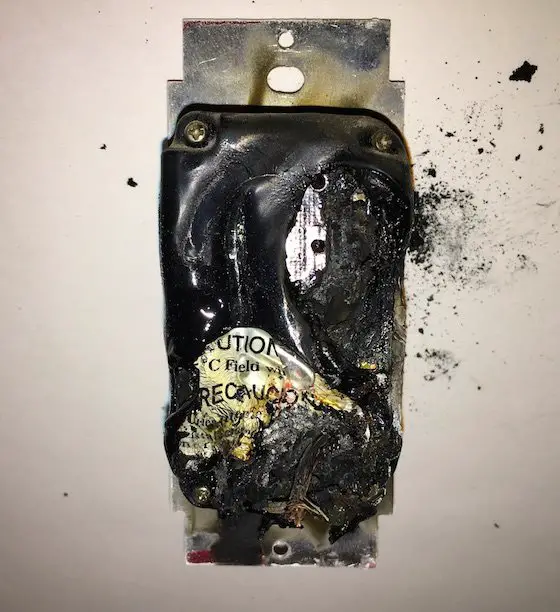
You can see how much plastic burned. You can also see some of the letters from the CAUTION warning label. Dimmers are time bombs waiting for their next victim. (C) Copyright 2016 Tim Carter via anonymous friend who is still breathing along with his beautiful wife.
It didn't take long for the fire to start in the electric box. Within minutes of plugging in the heater and turning it on, my friend luckily saw small flames coming from the switch.
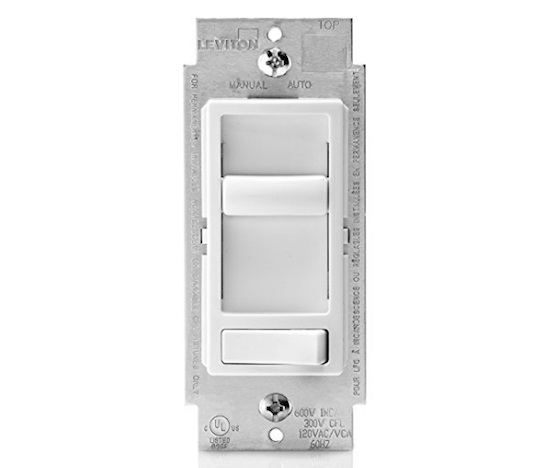
Here's a dimmer switch for LED and regular lights. I believe it works for CFL bulbs to. CLICK THE IMAGE ABOVE TO ORDER IT NOW.
Empty Room = Death
But what would have happened had both of them left the room? What would be the outcome had they gone to bed?
We both know what would have happened.
Be sure you never overload a dimmer switch.
NEW Technology Protects You From Dangerous Arcing
Are you terrified of burning up in an electric fire at your home? You can install in minutes a sophisticated device called Ting that plugs into an outlet in your home. Look below at the photo caption for a SPECIAL promo code. It connects to the Internet via WiFi. The device sends data about your electrical system to a company that monitors your entire home.
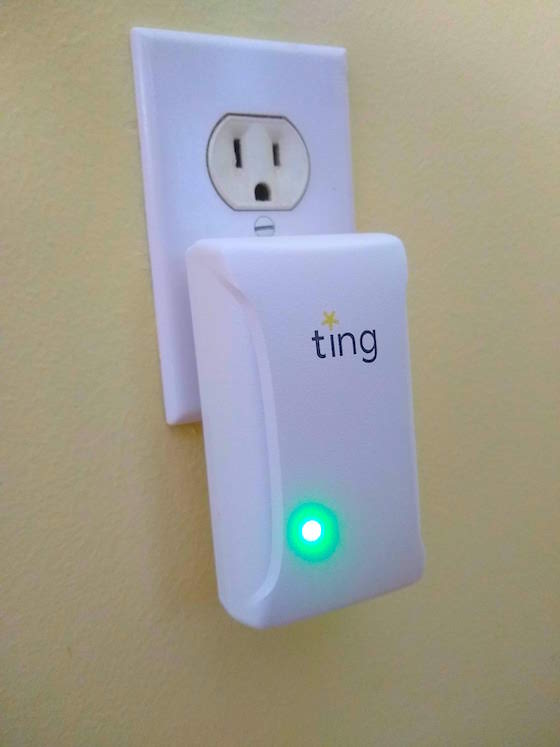
This is the Ting Arcing monitor. It plugs into any outlet, connects to the Wifi in your home, and then starts to protect you, your family, and all your possessions. CLICK or TAP HERE for a Special Discount exclusive to Ask the Builder newsletter subscribers and website visitors. IMPORTANT: Use the promo code TIM10 (note UPPER CASE) at checkout for exclusive savings. Note that Tim Carter gets a very small commission from TingFire should you purchase using the above link. Tim only promotes products he trusts and uses in his own home.
An app on your smartphone allows you to check the condition of your home's wiring at any time. Here's a screenshot of the app on my phone showing all is well:
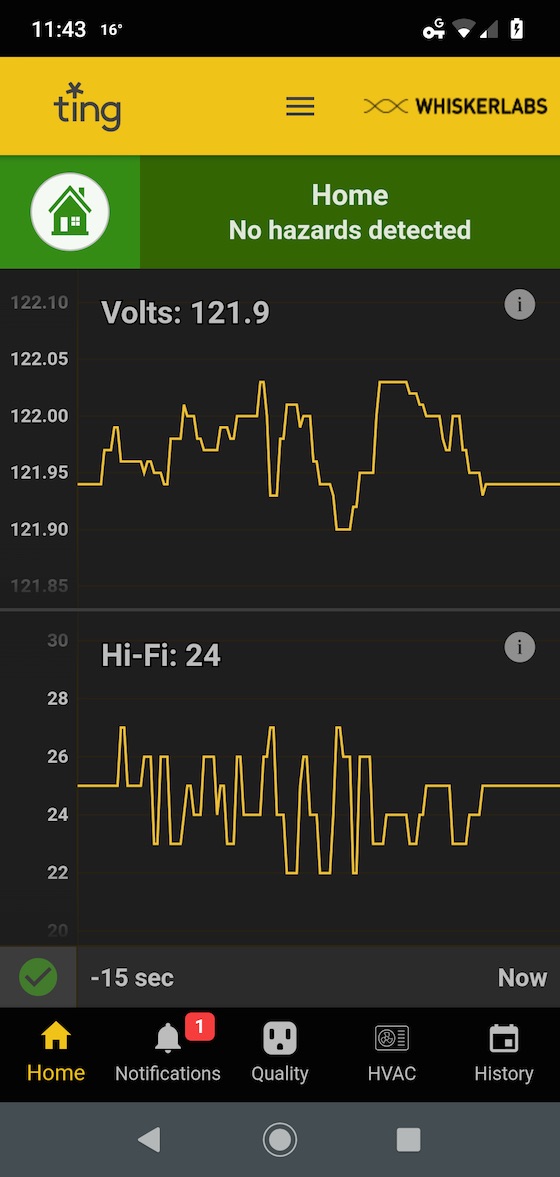
This is the home screen of the Ting App. The green bar at the top shows all is well. If Ting senses an issue in your home's wiring, you get an instant push notification on your smartphone app as you see above, the red #1 above Notifications. In addition, the Ting service center CALLS you on your phone should it detect hazardous arcing! In my case above, that notification told me that I had a minor power outage at my home. CLICK or TAP HERE to purchase one priced with a special AsktheBuilder discount. Don't forget to use the promo code: TIM10 for a big savings
Warning Label on Outlets
If you have outlets in your home in any room that are controlled by wall switches, PLEASE go to the outlet cover plate and use a RED Sharpie fine-point permanent marker and write a WARNING on the cover plate. You can write this:
If this outlet is controlled by a dimmer switch, do NOT plug in a heater, hair dryer or any other thing that draws more than 500 watts.
I suggest the 500 watts because you might as well have a slight margin of safety.
20-Amp Circuits
Electric space heaters should be plugged into circuits wired with 12 gauge cable that's rated for 20 amps. When I built my last home, that's all I used. I didn't have one piece of 14 gauge wire in my home. I refuse to use that size wire.
But remember, you can't mix and match cable sizes! Don't think you can add a piece of 20-amp 12-gauge cable or wire to an existing 15-amp circuit that is wired with 14-gauge cable! The amp rating for any given circuit is dependent on the SMALLEST SIZE cable in the circuit.
15-Amp Circuits
14-gauge wire is only rated for 1800 watts or 15 amps. 12-gauge wire is rated for 2,400 watts or 20 amps.
Are you worried about your dimmer switches? Are you wondering if you and your family are SAFE?
CLICK HERE to get FREE BIDS from electricians in your city or town. Let them come over and inspect your dimmers and circuits to make sure you don't die in an electrical fire.

Tim built custom homes and did ultra-custom remodeling for 20+ years before launching his Ask the Builder media presence. He was selected as one of the Big 50 by Remodeling magazine in 1993. This award gave birth to Ask the Builder in October 1993. Tim also operates https://DrawPlumbingPlans.com. His @askthebuilder YouTube channel was the first home improvement channel on YouTube.
I just wired in an overhead LED light on a 15 amp circuit. All I had was #12 wire, and I felt kind of silly running that huge stiff wire through the ceiling and hooking it to the #20 wire in the lamp. I guess I don't have to worry about the wire getting hot.
Tim, Thanks for writing about this. What a great tip! I'm replacing the knob and tube wiring in my home with 12 gauge romex right now. I definitely won't wire a dimmer to an outlet.
if all lights on a circuit are LED's bulbs, thus using way less wattage than incandescents, can I add more light fixtures, but still staying well under limit - whichever amperage the circuit is on?
Yes, what matters is the total current draw on the circuit. LEDs, in particular, draw very little current relative to their light output, so adding more is usually not a problem--if you are talking about LED fixtures. If you put in fixtures that can take other bulbs, you run the risk of someone putting in a halogen rather than an LED!
The thing about Tim's story is that the heater was on a breaker circuit that could handle the load, so the breaker had no reason to trip and protect the house. But the 600W dimmer was in line before the receptacle so it was trying to pass the full load of the heater.
Rather than starting a fire it's also possible that part of the dimmer would have just melted or burned open and cut off the power to the receptacle. What I wonder is, what genius wired a dimmer to a wall receptacle???
It sounds to me like the dimmer may have been installed to control a split duplex outlet, meaning the metal tabs tying the two outlets together had been removed in order to isolate each outlet from the other. That's a pretty common scenario in a room without overhead lighting and allows the switch to control lamps. I think the lesson is don't use a regular lighting dimmer switch to control anything other than up to 600 watts of lighting load. The other lesson might be it's not a good idea to use a lighting dimmer to control an electrical outlet.
U are bang on, Joe.
Its a shame, but lots of home owners do not understand, the loads that can not be installed on these devices.
The problem here is that the National Electric Code requires each room to have either a switched overhead light OR a switched receptacle. When there is no overhead light It is common practice to wire a switch to a split receptacle, this gives the homeowner a switched receptacle and a non switched receptacle in the same location.
Another horror story. REFRAIN from using(C)7 watt clear night light bulbs in Christmas candoliers! The regular C7 Christmas bulbs are OK.
What happened is that one of the cats has cabin fever and runs wild through the house when she can't get out; she(?) allegedly knocked over two candoliers in the low set window onto the Berber carpeting.
Out of 10 bulbs, one had a C7 (watt) nightlight style bulb. It started smoldering and burned through the white carpeting and even scorched the subfloor black. Thank goodness we caught it before it went up in flames!
Needless to say we checked the other candoliers to make sure they have no "hotter" 7 watt clear bulbs as well. The other 9 (5 watt) bulbs touching the carpet after the fall caused no problems.
Thank you Tim! I could have been in your friend's shoes. My master bedroom has four duplex outlets that have one socket each wired to the light switch dimmer by the door. We don't have the old fashion glaring ceiling light and we like being able to have table lamp(s) bright or dimmed down with the switch by the door.
BUT last week I needed a little extra heat in that room so I plugged an electric oil heater in, turned it on the lowest setting (600w), saw it was working and left the room. When I came back the heater was stone cold. At first I thought it was broken but with some experimentation I realized that I had plugged it into an outlet that was attached to the light switch and when I left the room I had turned the light off thus turning off the heater.
Fortunately I'm frugal and didn't want to leave the light on so I found an outlet that was not connected to the light switch. Not realizing the potential consequences I could have just as easily left the light on so the heater would run. Even though I had the heater on low at the time (600 w) I shutter to think what could have happened if I decided to put it up on medium or high - and I was working on a project in another part of the house. We had our house built in the 80's with nothing less than 20 amp circuits, but now I understand that my 20 amp circuits would not have prevented a fire at the dimmer switch.
For starters I'm going to print out a warning of the limit to put on the outlets connected to the switch and affix it to the FRONT of the switch cover. Also, I'll tape a warning on each outlet connected to the switch I think I'll talk to an electrician about converting two of the outlets to a regular connection not connected to the switch. Then I'll just have two receptacles dedicated to floor / table lamps which will be enough. I could even go to a regular light switch and put dimmers on the light fixtures or see if I can purchase a dimmer switch that handles more wattage.Thank you so much for sharing this, Tim! You could have saved my life or my house from being burned down.
Thanks Tim for the info. Checked all my outlets. You are the man!
We have a wall switch that runs two outlets for lights. We just put lights on those outlets and would really like to be able to dim them - is there a way to do that without installing a switch that could easily overload? I'm glad I read this BEFORE we changed anything with our wiring!
I have installed 2 Dimmers rated at 1200 watts each to handle a large den with 18 60 watt bulbs. the 1200 watt dimmers aren't that much more expensive.
18x60=1080 watts divided by 2=540 watts per switch.
When turned up all the way they actually raise the room temp 3 deg. Size does matter.
We have just had new kitchen appliances installed, and the dedicated breaker to the oven combo had to be changed from a 50 to a 40. I'm confused as to your reference to 20's. Can you explain? Also, we have dimmer switches on almost all of our overhead can lights, is that wrong?
Lisa,
Be SURE the breaker size is MATCHED to the amperage rating of the cable serving the oven!!!!!!!
Re-read the above column and get your head around why the dimmer failed. Too much current was flowing through it. ALL SWITCHES, dimmers or not, have a rating.
Most dimmers are rated for 600 watts.
If you want to go into more detail to get a comfort level so you don't become a NFPA statistic, you can have me call you on the phone.
Here's how to set it up:
http://shop.askthebuilder.com/products/15-Minute-Phone-Conversation-with-Tim.html
Many thanks for the safety information. Had a 20 amp circuit installed for a space heater in the porch. During winter months, we use the porch as a green house for Jasmine plants.
Fortunately for us, our electrician friend showed me how hot the cable plug was on a 15 amp circuit.
Your news letter is always very interesting.
Staying away from home I have run into outlets on switches, so floor lamps can be plugged in and function as a ceiling light, walk in the door and flip a switch to turn on a light. I don't understand why anyone would install a dimmer switch in that situation! One would need to get up and go to the switch to adjust the dimmer. I have never experienced anyone putting a dimmer switch on their ceiling light, although I have installed a dimmer switch on a wall light over our Server, but, again, not a ceiling light used for general lighting.
We have swapped out many switches for dimmers for ceiling switches in bathrooms and kitchens, saves power and makes the ambiance much nicer. Never on a wall outlet!
We do have dimmers on bedside lights, but they are the kind on a cord that plug into the wall so they aren’t permanently changing the wall outlet. (Electrical Engineer here that loves Tim’s stuff!)
I gave up on dimmer switches in my last house. My hubby installed one in my kitchen and it got so hot that I refused to use it. No more dimmers for me.
I just had a very old dimmer switch short out. It is all hand soldered, a remarkable object. It worked with a dimmer dial and a push on/off. Looking at it now, the circuit elements flex with each on/off cycle, and in the 50 years since the house was built, two elements rubbed together and eventually shorted out. When I took it out, I found there was no ground connection! I consider us to be lucky it failed gracefully (lights blinking when switch was turned on or off), rather than setting fire. I can send a picture if you are interested. I replaced it with a simple, grounded, switch.
I am rewiring my second floor, all 20 amp circuit breakers, all #10 and #8 M/C stranded cable, new subpanel with 85 amp feed with a 42 space copper bus. Never use dimmer switches. Hospital grade 20 amp switches and receptacles, no more than 4 outlets to breaker. No wire nuts, only Ideal 2011S Crimp Connectors and Ideal 2014 Splice Cap Insulators.
I have enjoyed your column for over 10 years!