Extension Cords Size Chart
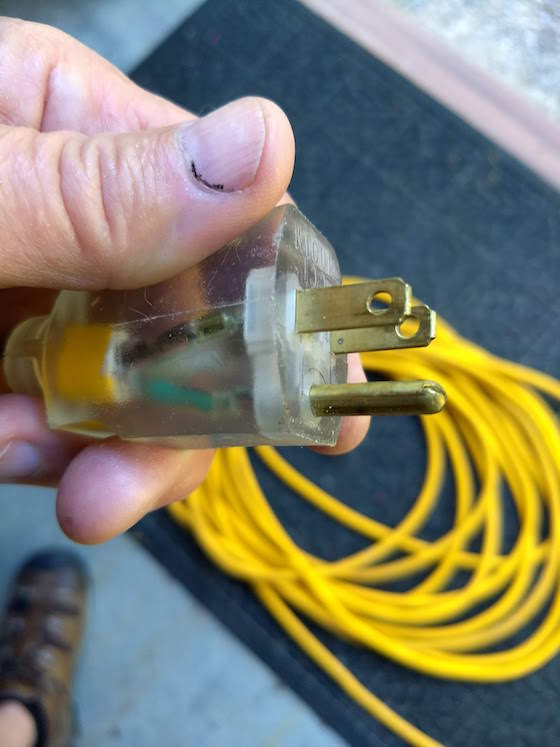
Extension cord sizing is not a guessing game. This is a beefy 12-gauge extension cord. This is the male end in my hand and the female end has a small glowing light in it when energized. Copyright 2018 Tim Carter
"Electricity encounters friction as it travels through electrical wires. Knowing this, use only as much extension cord as you really need. I can call you on the phone to answer your extension cord questions so you don't get KILLED or BURN DOWN YOUR HOME. The call is FREE if you're not satisfied with my answers. CLICK HERE to set up the call."
Extension Cord Sizing Checklist
- Determine the amperage of the tool/appliance
- Calculate cord length - use the shortest possible cord.
- Wire gauge determines amperage load
- Watts = Amps X Volts Example: 2,400 watts = 20 amps X 120 volts
- CLICK HERE to subscribe to FREE AsktheBuilder.com Newsletter
The size of your extension cord is very important. If you under-size one, you can start a fire or ruin an expensive tool.
CLICK on my face to ensure you get the CORRECT extension cord so you or your family doesn't DIE IN A FIRE.
Fortunately, many common small hand-held electrical tools can operate without danger of motor damage when powered by a 16 gauge cord that is 100 feet long. To make sure you're properly protected, use the following sizing guidelines below.
How Do You Start to Size an Extension Cord?
You start to size an extension cord by obtaining the motor amperage from the plate on the tool. You'll find this information on the small metal plate where the serial number and model number is listed.
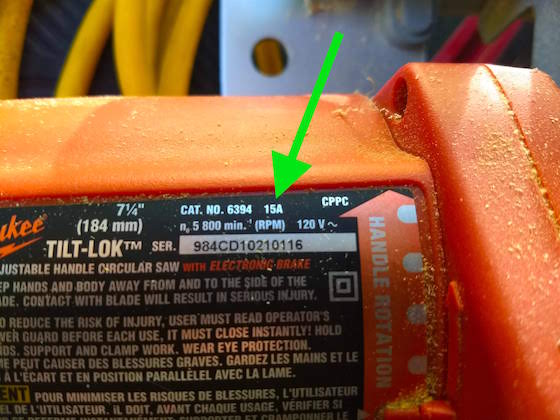
The green arrow points to the amperage of this professional circular saw. It shows 15A. That means 15 amps. Copyright 2018 Tim Carter
Usually, you will see an amperage rating. A tool may say it's rated for 8 amps. That's amperage.
What is Ohms Law?
Ohm's law is a physics principle that helps keep you safe with electricity. In its simplest form Ohm's law is:
Volts X Amps = Watts
This simple formula helps you to understand the sizing of extension cords because you may be required to convert an amp rating on a tool or appliance to watts.
Think about a light bulb. They're often sized by watts. The voltage in most circuits in USA homes is 120 volts. You may have a circuit breaker panel in your garage that has 15 or 20-amp breakers. All of these things concern Ohm's Law.
If for some odd reason, you see watts listed instead of amps, you can convert watts to amps easily!
Here is how you do that: The formula for the conversion is:
Voltage x Amps = Watts
120 x 20 = 2,400
120 x 15 = 1,800
Because we use 120 volts as an electrical standard here in the USA, that means that every 600 watts equal 5 amps (120 x 5 = 600).
What is Voltage Drop?
Voltage drop is the loss of voltage as it travels down a long wire.
Voltage drop is real. Electricity encounters resistance as it travels through electrical wires. Knowing this, use only as much extension cord as you really need. Resistance in the real world often creates friction which in turn almost always creates heat.
You can do your own simple experiment to demonstrate somewhat how this works. Use your one hand to rub your forearm back and forth. Go slowly at first and you may not feel much. Increase the speed of going back and forth and press down harder as you rub. That increased resistance will make your skin feel HOT for sure!
In other words, don't use a 100-foot cord for a project that is only 20 feet away. Purchase and maintain an assortment of different length cords.
Can I Have Multiple Tools On 1 Cord?
Yes, you can have multiple tools operating on one extension cord. You just have to be sure the cord is large enough to handle the loads.
I was guilty of this infraction many years ago before I fully understood all that was involved.
On construction sites, we'd commonly feed multiple saws and drills from one cord. If the circuit breaker at the panel is working fine, then you'll pop the breaker if there's a current overload.
But, if you've got a smaller-gauge extension cord, it's possible to overheat the cord and melt the insulation before the circuit breaker would trip!
However, if the breaker is bad you can either burn up the cord or damage tools from voltage drops. Use common sense.
How Do You Size an Extension Cord?
You size an extension cord by first determining the appliance or tool that will be plugged into the cord.
Determine the amperage of the tool(s) being used. Here is a handy list of some common electric power tools. The average amperage is listed below the tool. Always check on your tool label for its specific amperage.
Here are some COMMON amperage ratings of tools around your home:
- Circular saw: 12-15 amps
- Power drill: 3-7 amps
- Hedge Trimmer: 2-3 amps
- Weed Wacker: 2-4 amps
- Electric Chain Saw: 7-12 amps
- Leaf Blower: 6-12 amps
- Electric Lawn Mower: 6-12 amps
- Table Saw: 14-20 amps!
- Reciprocating Saw: 6-8 amps
- Router: 4-6 amps
Is the Length of the Cord Important?
Yes, the longer the cord is the greater the voltage drop will be. If you must go a distance greater than 100 feet, then upsize the extension cord.
Calculate the length of the cord you will need. Of course, you want to determine the maximum distance you think you will be from a permanent electrical outlet.
What Does Wire Gauge Mean?
Wire gauge is the measure of the diameter of the metal conductors in the extension cord. Common extension cord wire gauges are:
- 18
- 16
- 14
- 12
- 10
Use the following list to select the proper gauge extension cord. Remember, wire gauge refers to the thickness of the actual copper wire. As a wire gets thicker it can carry more electricity (amps). To confuse us, some idiot decided that as a wire gets thicker (bigger) the gauge number should get smaller!
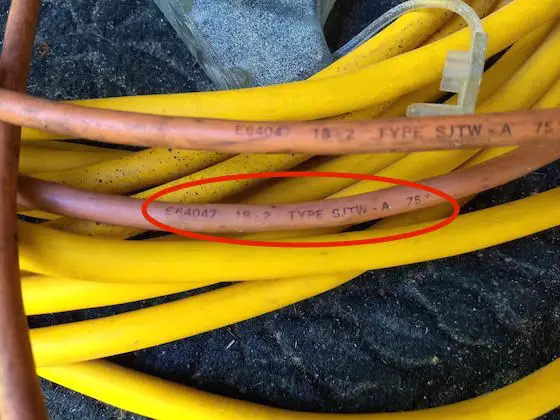
The orange cord is only 18 gauge. Look how thin it is compared to the yellow cord that's 12-gauge. NOTE the 18-2 before the word TYPE in the red oval. That's how you know it's 18-gauge wire. Copyright 2018 Tim Carter
Here's what I mean. A 14-gauge wire can handle LESS current than a 12-gauge wire. The number 14 is bigger than 12. Confused? You should be!
What Load Can Each Gauge Wire Handle?
16-Gauge Cords: Any 16-gauge cord between 0 and 100 feet long will adequately handle tool loads up to 10 amps.
14-Gauge Cords: Any 14-gauge cord between 0 and 50 feet long will adequately handle loads between 10 and 15 amps.
12-Gauge Cords: If your tool load is between 10 and 15 amps and the length of the cord is 50 to 100 feet, you need a 12-gauge cord to safely power any tool.
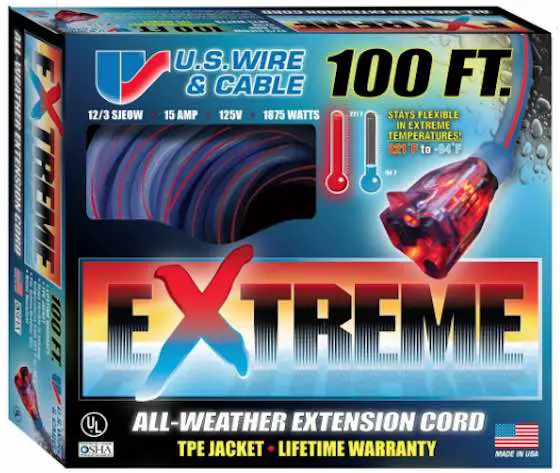
This is a great extension cord for many purposes. CLICK THE IMAGE NOW to have it delivered to your home.
Why Does my Circuit Breaker Trip With the Right Cord?
Your circuit breaker may trip because the tool you're trying to power draws too much current. This is very common if you're trying to operate a large table saw cutting thick wood.
CAUTION: Most circuits in ordinary houses are wired with 14-gauge solid copper wire. This means you'll see a 15-amp breaker on the circuit breaker panel.
You may purchase a 12-gauge extension cord thinking that you'll be able to operate a powerful table saw but the breaker will probably trip when you load the saw. Remember, the circuit is rated for the SMALLEST SIZED cable or wire in the circuit.
Do Other Things on a Circuit Add to the Load?
Yes, other things, like a garage light or some other appliance, could be on the same circuit you've plugged the extension cord into. This adds to the total load on the circuit! You may think you have 15 amps available going to your extension cord, but several of those amps might be in use from something else.
B174

Tim built custom homes and did ultra-custom remodeling for 20+ years before launching his Ask the Builder media presence. He was selected as one of the Big 50 by Remodeling magazine in 1993. This award gave birth to Ask the Builder in October 1993. Tim also operates https://DrawPlumbingPlans.com. His @askthebuilder YouTube channel was the first home improvement channel on YouTube.

I really appreciated your website info regarding what size extension cord I might need. Could you give me your opinion.
I have a Taylor soft serve Ice cream machine (Refrigeration basically off and on) that will be used at wedding receptions and out doors. Ideally I wanted to get a 100 foot extension cord.
The machine states its 16 amps at 110 v and requires a dedicated 20 amp circuit/outlet and the cord coming out of machine states 12/3 300volts.
I was hoping maybe a 10/3 size extension cord at 100 feet would provide up to and maintain 20 amps by the time you hit the 100 feet, but not so sure. Would I need to go with an 8/3 to have at least 20 amps available at 100 feet with current drop, I would think that the 8/3 for sure would maintain up to 20 amps but cannot find anything beyond a 50 foot in the 8/3 size but have found the 10/3 in the 100 foot range everywhere.
What do you think between the 8/3 and 10/3 for maintaining 20 amps at 100 feet. I appreciate any opinions or math formula's used to figure this out. I figure if machine is 16 amps then giving the extra up to 20 is most likely the way to go, I guess.
Thanks much
Best regards
Tiffany
The 10/3 will be more than enough. A 12 gauge wire is rated for 20 amps.
The problem you'll have at other venues is the LACK of a dedicated circuit that you plug your extension cord into.
But it gets worse. If you're at a residential home, MOST branch circuits are typically fed with 14-gauge wire rated for only 15 amps.
Your cord may be able to handle the load, but it's what's between the extension cord and the service panel that counts.
The manufacture states it draws 16 amps. You'll need to have a dedicated 20 amp run with a 20 amp receptacle. This is not a receptacle you'll find in a home as they are only rated for 15 amps. Granted, you're talking 1 more amp that what a common receptacle is rated for. Keep in mind that the 15 amp receptacle is most likely fed by 14/2 wire. The weak link is the outlet and the 14/2 feeding it. Using the 12/2 or 10/2 extension cord should ensure the cord will not go into thermal overload. But guess where the thermal overload will occur? At the outlet or the wiring in the walls. Your best bet is to get a dedicated 20 amp outlet and get an extension cord with 20 amp connectors; 12/2 for 50-75' or 10/2 for a 100' cord.
I want to run two 100-ft extension cords connected together to power two table lamps (60watt lamps) in my makeshift bunkhouse at my camping area. First, is this safe to do? And second, if it is, what gage wire extension cords should I purchase. Thanks.
can two 100ft. be jointed to make the 200 ft. with a 12/3 gauge extension cord supply a 12 amp electric
push mower? will it damage the motor with that connection by losing too much voltage.
250 feet of 10 ga extension cord. How much voltage and amps should I expect at end.
The current rating is based on the size and length of the cord. There is no perfect conductor, so even solid copper wire creates resistance (ohms). The smaller the conductor and the longer the wire, the more the resistance and therefore the less current the cord can handle. A 100' 12 ga. cord connected to a second 100' 12 ga. cord is going to allow less current (amps) than a single 100' 12 ga. cord. That is actually what I was searching when I came across this site--the allowable current with subsequent lengths. Also, if you are mixing cord gauges, use the heaviest gauge (smallest number) closest to the receptacle. Thus, if you have a 12 ga., 14 ga. and a 16 ga. cord that you are using, plug the 12 ga. cord into the outlet, the 14 ga. cord into the 12 ga. and the 16 ga. cord will be providing power to the appliance.
It doesn't matter the order you plug the cables in. The resistance from the source to the load will be identical. Not many people feel their cords when in continuous use. The voltage drop across the extension cable is dispersed as heat; normally not a major deal if the current is low. As the current increase so does the temperature of the conductors. The insulation of the conductors plays into how much heat in can dissipate. As the temperature of the conductors increase so does its resistance. The higher the resistance the more power is dropped across the extension cord. This is a snowball effect and either the breaker trips or the cord melts or catches fire.
If you use cfl or led bulbs that are 60 watt equivalents their actual wattage will be closer to 11 to 13 watts each, making for a total of about 25 watts.Assuming the voltage at the outlet is a normal 115 to 120 volts then you will only be using about a quarter of an amp which is next to nothing. As long as your extension cords are approved for outdoor usage your typical 16 gauge should be more than enough.
I have an above ground pool that runs on an extension cord. I had a dedicated outlet run from the breaker box exclusively for this purpose. I originally used a100' 12 gauge with no problems. A couple of seasons ago I switched to a 50' + a 25' 12gauge for ease of disconnecting. It's there aa problem going this because I went to plug it in today & saw a puff of smoke??? Yes, I immediately unplugged it.
What happens if I use a 16 gauge instead of a 14 gauge 100' for 12 amp electric lawnmower? Home Depot is pushing the 14 gauge.
I used the 16 gauge 100' for a 13.5 amp snow blower last year. Home Depot recommended the 16 gauge.
The 16 gauge worked perfectly for the 13.5 amp at 100 ft..
It should make no difference, or maybe it does, but the house and all the breakers, and the outlet used, were all professionally upgraded before using the snow blower.
What Load Can Each Gauge Wire Handle?
16-Gauge Cords: Any 16-gauge cord between 0 and 100 feet long will adequately handle tool loads up to 10 amps.
14-Gauge Cords: Any 14-gauge cord between 0 and 50 feet long will adequately handle loads between 10 and 15 amps.
12-Gauge Cords: If your tool load is between 10 and 15 amps and the length of the cord is 50 to 100 feet, you need a 12-gauge cord to safely power any tool.
I have a new pool pump that has a dial for backwash,rinse,and regular with pump. How do I know what Guage extension cord to use
What if you want to run 2 items off a 100' cord? Each is 1800 watts and 110/120 volts. If each calculates out to 15/16 amps, does it need 30 amp rated cord? They are each induction single hot plate.
I have a diesel truck with a block heater and the closest outlet is about 300 feet away. Can I use a 250 14 Guage extension cord with another 50 foot cord? Is this safe and will it have enough power to still make it work? Please let me know or if you have any other suggestions
I need to run power off a 250 ft extension cord
What size wire do I need to get the most out of the curd?!
I have a commercial backpack vacuum. It states it is an 11.5 amp machine. It has an attached 50 ft power cord. Can I safely use a 50' or 100' - 12/3 extension cord, rated at 15 amps?
Thank you.
I have a 100' ext. cord that says "style 10". Is that referring to the wire gauge? It's rated for 600v.
I am looking for the proper extention cord for a 5" ac/dc grinder.
I mention above looking for allowable current drops in additional cord lengths. The link below should help anyone wanting the same information. While the calculator is designed for voltage drop, the resistance in the chart can be used for the current calculation. Simply use the same equation (V=IR) but keep the voltage constant and adjust the resistance based on length. Thus, I=V/R provides you the current drop over the specified length of cord.
I would like to build a work light for my grinder. What is the best material and what type of wiring should I use? Any and all information will be greatly appreciated.
My mom wants to use a 16 AWG extention cord to plug in her heated water bowl for her birds outside. The bowl says it uses 60 watts. Is that ok?
That's fine. Since the cord is outside and in COLD WX, it helps prevent any overheating. It's not going to overheat with just a 60-watt load.
Make sure there is a ground fault interrupter so the birds don't get electrocuted taking a bath
Hello experts ,
I know you guys probably covered everything but I have no idea whats going on So i will ask here I have a Heater which is rated 2000 W 250 V . I have an extension cable 10 ft which is rated 6 AMP and 250 V is it safe to run the heater on it ? If not which cable should i get thankyou veryyyy much in advance please answer ♡♡
No it's not safe. The formula is:
Watts = Amps X Volts
Your heater draws 8 amps. The cord is rated for 6.
Hi Tim,
Thanks for this write up. I am planning to build a shed, the nearest outlet is 200 ft. I’ll be running a 12” chop saw that runs at 15amps. Will a 12/3 do the trick and can I run 2 100ft cords, or is a 200 ft necessary?
Thanks
Shane
Shane, you should run a proper electrical circuit with buried cable to a box in the shed, not string extension cords since this is obviously a repetitive use scenario and seemingly going to be your workshop where it will be handy to have power for many things, including lights.
Run 10/3 to two, 15A outlets.
I have leaf blower with a 12 amp motor. Right now, I am using a 50' 16 gauge extension cord but want to move up to a 100' cord. I am looking for a 14 gauge cord now but I have seen some conflicting information. One package I saw said 13 amp and 1625 watts, which sounds right based on 125 volts. I saw another 14 gauge cord that claimed 15 amp, 1875 watts. Still another says 13 amp, 1875 watt. The last claim doesn't seem right. My question is, can you have a 100' 14 gauge cord that will handle 15 amps and 1875 watts? And, is it possible to have a cord that claims to handle 13 amps AND 1875 watts?
Watts = Volts X Amps
A 14-gauge wire can only handle 1800 watts. PERIOD.
That's assuming the AC is 120 volts.
No, Kenny. The current flow is the same. The VOLTAGE drop is higher, which leads to lower watts at the end.
Most equipment is rated for a certain tolerance of % voltage drop. I've seen 3-5% used, which actually matters at higher amps and distances. Depending on what tolerance you assume, you can have a need for a whole different AWG.
I need to buy a 50am 50 ft extension cord for my RV. What guard wire 10awg? to 6/3 /8/1?
I have a shop vac that requires 7.3 Amp. What would happen (if anything) if I use a 25 ft extension cord of 14 AWG? I realize that this cord delivers around 14 or 15 Amp. What would happen if the cord provides more Amp than the tool requires? Will I damage my tool? Thank you.
Tanner,
Great question! The short answer is using a larger sized cord will NOT damage your tool.
The best analogy might be: Imagine you're driving on the 205 Freeway in southern California, but you're the ONLY CAR on the giant road.
There's more than enough room on the road for you and there's no danger because there are no cars near you that can rub up against your car.
Does the maximum cord length for a tool based on it's amperage requirements include the cord length already wired into the tool?
You'd have to ask the electrical engineer that designed the tool. Yes, that's pretty much impossible. My gut tells me the answer to your question is "No".
Tim, a couple of other things about extension cords:
1. There are still retailers who sell non-UL cords, some of which have undersized grounding (green) wires. Always verify any cord you want to buy has a UL sticker.
2. If you see - or have - a cord that won't lie straight (has curves every foot or so) it's been damaged by too much current - got too hot. Discard it.
3. For safety, every cord used outdoors should be plugged into a GFCI receptacle, many of which are only rated at 15A. 20A GFCI receptacles are available, but cost quite a bit more so many builders won't use them unless the local code requires it.
Larry this is not necessarily true on #2. If it has curves that can merely mean the temperature is not high enough for the outer jacket to be very flexible, or even the copper (or gasp, CCA) inside, or it has gotten stiff from some time and UV exposure.
I have several cords that have definitely never been used with equipment that can exceed their ratings and do have some that have curves, especially when they are looped to less than about 2' diameter for storage. They have been like that for over a decade and still work fine.
Tim, great article. I had no idea there were so many considerations in using a (heavy duty) extension cord, as in using outdoors for my hedge trimmer. My question is while trimming a few weeks ago, I cut into the cord. Hubby taped it together with electrical tape but I haven’t used it since. Is it safe to use or should I get a new cord? It was a 100 foot, heavy yellow one.
Susan,
I can't really offer you the answer you want because I don't know how your main squeeze made the repair. Did he solder the wires? Did he use heat-shrink tape on each conductor? Heat shrink over the entire repair is much more desirable than electrical tape.
I don't remember the full details, but I think wire gauge is determined by the number of wires that will fit in a one-inch circle--only ten 10-gauge wires will fit in a one-inch hole; fourteen 14-gauge wires will fit in the same one-inch hole; sixteen 16-gauge wires will fit in the hole. This explanation will make sense of the smaller number being the larger wire. Please check the details before passing the information along.
Eleanor,
That's not correct. You can discover how wire gauge is determined here:
https://en.wikipedia.org/wiki/Wire_gauge
Hi Tim,
As always, thanks for good, useful information. This article is particularly helpful for keeping people (and their tools) safe! I once loaned my almost-new large Milwaukee angle grinder to a co-worker who was welding up some fence post assemblies to house his 9 Husky sled dogs. He burned out the motor using a too-small long extension cable. Note: he paid to have the motor rebuilt, so it ended well.
One small nitpick - I'm an electrical engineer so I find I must point out that Ohm's Law isn't really about watts (power). It's about the relationship between voltage ("V" in volts), current ("I" in amperes), and resistance ("R" in ohms, appropriately named). The formula is V=IR. Yes, it's very related to how much current a cable or cord can safely carry, and your piece does address that well, as determining the resistance of a cable isn't something easily done with readily available testers. Thanks for listening....All the best, and I loved the piece on rallying - congrat's on your Comm position!
I would talk to an electrician before doing it, an electric dryer receptacle is 240 volt 30 amps. Code permits a so-called 3 wire circuit of to 120 volt 30 amp circuits sharing the same neutral white wire. This is not a problem because all the neutral carries is the difference between the 220 volt circuits, it has to do with how the 120 / 240 volt Supply works and the center tap utility Transformer. Home Depot and Lowe's both sell 10 gauge 4 conductor rubber cord by the Foot. Also the connectors for both ends. In most jurisdictions it is legal to plug into the dryer receptacle and take off 2 120 volt 30 amp circuits with the 4 conductor 10 gauge wire. You absolutely have to wire this right so that's why you need an electrician do it, but you're using the red for one hot and the black for the other, and your green is ground and white the shared neutral. You also want to use two gfi's rated for 20 amps they are the ones that have the sideways slash in the receptacle. And definitely have electrician Wireless for you, and verify that it's legal in your location.
But this is how you can temporarily use a 20 amp device in a house that has electric dryer but only 15 amp circuits
We have a 12amp electric lawn mower and we need 100’ of extension cord...we purchased a 16 gauge is this going to be an issue??
Yes. It's TOO SMALL.
I'd be using a 12-gauge wire. Look at the table above.
Great info! But some web pages I've visited give me slightly differing opinions.
If I understand, you seem to say that I can plug my 6.5 amp refrigerator/freezer into a generator (in case of a power outage) using a 100 foot long 16 gauge extension cord.
The last page I visited:
http://www.diybyexample.info/2010/07/what-size-extension-cord-do-i-need/
says I'll need a 14 gauge 100' ext. cord.
I'll need all 100' of that cord since the generator is at my neighbor's house... but you're saying the 16 gauge should be ok?
Many thanks for your help with this.
Btw, Tim... my refrigerator/freezer is 6.5 amps but it also says 115 volts. Not sure if that would make a difference.
Great article, thank you!! There is much confusion about extension cords. Recently my brother and I found mom had cheap extensions, some daisy chained throughout her house in practically every room. A big terrible devastating just waiting to happen. We fixed and made sure they were removed and replaced with appropriately sized extensions.
Hi Tim-thanks for all your wisdom and assistance!
So: I have a detached garage that currently has no power in it. I would like to run some power tools in it, so I figured, in the short term, I'd use an extension cord. My highest amp draw would be a Century FC90 Flux Core welder. It's Rating Plate says it's I1max=20A, and it's I1eff=11.
The other tools I am liable to use would be Angle Grinders, a SkilSaw, Router and Jigsaw, but I would not be using those at the same time that I was welding. The only other thing that would be running while I was welding would be a 500 Watt work light, drawing 5 amps. I normally plug the welder into the laundry room outlet, which is a dedicated 20a circuit, in a house built in the 50s. The laundry circuit was equipment grounded by us when we moved in.
So the plan is, if I could, to plug the extension cord to the laundry room outlet, and run it out to the garage. The question is: what gauge would work? I could take one of two routes: one is, at last measurement, 62 feet, but would come with greater hassle (putting a hole in a door, or the wall), and the other is pretty much a full 100 feet (more convenient, but longer, and generating yet more resistance).
I was looking at a 10 gauge extension cord. Would I need that gauge, or could I get away with 12 gauge?
Hi Tim-thanks for all your wisdom and assistance!
So: I have a detached garage that currently has no power in it. I would like to run some power tools in it, so I figured, in the short term, I'd use an extension cord. My highest amp draw would be a Century FC90 Flux Core welder. It's Rating Plate says it's I1max=20A, and it's I1eff=11.
The other tools I am liable to use would be Angle Grinders, a SkilSaw, Router and Jigsaw, but I would not be using those at the same time that I was welding. The only other thing that would be running while I was welding would be a 500 Watt work light, drawing 5 amps. I normally plug the welder into the laundry room outlet, which is a dedicated 20a circuit, in a house built in the 50s. The laundry circuit was equipment grounded by us when we moved in.
So the plan is, if I could, to plug the extension cord to the laundry room outlet, and run it out to the garage. The question is: what gauge would work? I could take one of two routes: one is, at last measurement, 62 feet, but would come with greater hassle (putting a hole in a door, or the wall), and the other is pretty much a full 100 feet (more convenient, but longer, and generating yet more resistance).
I was looking at a 10 gauge extension cord. Would I need that gauge, or could I get away with 12 gauge?
No No No and Hell No.
Do this job the correct way and install a subpanel in the garage that's rated for at least 40 amps MORE than the draw of the welder.
Run the 240-volt power line from the house to the garage in approved conduit buried at least 2 feet into the ground or whatever the current NEC requirement is.
Trying to do this with an extension cord is both foolish and DANGEROUS.
If the extension cord has a 20 A Breaker and the outlet is Dryer/Washer outlet which is usually 30 A rated and has its own established breaker, I see no reason why not use a 10 Gauge industrial or Generator Cord. That's what extension cords are for when you really need them and have no alternative. Digging isn't that easy. The welder would not be drawing 20 A constantly. Most welding jobs last seconds. Just Be Careful!
get a 10 G generator extension cord. Get an adapter with a circuit breaker to be tripped if the welder exceeds 20 Amps. Most welding jobs are intermittent and last seconds at a time. Most Dryer/Washer outlets are 30 A with higher breaker. I see no danger in your attempt to remedy the situation with extension cords. Just be sure the cord is at least 10, industrial with heavy draw rating and be sure the adapter you buy to connect the welder cord has at minimum higher than 20 Amp breaker. You will figure it out ...just be careful
Hi,
I have a Champion generator with 7500 running watts and a 30 amp breaker internal to the generator. What's the longest 10 gauge cord can I use to connect it to my house? Thanks!
A 100-foot cord will be fine.
Hi,
I need to run a small space heater, 120 volts, 1000 to 1650 watts at a shed about 300 feet from my house. I plan on direct burial. Would a run of 12/3 be sufficient, barely sufficient or overkill?
Hi Tim, I just bought a Greenworks 16" 120V Corded Electric Lawn Mower 25142. I was all ready to go out and start mowing my overgrown grass, when I read the manual and saw it was asking for a 12 gauge extension chord. I went to Home Depot and couldn't find a 12 gauge 100 foot chord, which I thought I would need because I have a 90 ft curb area, although small lawn. All I could find is 14 gauge 100 foot chords, or 12 gauge 50 foot chords. I spoke with a few people, including my husband, who thought I'd be fine with an old chord (which is probably 14 gauge), 100 ft. When I called the company, they said that they don't recommend 100 ft chords, but only 50 ft, or 150 ft chords, which didn't make a lot of sense to me. The person I spoke to said the mower was 12 amp, (it says it's 10 amp right on the mower) and either a 50 ft chord or 150 chord would need to be 12 gauge. Does this sound right? Since the mower is 10 amps, would it be safe to use a 14 gauge 50 ft chord? What about 14 gauge 100 ft chord? Thanks.
Just follow the manual. The manufacturer, as well as what I say above, wants you to use 12-gauge wire for a reason.
Tim - sounds good. I've been using a 100 FT 16 GA extension for years with my electric lawn mower. No warming to note on the wire. Small blade length on the mower, so its not stalling. Bought a 12 GA 100 footer -- just because it had lower losses. My son managed to cut the end off on his very first try. Went back to the 16 GA pending connector repair. Funny how its still sitting in the garage waiting... 😉
Nick
Hi Tim,
I loved your article; when I worked at Sears I sold a lot of power tools including outdoor ones. In particular, corded lawn mowers scared me (yes, I once owned one) and I always tried to warn my customers to have the proper cord. Far too many times I heard people complain about the cost, and I tried to warn them what could go wrong if they cheaped out. I preferred to lose the sale then help anyone take a chance. Also, years ago I bought a home laser printer. Official power draw was well within circuit limits. But each time it powered up the lights went dim. Turns out the builder kind of sort of forgot to mention that the peak power draw was twice the published rating. Completely UNSAFE to use on the typical home AC circuit.
Hi Tim, I need to use a 6 amp water pump off a 20 amp GFI outlet. What's the longest extension cord I can use? I have several 100 feet 10 and 12 gauge cords. How do I figure out maximum extension cord length? Thank you.
Hi. I have a 4.5 amp, 515 watt window AC unit. The voltage says it's 115v/60Hz. I'm currently running it with an extension cord which I know I shouldn't be doing but I really need it for my kids. I'm using an orange extension cord and don't know what size it is and the length I'm guessing is 25ft or more. It's only temporary but I'm worried about it catching fire or something else because everyone says never use an extension cord for the AC unit even the manual for the unit itself says that. Do I really have something to worry about, should I just unplug it and not use it?
I have some 50' & 100' extension cords that are not labeled well and I want to know their gauge.
How many ohm's is a 12 gauge 50' cord?
How many ohm's is a 14 gauge 50' cord?
How many ohm's is a 12 gauge 100' cord?
How many ohm's is a 12 gauge 100' cord?
Tim,
I have a dedicated 120 V 20 Amp Receptacle in my garage. I recently purchased a 120 V 20 Amp Welder that I plan on using for some projects on my driveway near the garage. Hence, I need roughly a 50 foot Extension Cord to reach the dedicated 120 Volt / 20 Amp receptacle. The Welder manufacturer recommends a 10 AWG Extension Cord for distances up to 30 feet an 8 AWG Extension Cord for 30 to 50 feet. The problem is that I am unable to find a 50 foot Extension Cord that has 120 V / 20 Amp plugs.
What do you recommend?
Much thanks,
Joe
So simple. Keep looking, unless you want to become a statistic.
Well-intentioned article but not very accurate or informative. Ohm's Law is not what is stated, and had nothing to do with power. Ohm's Law is a formula used to calculate the relationship between voltage, current and resistance in an electrical circuit. It does not calculate power (watts). That's a different equation. Also, they're is no "friction" in an electrical conductor, there is resistance. You may think it's the same thing, but you are wrong. If you wish to educate others, seek to educate yourself first. And please stay away from doing electrical work and leave it to those who understand electricity.
Thanks, Sean for your blunt comment. Perhaps you should create your own website all about electricity to demonstrate to all of us the depth of your intelligence or quite possibly ignorance. Your comment makes me think back to one of my dearest college professors, Dr. Caster. My guess is there's quite a bit you think you know, but you might be proven wrong by experts who know far more than you do. When you get the blog started, please come back and post the URL here so we can all go see what you know.
Can I over power a tool by using a lower gage wire than needed? For example can i use a 12 gage wire for my orbital sander?
Also what does the second number mean when looking at cords? example 12/3
Hi Tim! Great article! Easy to understand. Except-
Volts X Amps = Watts Is Watt’s Law
Can i use a 12 guage 100' extension cord to a camper which will have a plugged in 1500 watt heater inside. It will be plugged into the house outdoor plug GFCI
Richard,
Go back up and look at what I said about amps and how many watts that cord can handle.
It's an easy calculation.
Hi Tim. I want to plug my electric blanket in when I tent camp. The power at the campsite is listed as 30 or 50 amp. The last time I did this the plug on the 100’ extension cord my husband brought got so hot I could barely touch it to unplug the blanket. I want to get a shorter, heavier duty cord. What do you recommend?
I'm trying to run an outdoor speaker system for a party; two tower speaks requiring 6 amps each. The area is 150ft from my homes power outlet. I will be plugged into a home outlet so a 15amp circuit powering a 14 gauge wire to the plug.
I was planning to buy a 200ft 15amp 12/3 extension cord to try and prevent voltage drop between the house and the speakers over that long distance.
Would the 12/3 cord still help prevent voltage drop across that distance or am I at risk over overloading the 14 gauge wiring in the home with this plan?
Hi,
I just had a quick question. I have a mini fridge in my room and there is only one socket in the room. although the fridge is currently plugged into that socket, I want to move it as it is in an awkward space. could you please advise me if I can safely plug it into an extension wire and if so what precautions should I take.
Hello,
Quick question if you wouldn't mind- what gauge extension cord (50ft) should I use for a AC heater unit:
• Electric Heating Watts: 3500
• Electric Heating Input Watts: 3680/3030
• Electric Heating Amps: 16.0/15.6
• Voltage: 230/208
I have a 12 gauge but I am thinking from research that I may need a 10? Does that sound correct? I appreciate your help sooooo much!!
Hi. Great article.
I have an extension cord that is 12/3 SJTOW with a total max. rating of: 15A, 1875W, 125V and intend to take it with me to Europe where current is 220V.
Will it be safe to use? and what will happen to the power indicator light? thanks for your advise.
Hi -- I'm looking for an extension cord to use for an Electric Car charger. Any recommendations?
Can one 100 foot 10 gauge power cord with a three outlet splitter power a full size fridge/freezer and a full size upright freezer through one outlet safely ? Living in small mobile home and the fridge with top freezer and the other upright freezer were put outside under awning on patio by previous tenant. There are two sets of 2/ 3 prong outlets attached to outside of mobile home...they seem to be coming from under trailer and plugged into main power breaker box at the power pole for my lot space. This was all done before I moved in and there is nobody who knows the specifics of what was done or why. There are two separate breaker boxes on the pole for the trailer and outside outlets to one box and the other box powering the tool shed..I’m thinking of plugging the both into the 10 gauge cord into the shed breaker box directly since I was only able to find a 100 ft. Cord and have only a few 3 prong outlets inside the trailer: it’s 1957 vintage mobile home with mostly 2 prong outlets through the trailer and I’m afraid if I put the appliances inside it will overload and trip the breaker constantly or start an electrical fire..
Any advice would be greatly appreciated. Hope I was able to explain my dilemma clearly. Thank you for your time.
Another reason to call the power company when you have an outage is if everyone calls they will have an idea of how widespread your particular outage is. That may affect the priority for repair.
Hi. Do you think plugging my treadmill into a 50foot 10gauge extension cord that will be plugged into a dedicated 20amp cicuit will be ok? My only other option is to plug it into a shared 15amp circuit that is shared with 3 ceiling lights and not turn on the lights when I use it.
Did you watch my video way at the top of the page under the top photo???? Did you do the math to determine the number of AMPS the treadmill draws?
TWO QUESTIONS:
When my power goes off in storms, I want to use extension cord from frig to reach my backup solar generator, located in garage about 50-60 feet away, from frig to use solar, when power company has outage.
1. What gauge extension cord should be used?
Frig is rated 15 amps and 120 volts.
I also would like to have an extension cord added to the cord that came with frig, and in use so that I can easily reach the cord and add the extension cord which goes to garage for solar generator, when back up solar is needed after storm outage.
I live alone and am physically unable to move frig to get behind to reach its outlet when I need to plug frig into solar back up outlet in garage. So I want to be prepared and already have frig using an extension cord so that I can reach it to connect to solar generator back up in garage.
2. What size gauge should be used here, and it would only be about 2-3 feet long? Then I can easily connect it to the 50-60 ft. long cord going to garage.
Thank you
Please use a 12-gauge cord in both instances - as short as it can be to work.
I have a pop up camper. I want to run an extension cord from a space heater directly to the power box at the camp site. 12.5 amps, 1500 watts (high) 750 watts (low). I was told to get a 10/2 25' cord. Is this correct/safe?
That's overkill. A 12-gauge cord 25-feet long will suffice. The fact that the cord is exposed to the air HELPS keep it cool.
I have an electric heater in a small greenhouse aprox 50 ft from a power source. What extension cord can I use to power this?
Thank you for this informative article on extension cords.
Power computer by voltage times current is NOT Ohm's law. Ohm's law states that voltage equals current times resistance. Your mention of Ohm's law could correctly be used to explain the voltage drop with each cord, however.
I realize some of the 88 responses may make this reply redundant, but I cannot figure out how to see the other replies. Please let me know how to do that. Happy Thanksgiving, and stay safe.
In your article, " extension cords size chart ", you state that 120 volts is the electrical standard for US homes. I thought it was 110/220 volts. Or, can it be up to 120/240 volts, and if so, how do I determine how much voltage is coming through my wall sockets?
Case in point, I have a heater that is 1,500 watts, by using your formula (120 volts) it'll look like this:
1,500w ÷120v=12.5Amps. Therefore the heater should be rated at 12.5 amps.
Now, if we use ( 110 volts) we'll get a different Amperage.
1,500w÷110v=13.6 amps. Which in this case the heater is rated at 13.6 amps.
The 2"×4" board came to mind, the true measurement is 1 3/4"×3 3/4".
Thank you in advance for your time and clarification.
so mostly out of curiosity say I have 2 16 25ft cords but oh no the damn plug needs to be replaced on both of them say I was to wire them in parallel to just 1 plug at each end would that increase the amount of current I could handle SAFELY ? I like to tinker with battery and dc but have little to no experience with ac. Thanks.
Dear expert:
I am so confused even after reading your article.
I went to two stores shopping for 25' cord for my shop.
I have one tool that is 1500 watts.
So I thought I would get a 12 gauge cord. But then I noticed (at both stores, different manufacturers) the both the 14 gauge and the 12 gauge were rated for the same watts/volts/amps. Identical. I am on a tight budget. Why would I buy the 12 and not the 14 if they are rated for the same load? Makes no sense. One sales person said "oh, the 12 gauge is heavy duty." At the other store the salesman said "they carry the same load but the 12 gauge has a thicker cover for protection". I don't trust either of those responses to my question. What is the diff if they are the same?!?!
I have a mini appliance that in my bathroom, its 3000 watts and 110/25-30amp. The cord is 3ft long and my bathroom outlet is on a 15amp. My outlet that's wired to a 30amp is about 15 feet away. What kind of extension cord can I use? the item would only be used for 20-25mins every other day.
Hello. I have a cyber power 425va with battery backup built in. The cord isn’t quite long enough at 6 feet. Looking to add a 10 ft extension cord. Am I correct that. 14 gauge cord will work and not cause a fire? It will carry half the load at a computer desk. A couple monitors, speakers, and a docking station. Thanks!
Hello!
I have 6 deep-cycle batteries in series. I would like to extend my little voltage meter about 70 feet into a cabin (so I don't have to walk up in the snow to check the available voltage). Would 20 or 22 gauge be OK, or can it be smaller? Thanks in advance!
Thanks for the information. Very helpful
I substituted 3 LED 6" ceiling lights in my kitchen to replace a flourescent light fixture. The wire to my old light is 12/2 w ground. I always save older wires when deconstructing in case I need say a 8 foot wire to add an end of the run outlet. Well after I ran the wire and put up new drywall, I went to install my new LED lights and when conecting the light I realized that wire I used to extend 6ft run was 10 gage to the last light. Will this be a problem or since it is so low in amperage this is OK?
Hi, I bought a Black & Decker weed wacker that’s 6.5 amps, the instructions say use utility cord higher than 6 amps but not over 10 amps. Why not higher than 10 amps?
Would it just be better to get a 10 gauge extension and not worry about what your using it for,since it can be used for everything you use as a homeowner.
I have purchase a Dynatrap 1/4 acre Atrakta Lure Insect Lantern and I will need to buy a 10 foot extension cord but only specs I can see is 110 volts. What AWG size do I need to buy. Thank you any help you can give me. I'm an old lady and afraid of electricity so want to avoid problems.
I have to run an extension cord from my 5 gallon compress that pulls 22.5 amps, into a 220 dryer outlet. What gauge cord do I need? I've been told 10ga will handle it, but by your chart it doesn't appear so.
What do you think? Can I power a refrigerator using a 12 gauge, 100' + a 25' extension cord from a 12 kw Kohler generator?
Hi,
Thanks for the info. What does 2 in 18-2 signify? I've also seen 16/3 listed for extension cords. The first number is the gauge. What does the second number mean?
Thanks.
can i connect two 16 gauge 100ft extension cords together to power a chicken coop heater that requires 140 watts?
Does the distance from the service panel to the permanent receptacle count towards total length of a proper cord? Example a trailer home thats 65 feet long with the service panel on one side and the receptacle is on the other side of trailer. I have a 20 amp outlet on a dedicated line that was used for a refridgerator, can I plug up to that running a 150 foot 10/3 cord to a barn for temporary lighting?
If I use an undersized extension 75 foot cord to power my electric 15 amp chain saw will I damage the motor in the saw? Thank you.