Foundation Crack Illustrations
Foundation Crack TIPS
- Location, shape and size of crack tells much
- Hairline cracks in cast (poured) concrete are normal - See Below!
- Measure crack width at same location over time to check movement
- DIY crack epoxy - WATCH VIDEO below - same process for concrete walls
- CLICK HERE to Get Tim's FREE & FUNNY Newsletter!
Foundation Crack Truth
The truth is that a great foundation can be in place for hundreds of years and never develop more than a tiny shrinkage crack. If you have a foundation crack, here are some of the major reasons why it cracked:
- Weak soil that's got organic matter or was poorly compacted fill
- Footing not wide enough to spread building weight over soil
- Lack of structural steel in footing and foundation walls
- Foundation wall too thin for height and soil pressure behind it
- Poor quality materials used for foundation
CLICK HERE to get FREE & FAST BIDS from local structural engineers in your city or town.
Foundation Repair
To repair a foundation, you first need to determine what is going on. This means you need to identify what's causing the crack. There are many different possible causes.
For example, you could live in, or around, Cincinnati, Ohio where foundation problems are common.
The Cincinnati, OH area has some shale bedrock that turns into a weak clay that slides easily when wet. There are two rock formations that are responsible: the Kope and the Lower Fairview. You can easily see where these rocks, and poor soil, are by referencing a geologic map of the area.

This is a copy of a United States Geologic Survey (USGS) geologic topographic map of the East End of Cincinnati, OH. The downtown area would be just to the left of what you see. The Kope and Lower Fairview formations are the light pink rock just above the magenta-colored alluvium that's north of the Ohio River. (C) Copyright 2017 USGS and every US taxpayer that owns the maps.
House foundations built on this weak Cincinnati soil can shift, buckle, crack and fall apart in no time.
It's best to call in residential structural engineers to assess the problem BEFORE you call a foundation repair company. The money spent on an independent engineering study is the BEST MONEY you'll spend on the repair. CLICK HERE to get FREE & FAST BIDS from local structural engineers in your city or town.
They may suggest you talk with a soil engineer or they may hire one as a secondary consultant.
CLICK HERE to get FREE & FAST BIDS from local Soil Engineers in your city or town.
DIY Foundation Crack Repair
If you've got a crack in your foundation and you know the crack is not getting wider, then you might try to repair it yourself.
There are any number of concrete, or masonry epoxies that will do a fabulous job. Watch the following video to see one I've used with great success:
CLICK HERE to BUY NOW the epoxy I used in the video.
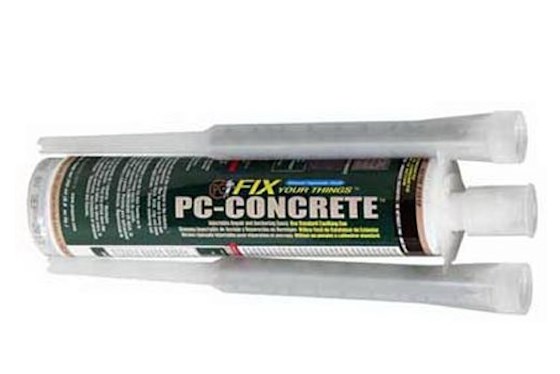
This is a wonderful DIY foundation repair epoxy. I've used it with great results. CLICK THE IMAGE TO ORDER IT NOW.
Foundation and Wall Crack Illustrations
The following crude illustrations give you and idea of examples of foundation cracks and what might be causing the problem at your home.
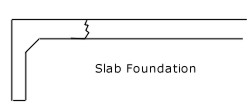
The following illustration shows a very typical crack that can happen in both poured concrete and block foundations. Both materials shrink as they dry, and tight 90 degree corners are splendid places for cracks to originate.
The key is to monitor the width of the crack. Make a mark somewhere along the crack and measure it accurately with a ruler that has millimeter markings. If the crack starts to get wider at the top or the bottom, it could be trouble.
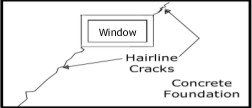
Other times, the crack can grow to 1/2 inch or more in width. Monitor the width of these cracks and call in a structural engineer early in the process to get a professional assessment.
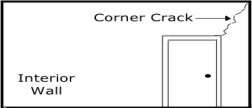
Every house has joints in it just like your knees, elbows and hips. These joints move during the changing of the seasons as indoor and outdoor humidity levels change. Often these cracks get smaller as the outdoor humidity rises.

This causes a bow in the ceilings closest to the center of the trusses. The cracks close up usually in the middle of summer. The solution is to install special simple clips between interior walls and the bottom of the trusses. CLICK HERE to read my past column about truss uplift.

If the cracks are wide at the top, it usually means that one end or both ends of the foundation are dropping or the middle of the foundation is rising or heaving. If the crack is wider at the bottom then the exact opposite is probably happening. You need a structural engineer as soon as possible to evaluate this type of problem.
CLICK HERE to get FREE & FAST BIDS from local structural engineers in your city or town.
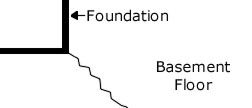
Many basements have inside 90-degree offset corners like this. It is common to see a crack in the basement slab floor radiating from such a corner. This is NOT a serious problem.
The cracks often take one year to grow to their full size. At the end of one year you can caulk the cracks with the PC Products magic epoxy you saw above. CLICK HERE to order it NOW.

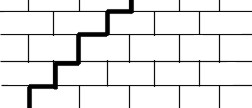
This crack is one that appears in the horizontal bed joints of either a brick or a concrete block wall. These cracks spell trouble with a capital T.
If you see these in your basement block walls, they are a sign that the walls are in the early stages of failure. The pressure of the dirt behind them has bent the wall and the crack is the hinge point. On a brick wall, the cracks can be caused by corroded wall ties or inadequate ties and wind pressure is actually causing the wall to bend.
The wall can be stabilized on the inside with vertical steel I-beams. CLICK HERE to get FREE & FAST BIDS from local structural engineers in your city or town. This pro can draw up a simple plan that shows you how to SAVE your foundation.
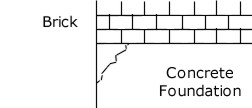
Often a small chunk of the concrete foundation will fall off and the brick will be unsupported. These cracks are caused by the brick expanding and pushing the outer corner of the foundation with it. This problem is not a foundation issue. Your foundation is not going to cave in. Use the magic PC Products Epoxy to glue back on the chunk that fell off.
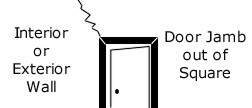
If you see cracks or gaps like this consider them to be huge flashing red lights telling you that major problems are happening somewhere else in the house.
Column B288

Tim built custom homes and did ultra-custom remodeling for 20+ years before launching his Ask the Builder media presence. He was selected as one of the Big 50 by Remodeling magazine in 1993. This award gave birth to Ask the Builder in October 1993. Tim also operates https://DrawPlumbingPlans.com. His @askthebuilder YouTube channel was the first home improvement channel on YouTube.
how best can one address severe settlement on buildings?I am experiencing cracks as shown on the last illustration.
Regards,
I have cracks appearing above one of my bedroom doors, from the frame outwards to the ceiling and the same above the door in the same location on the ground floor below. At the same time as these cracks, others have also started appearing on the wall above the stairs with similar cracks appearing on the other side of the wall in the bunk/box bedroom of our house. The cracks are appearing through the wall paper on both walls (more severe on the bulkhead stair wall). The wallpaper on the stairs has been there for over 16 yrs so I know that the cracks are new.
Can anyone advise what is the cause of these cracks.
Regards
F Usman
I'm buying a house and the inspector found a foundation crack. The sellers agreed to repair it but I'm wondering what questions I can ask to make sure that the job is being done well and not just well enough to sell the house.
Thanks,
Kate
Dear Sir,
I notice a crack from the front door up to the corner of the wall to roof, Upon closer checking I noticed the corner of the two walls that meet at is cracked all the way down to close to the floor. WHAT CAN I DO ? PLEASE HELP ME I DONT HAVE ANY MONEY AT THIS TIME. MY SON WORKS FOR A HOME STORE COMPANY. I WILL WAIT FOR YOUR REPLY.
THANK YOU..........VIRGINIA PEIFFER
Without money, I don't know what to say...... Read ALL of the columns at my website about cracks and their causes. Try to discover the source of the cracking.
Brick home built in 50s. One end off ground 3-4 feet. In winter walls & floors sooo cold. Cover vents. What else can i do on fixed income. Had insulation blown in attic 2 yrs ago. This is under the house. I have to do myself. I am 70 yrs, female & live alone. Can you make suggestion?
Hi. I'm about to buy a house which is 80 years old. It has a crack in the foundation which runs parallel at the top of two windows. The crack does not shift right or left. I had a contractor look and he said its just an old house settling but how can one be sure? Thank you.
You can be sure by hiring a residential structural engineer that specializes in FOUNDATIONS.
I have hairline to 2mm stairstep cracks in the sw corner off my basement... along with a crack in the basement floor in the Same corner. Hired a contractor fix it but new said it was nothing and to just spray foam it... his he pulling a fast one on me?
The inspection on a house said one half the house is 1 -2 inches higher than the other half. I am looking at buying this house. Only a couple cracks in closets and one small in living room
We have found lot of cracks in a newly build house vertically and horizontally. Most of the cracks were found on both side of the wall. Some were splitting into two. Will it cause any trouble in future.
I recently brought a house. There is a 1" stairstep crack in the foundation. The foundation is a concrete block wall. How concern should I be I have read that this can be the cause of clogged gutters or settling. The gutters in the house were clogged I hope this is what is caused the 1" crack
When I click on the WATCH VIDEO, nothing happens.
What's up?
(i already receive your newsletter.)