Framing A Door
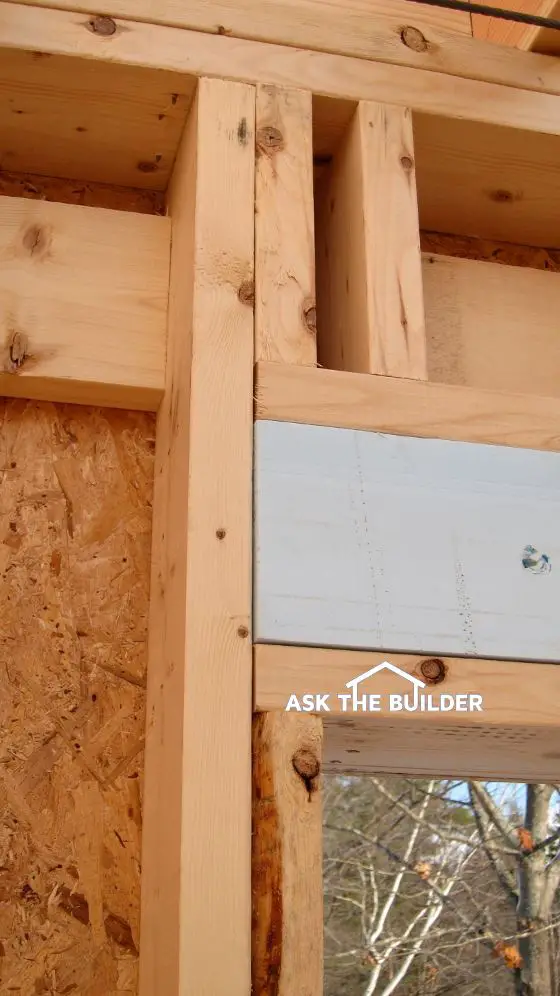
Framing a door in the USA and this is what it's going to look like. This is an exterior door showing the all-important beam covered with closed-cell foam. The load above the door is transferred to the framing on either side of the opening. Copyright 2018 Tim Carter
"A doorway in a non-load-bearing wall doesn't need a structural header. You'll place just one or two 2x pieces of lumber flat across the top of the opening."
I can call you on the phone to help you frame your door. The call is FREE if you're not satisfied with my tips and advice. I could save you hours of time and prevent WOOD ROT and mold caused by a lack of the correctly flashing! CLICK HERE to set up the call.
Framing a Door Tips
- a small beam is required in load-bearing walls
- king stud on either side must be straight
- perform string test with letter X
- use studs with vertical grain
DEAR TIM: I'm going to build a room addition myself because money is very tight. Can you help me understand how I frame in the door openings?
I've never done this before and am very confused. Is the method the same for all doors? How wide and tall do you make the opening?
What do I do on an exterior wall? Elizabeth S., Denver, CO
Related Links
How To Select Vertical Grain Studs Video
Interior Wall Framing Tips & Magic
DEAR ELIZABETH: I first want to congratulate you on your ambition and wisdom in asking questions before you get in trouble. No doubt it's easy to jump into a project, but in these very harsh economic times, you can't afford to waste any money on mistakes. Ask enough questions and you should be able to get through this daunting project.
Is it Hard to Frame a Door?
Framing a door is not too hard. There's absolutely a difference in how a door is framed for an exterior door versus an interior one.
Not all carpenters will do it the same way, so be prepared for different answers to your questions. There commonly is no one right answer.
How Do You Frame a Door in a Bearing Wall?
The first thing to understand is there could be a concentrated load above a door. This happens on bearing walls. In these instances, there's a structural header that acts as a beam over the door to support the load or weight that's bearing down on that portion of the house.
Where are Bearing Walls Located?
Bearing walls can be both on the exterior of the house as well as on interior walls. In the last house I built for my family, I had an interior bearing wall with a door in it. Immediately above the door was a concentrated load that I'd estimate was about four tons.
You can bet I installed a double 2x12 header above that door! Headers come in all sizes and usually, a structural engineer or an architect will size them for you.
Do You Need a Header in a Non-Bearing Wall?
A doorway in a non-load-bearing wall doesn't need a structural header. You'll place just one or two 2x pieces of lumber flat across the top of the opening.
This framing lumber is used to support the finished wall material and provide solid nailing for any trim around the door. It also acts as a tiny bottom plate for the cripple studs above the door opening that reach to the top plate.
How Straight Should the Framing Lumber Be?
When you frame a door, it's very important that you use the straightest pieces of framing lumber that you can find in the pile. What's more, you frame the door with a continuous bottom plate just as the wall has a continuous top plate.
The bottom plate at the doorway gets cut out after the wall is in place, secure and the bottom plate is securely fastened to the floor.
Do You Use a King Stud?
Door openings commonly have two king studs and two jack studs. A king stud is one that runs continuously from the top plate to the bottom plate. The jack stud is nailed to the king stud, but it's shorter as it supports the structural header or the flat 2x material that you use for a door in a non-load-bearing wall.
How Many Jack Studs Should Be In the Opening?
For rough openings 6 feet or less in width, one jack stud next to the king stud is normally what is required to support the structural header beam. Any opening over 6 feet should have two jack studs under each end of the beam.
Do You Need Cripple Studs Above the Door Opening?
You may have to install small cripple studs between the top of the header and the top plate when framing a door. These need to be a continuation of the other king studs on the wall being sure to maintain the even 16-inch or 24-inch on-center spacing you have for the finished wall material.
How Important is the Rough Opening for the Door?
The width and height of a rough opening for a door are very important. Your plans may call for a 3-foot-wide door that's 6-feet 8-inches tall. From years of experience, I'm here to tell you that the rough opening should be at least 38 and 1/4 inches wide and the height of the opening should be 84 inches.
Where Should the Bottom of the Exterior Door Threshold Be?
The bottom of the exterior door threshold should be at the same elevation as the top of the finished flooring material.
You must keep in mind that exterior doors have a threshold that's often at least 1-inch high and that the bottom of this threshold MUST be installed at the same elevation as the top of the finished floor in the house. Rookies often forget this making the rough opening too short.
What About the Height of Interior Doors?
Height considerations are the same for interior doors. These doors are set on the finished floor and there is almost always a 1-inch air gap under the door after it's installed.
How Do You Calculate the Exterior Door Rough Opening Height?
Here are the things you need to consider when adding up to get the rough opening height for an exterior door:
- the actual door height
- the thickness of the weatherstripping under the door
- the thickness of the threshold
- the thickness of the finished floor
- the thickness of the finished top door jamb
- add about one-half inch wiggle room for shims and other site conditions
How Do You Calculate the Rough Opening Width?
You do the same exercise to figure the rough opening for door width. You add the actual width of the door to the thicknesses of both finished jambs, plus add about 3/4 inch for shims and wiggle room.
What is the String Test for Rough Openings?
A string test for a rough opening is when you create the letter X using two strings stretched from opposite corners of the rough opening. If the two pieces of string barely touch one another, then the rough opening is in the same plane.
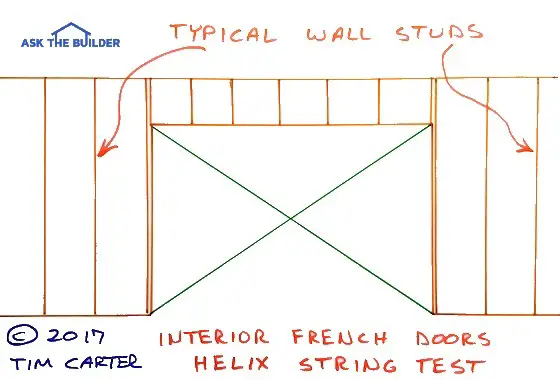
This is a crude drawing of a rough opening for interior french doors. The green lines are pieces of string attached to the corners of the rough opening. They must barely touch at the center of the "X". Copyright 2018 Tim Carter ALL RIGHTS RESERVED. Do NOT COPY
It's mandatory that the rough opening for a door be in the same plane. This is one function the top and bottom plates of a wall perform. If the plate material is straight, the bottom plate is installed perfectly straight and the wall is plumb, then the wall and opening will be in the same plane.
Should I Put a 4-Foot Level on the Studs to Check for Plumb?
NEVER plumb a wall putting a 4-foot level on the wall studs. If the stud the level is resting on has a crown or hump in it, the level will not give a true reading.
You plumb a wall using a perfectly straight piece of lumber that only contacts the top and bottom plate. Place this lumber between king stud locations so it's only touching the wall plates.
Column 913

Hi,
My backdoor was broken into and the jack stud damaged at dead bolt location. Does the jack stud need replacement since this is a load bearing wall?
thanks,
laird
Cut in a splice piece at the damaged location and glue and nail it.
Frame. A. Door. French. Door. 48 inch by. 80. ???? Colum. 913
I offer a phone consult service for situations like this. No easy one-sentence answer.
How do you determine how many jacks are needed for a load baring header
The answer is in the column above. You must have missed it.
Hey Tim,
I am installing a sliding patio door, and my plywood floor is not level. It is about 1/2 inch leaning left. How do I level the bottom? Can I use a 2x6 as a bottom plate? Or should I just cut a piece of plywood?
Thanks,
Paul
When adding a door to an interior hallway, can the existing wall act as a king stud? Do double-acting hinges require any additional support beyond the existing wall and new jack stud?
The existing wall can act as a king stud IF there is a stud right where the door is going. The odds of there being two studs across the hallway at the exact place where the door will be are greater than 1000:1 in my opinion.
Double-acting hinges require a guaranteed king stud behind the jack stud. Long screws must penetrate into both studs so the hinges do not move.
I have a 2 story house. We had to remove a wall which had studs to make our refrigerator fit. My husband want to m as ke it lie an arch way. My cousin told him to cut out the header and replace with new header. I have a low ceiling above it which has plumbing and ducts in it. He said to get out of putting stud back, put the header in with 4x4s on the ends. My husband shares he is wrong because there was nothing above it but that low ceiling. On top of that ceiling is 2 bathrooms. What do I do?
Patty,
This is complex and requires a phone conversation:
http://shop.askthebuilder.com/products/15-Minute-Phone-Conversation-with-Tim.html
When adding a support header in a doorway 65” wide, Put a 2x4 on top of the 2x8 ( with 1/2” plywood in between) to make a support header about 8 3/4” wide. I found that I needed 3/4” or so to make my height so I added 2 1x2” side by side on top (flat) and installed the header with the 1x2 and 2x4s next to the top plate. Was this ok to do or do I need to start over and make it correct with maybe using 2x10’s or something with2x4 etc?
Hi Tim,
Thanks for putting out the info here. I am in the process of building a shed out of pallets (floor and three sides). In framing the front side with a door I am guessing that the front side would be considered a load bearing wall and would require the 2x6 header above it. Is that correct?? I've never built anything before. Thanks in advance for your assistance.
Hi Tim,
I am remodeling our bathroom that has a door between the shower and toilet. The bathroom is already small and we want it to feel bigger by removing the door and widening the opening. The wall is non-weight bearing, and it seems like the doorway was just framed in for functional reasons, to separate the toilet. I can widen the opening, but you can still tell it used to be a doorway. The Jack and king stud on the left side of the doorway stick out from the wall and the header sticks down to match the other doorways. Would it be ok to simply remove the Jack and king studs as well as the header? Then I could sheetrock over everything and it would appear as just one larger room with no doorway?
Yes. Do it. If you hear groaning and cracking as you remove this lumber, RUN AWAY!
I am trying to finish a basement. Want to make it a long hall room that has a provision of making a bedroom. Want to put quad barb doors so when I open it opens up all the way to make longer room. The length is 17 feet and I want to keep about 9-10 feet opening when we open the barn doors. I am struggling to figure out what size doors (qty 4) I need and how many feet of two side walls need to create to give that opening.? Also for the height of the doors..? I know I have to get tracks and hardwares too. I have a carpet on the floor
I am in the process of a remodel. The interior doors are 30". I am in a wheelchair and would like to make the interiors doors wider. There is no real room to do this but the person doing the remodel said he can take out the jack stud (as i think it is called) and since there is still a 2x4 we could use that extra space to make the door 1.5" wider. Is this correct. One wall is load bearing one wall is not.
In framing a door opening for a new 24" (wide) x 80 11/16" tall door bifold door into an existing rough opening width of 29-3/4" King stud to king stud that currently no jack studs, and the bottom plate stops at the the king stud. Below the bottom plate are 1" x 6" floor subfloor on top of 16" O.C. Joists.
Also note: I've got a second layer 1-1/4" OSB subfloor sitting on top of the bottom layer 1"x6" subfloor that currently spans the opening.
Now for the questions.
1. Does the jack stud need to land on an actual bottom plate? Or can the jack stud just land on the existing 1-1/4" OSB subfloor?
My general thoughts are, yes, as the jack stud is carrying the load of the header to the king stud so it should be find, no need to try and get fancy and make the jack stud go all the way down to the 1x6" subfloor.
I am assuming the building codes, probably say it should land on a bottom plate. I assume though it probably also depends on the local city inspector as well.
Assuming you do need a bottom plate?, would you first add a full bottom plate spanning the existing opening, but make sure you fasten the bottom plate within 1-1/2" of the ends as you will be cutting them off with thickness of a 2x4? Can the 1-1/4" OSB be considered the bottom plate?
In